
Risk strategy
What your trading journal is telling you: 7 patterns to look for
Your trading journal already knows your biggest mistake. 7 simple patterns to look for, what each one means, and one small fix for each. No spreadsheets needed.
Quick answer: your trading journal is telling you when you lose, not only how much. Look across two to four weeks for 7 patterns: the time your losses start, what you do right after a loss, size after a loss, number of trades on bad days, expiry days, good days given back, and charges. Find the one that costs you most, and change one rule for next week.
Most traders keep a journal for a week and stop. The ones who keep going usually write a lot and read very little.
A journal is not a diary. It is a mirror. The point is not to write how you felt about each trade. The point is to see the same mistake show up again and again, in your own numbers, until you cannot argue with it.
Here are the 7 patterns worth looking for.
1. The time your losses start
Look at your losing days and note the time of the first loss that turned the day bad.
Many traders find a clear window. The morning is fine. The damage starts after lunch, when the plan is old and patience is gone. Why discipline fails at 1:30 PM is about exactly this.
Fix: set a time after which you take no new trades. Even one hour earlier can change a month.
2. What you do right after a loss
Find every losing trade. Then look at the next trade. How many minutes later was it? Was it the same contract?
If the next trade often comes within a few minutes, in the same instrument, that is not a new idea. That is the loss talking. It has a name: revenge trading.
Fix: a short, fixed wait after every loss. Five or ten minutes away from the screen breaks the chain more often than any willpower does.
3. Your size after a loss
Compare your lot size on the trade after a loss with your normal size.
If it goes up after losses, your journal has found the most dangerous habit in trading. Bigger size after a loss is how one bad day becomes a blown account.
Fix: your size comes from your stop and your capital, never from the last trade. Position sizing for Nifty options shows how.
4. Number of trades on bad days
Put your days side by side: how many trades, and the P&L.
For many traders the pattern is plain. Good days have a few trades. The worst days have many. The extra trades were not a strategy. They were an attempt to fix the day. That is overtrading.
Fix: a daily trade limit, set from your good days, not your bad ones.
5. Expiry days
Pull out your expiry days and look at them on their own.
SEBI found that in FY26, 59% of index options turnover happened on expiry day itself (SEBI study, August 2026). Expiry days move fast, and cheap options tempt you into bets you would never take on a normal day. If your expiry days look very different from the rest, your journal is telling you something. More in expiry day trading risk.
Fix: smaller size on expiry days, or fewer trades, or a firm stop time.
6. Good days you gave back
Look at days that were up at some point and closed flat or red.
If you often had a good morning and lost it in the afternoon, the problem is not your entries. It is knowing when to stop while ahead. Why do I keep trading after winning is about this pattern.
Fix: decide in the morning what share of a good day you will keep, and stop when you give back more than that.
7. What charges took
Add up brokerage, taxes and other charges for a month and put the number next to your net P&L.
For busy traders, charges can be a big slice. SEBI found that for loss-makers in FY26, transaction costs were about 35% of their gross losses. More trades means more charges, win or lose. See the real cost of overtrading.
Fix: fewer, better trades. Your charges fall without you doing anything else.
How to review in ten minutes a week
- Open the last week, with the market closed.
- Look for which of the 7 patterns showed up most.
- Open your worst day. Find the trade where the slide started.
- Write one rule change for next week. Only one.
One rule a week, kept, beats ten rules you forget by Tuesday.
Where LossGuardian helps
The hardest part of a journal is keeping it. LossGuardian keeps it for you. It reads your trades from your broker every day, so there is nothing to type. It is read-only and never places, changes or cancels an order.
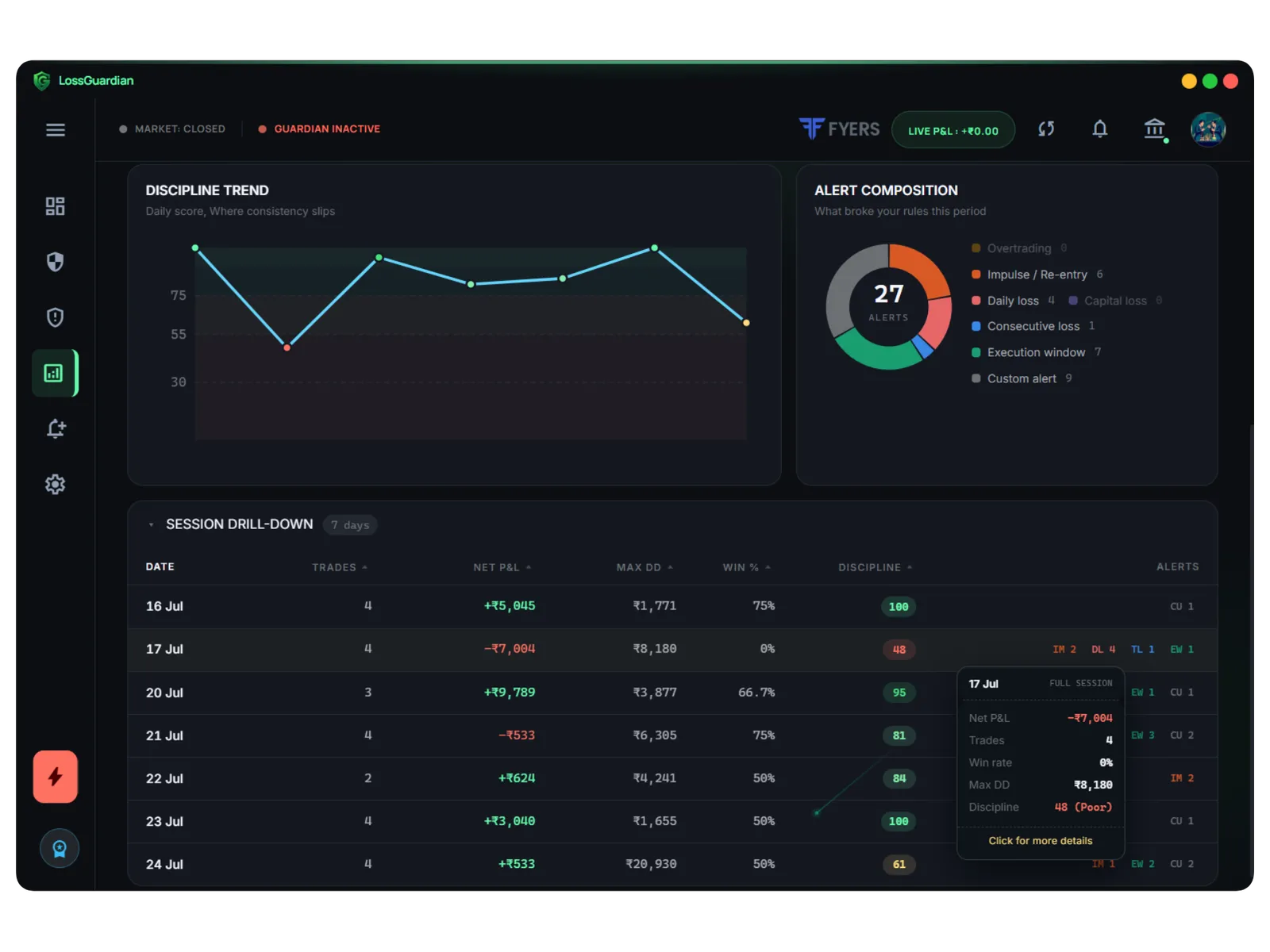
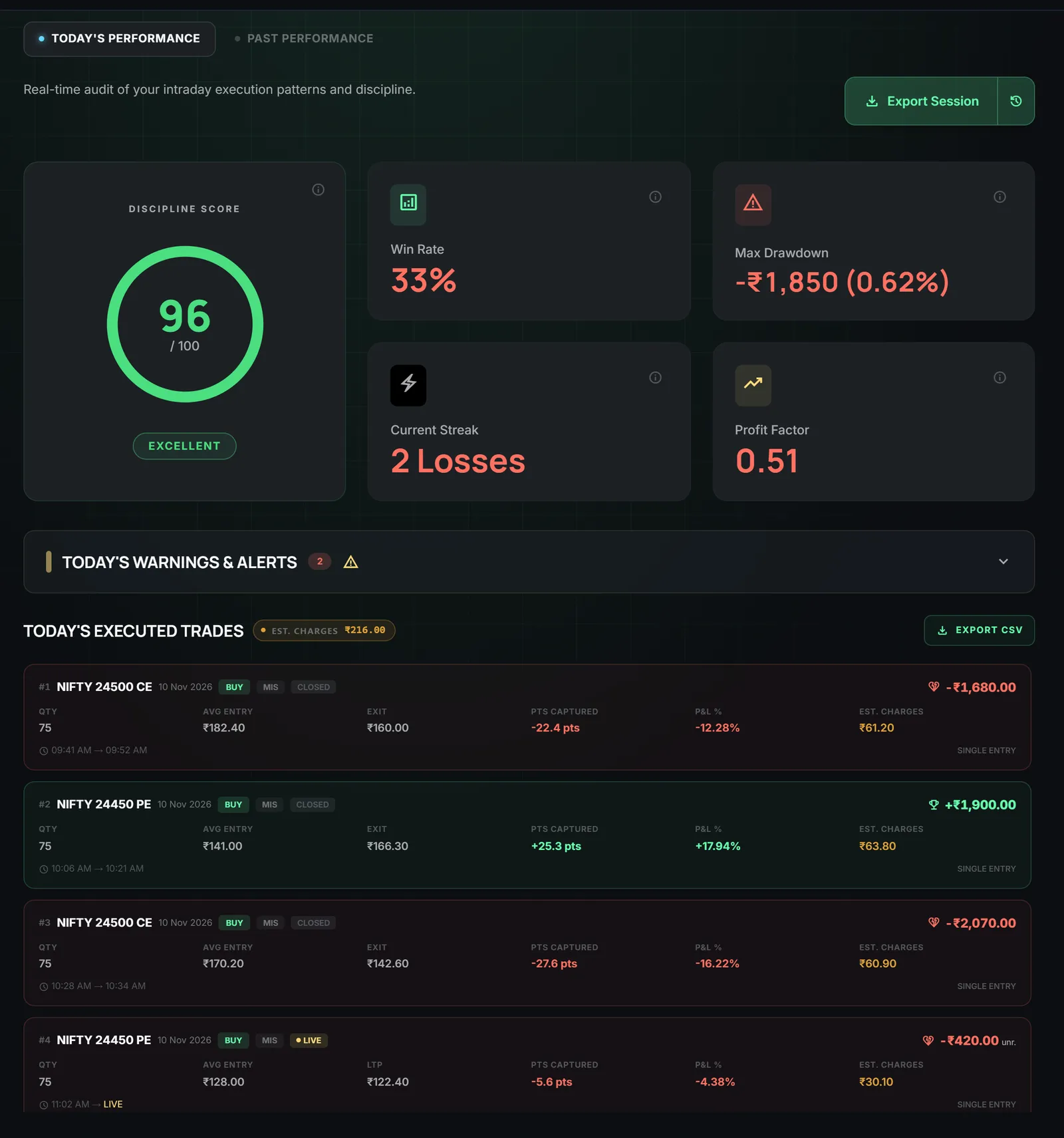
The Trade Log shows each day: every trade with its time and estimated charges, the alerts of the day in order, and your discipline score.
Past performance puts weeks side by side. The mix of alerts shows which rule you break most, and you can open any day to see the trades behind it.
The Trade Log and Analytics guide explains each part. When you find your pattern, set the rule that answers it in the Risk Manager: a stop time, a trade limit, a losing streak limit or a wait after a loss.
What you gain
You stop guessing. Instead of "I had a bad week", you know "I lose after 1:30 PM" or "I trade bigger after a loss". A mistake you can name is a mistake you can fix.
Over a few months, the patterns get quieter. That is what real progress in trading looks like. Not one great trade, but the same mistake showing up less.
LossGuardian has a free 10-day trial, no card needed. Download it here.
Questions traders ask
How do I read my trading journal?
Do not read it trade by trade. Look for patterns across two to four weeks. When do your losses start, what do you do right after a loss, and which rule do you break most? One pattern you can name is worth more than a hundred notes.
How often should I review my trading journal?
Once a week is enough for most traders. Ten minutes on a weekend, with the market closed, works better than a long review right after a bad day.
What is the most common pattern in a trading journal?
For many traders it is what happens after a loss. A quick re-entry, a bigger size, or a run of small trades to get it back. Look at the 15 minutes after each losing trade first.
Do I need to type my trades into a journal?
Not with LossGuardian. It reads your trades from your broker every day, so your journal fills itself. You only need to read it.
Is there an app that finds patterns in my trading journal?
LossGuardian keeps your journal automatically and shows the patterns: times of your losses, quick re-entries, trade counts and which rule you break most.
LossGuardian watches your positions across six Indian brokers and warns you the moment you cross your own daily loss limit. It is read-only: it never places, modifies or cancels an order.
Download LossGuardian