 LossGuardian
Trading psychology
How to stop revenge trading: methods that actually work
Revenge trading is the urge to win back a loss right now. Here is how to spot it early, why willpower fails, and five simple methods that work.
It is 11:40. Your morning trade hit its stop loss. ₹3,000 gone.
You were sure about that trade. And now there is a feeling in your chest that is hard to describe. It is not exactly anger. It is more like urgency. Something needs to be done about this, right now.
So you open the chart again. Nifty looks like it is about to move. You double the quantity, because a normal win will not cover the loss. You click buy.
That is revenge trading. Almost every trader has done it. Most of us have lost more money to it than to any bad strategy.
The good news: it is one of the most predictable mistakes in trading. And predictable things can be stopped.
What revenge trading really is
Revenge trading is trading to get your money back, not trading your plan.
The market did not do anything to you. But after a loss, your brain treats it like a fight. It wants to win this one back before the day ends. The trade you take in that state is not based on a setup. It is based on a feeling.
You can usually spot it by three signs:
- It comes fast. Within a few minutes of a loss.
- It is bigger. More lots than normal, because the hole is bigger.
- It is the same thing. Same index, often the same direction, as the trade that just lost.
If you ask yourself afterwards "what was the setup?", you will usually describe the previous trade, not this one.
Why "just be disciplined" does not work
Every trading book says: control your emotions. Stick to your plan. Be patient.
You already know all of that. Knowing it does not help at 11:40 with a fresh loss, because the part of your brain that knows the rules is not the part making decisions in that moment. Stress changes how you think. It makes you want quick action, not careful thinking.
So the fix is not to try harder in the moment. The fix is to set things up before the moment arrives. Decide your rules when you are calm, and put something in place that catches you when you are not.
Five methods that actually work
1. Make a waiting rule, and time it
After any losing trade, no new entry for 10 minutes. After two losses in a row, 30 minutes. After three, you are done for the day.
Why a timer? Because the urge to revenge trade is strongest in the first few minutes and fades fast. If you can get through ten minutes, most of the time you will not want the trade any more.
Write the rule down. A rule in your head gets rewritten when you are losing.
2. Cap your size after a loss
Revenge trades are dangerous because they are bigger. So make a simple rule: after a loss, your next trade can never be bigger than your normal size. Many traders go further and cut size in half after two losses.
This one rule stops the spiral where each loss is bigger than the one before.
3. Set a limit on losing trades in a row
Pick a number. Two or three is common for intraday traders. When you hit it, the session is over. Not paused. Over.
A losing streak is information. It says either your read on the market is off today, or your head is. Either way, more trades will not fix it. We wrote about why this happens most in the afternoon in why discipline fails at 1:30 PM.
4. Have a daily loss limit you cannot talk yourself out of
Revenge trading turns a small bad day into a disaster. A daily loss limit puts a floor under it. Decide it before the market opens, based on your capital, not your mood.
If you do not have one yet, how to set a daily loss limit walks you through it, and the loss limit calculator does the maths.
5. Let something else watch the clock
Here is the honest truth about the four rules above. They work, but only if you notice you are breaking them. And the moment you are revenge trading is exactly the moment you are not noticing anything.
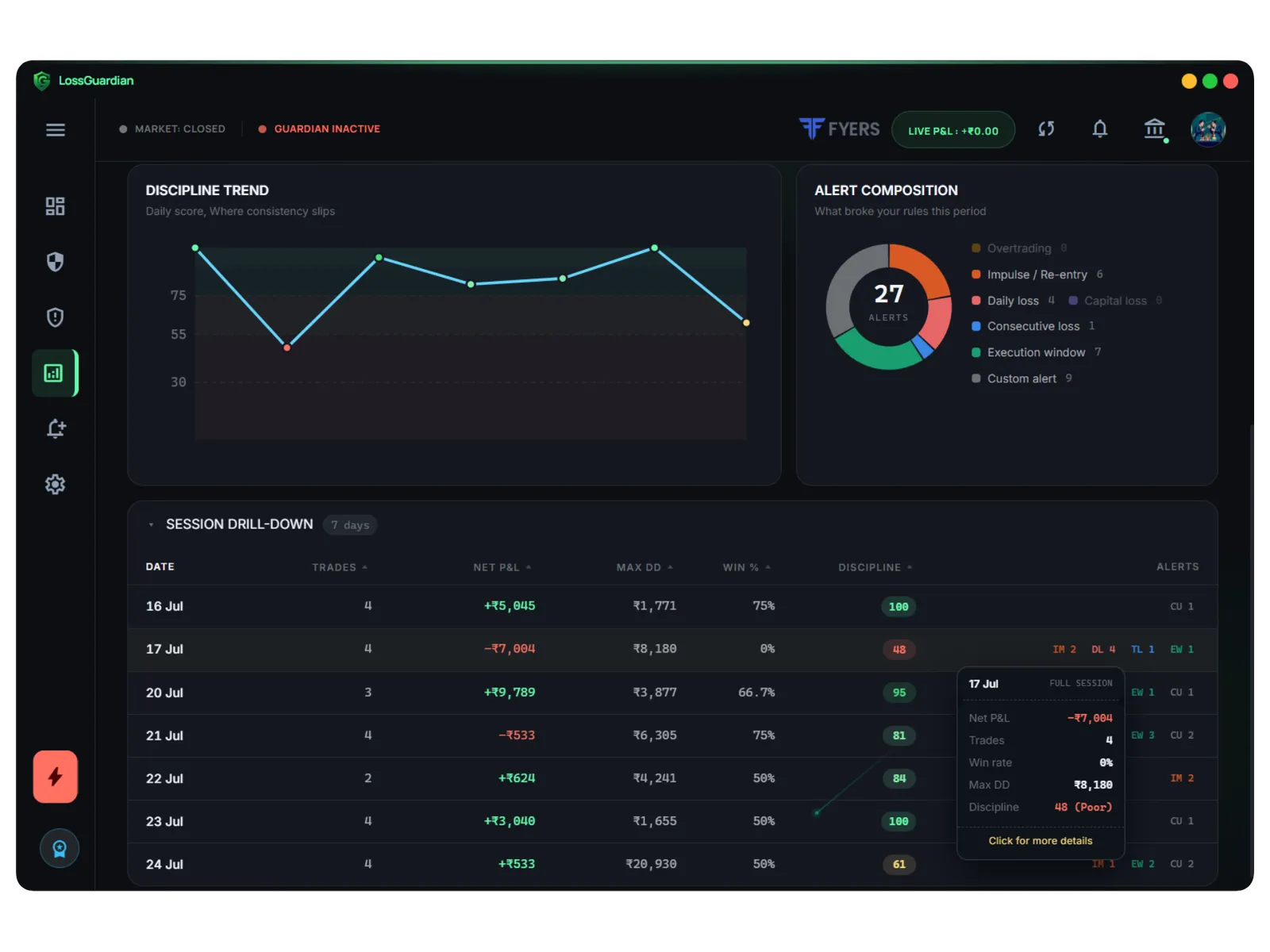
This is why we built LossGuardian to catch revenge trading by timing. If you open a new trade within a set window after an exit, 10 minutes by default, it flags it as an impulse trade and a cooldown timer starts in the corner of your screen. If you lose several trades in a row, a clear alert tells you to step away.
It works even when the revenge trade wins. That matters, because a winning revenge trade is the most dangerous kind. It teaches your brain that the habit works.
LossGuardian does not block your broker or close anything. It is read-only. It just makes sure you cannot miss what you are doing. The choice to stop is still yours, and that is the part that builds the habit. More on how alerts help in how trading alerts help you catch your mistakes.
Check your own data
Here is a quick exercise. Open your broker's tradebook for the last month. For every losing trade, note the time you exited and the time of your next entry.
Now put the trades in two groups: entries within 10 minutes of a loss, and everything else. Add up the profit and loss for each group.
For most traders the result is clear. The quick re-entries are where the money goes. Once you see that in your own numbers, it is much easier to believe. We show how to read this kind of data in your trading data knows your mistakes.
The goal is not zero losses
Losses are part of trading. Every good trader takes them every week. What separates a good trader from a struggling one is what happens after the loss.
A good trader takes the loss, waits, and comes back only when the setup is real. That is not a talent. It is a habit, and habits are built by repetition. Catch yourself enough times, and one day you notice the urge, smile at it, and close the chart.
That is the day revenge trading stops owning your P&L.
Questions traders ask
What is revenge trading?
Revenge trading is taking a trade to win back money you just lost, instead of taking it because your setup appeared. It usually comes fast, bigger than normal, and in the same stock or index as the loss.
How do I know I am revenge trading?
Look at the time between a losing exit and your next entry. If you often jump back in within a few minutes, with a bigger size than usual, that is revenge trading.
Can a revenge trade be a winning trade?
Yes, and that is the dangerous kind. A winning revenge trade teaches your brain that it works, so the next one comes faster and bigger. Judge the trade by why you took it, not by how it ended.
How long should I wait after a loss before trading again?
At least 10 to 15 minutes. Long enough for the urge to pass. After two or three losses in a row, many traders stop for the day completely.
Is there software to stop revenge trading?
Yes. Tools like LossGuardian watch the timing of your trades and warn you when you re-enter too soon after a loss or hit a losing streak. It does not block your broker. It makes the pattern impossible to miss, so you learn to stop on your own.
LossGuardian watches your positions across six Indian brokers and warns you the moment you cross your own daily loss limit. It is read-only: it never places, modifies or cancels an order.
Join the waitlist