 LossGuardian
Trading psychology
How trading alerts help you catch your mistakes while you trade
Most trading mistakes happen when you are not paying attention to yourself. The right alert, at the right moment, is what brings you back. Here is how.
Here is a strange thing about trading mistakes. You almost never make them on purpose.
Nobody sits down in the morning and says, "Today I will take 14 trades, double my size after a loss, and give back my whole week." It just happens. One trade at a time. Each one feels reasonable in the moment.
And that is the real problem. The mistake is not the trade. The mistake is that you did not notice what you were doing.
This is where alerts come in.
You cannot watch the market and yourself at the same time
When you trade, all your attention goes to the chart. Price, levels, the next candle. That is how it should be.
But it means nobody is watching you. Nobody is counting your trades. Nobody notices that your last three entries came within two minutes of a loss. Nobody tells you that you are already down more than you planned.
By the time you look up, the damage is done.
An alert is simply a second pair of eyes. It watches the things you cannot watch while you are busy trading, and it speaks up at the exact moment it matters.
What a useful alert looks like
Most apps already have alerts. Price alerts. Order filled alerts. You probably ignore most of them.
The alerts that change your trading are different in three ways.
1. They are about you, not the market. A price alert tells you what Nifty did. A behaviour alert tells you what you did. "You have hit your daily loss limit." "You have taken more trades than you planned." "You re-entered too fast after a loss." These are the ones that save money.
2. They come at the right time. An alert after the market closes is a report. An alert while you still have a position open is a chance to act.
3. They are hard to ignore. A small popup in the corner gets closed without reading. Especially when you are angry. An alert that fills the screen, shows your real numbers and tells you clearly what to do next gets read.
The alerts that matter most
Your daily loss limit
This is the big one. You decide before the market opens how much you can lose today. When you hit it, the day is over.
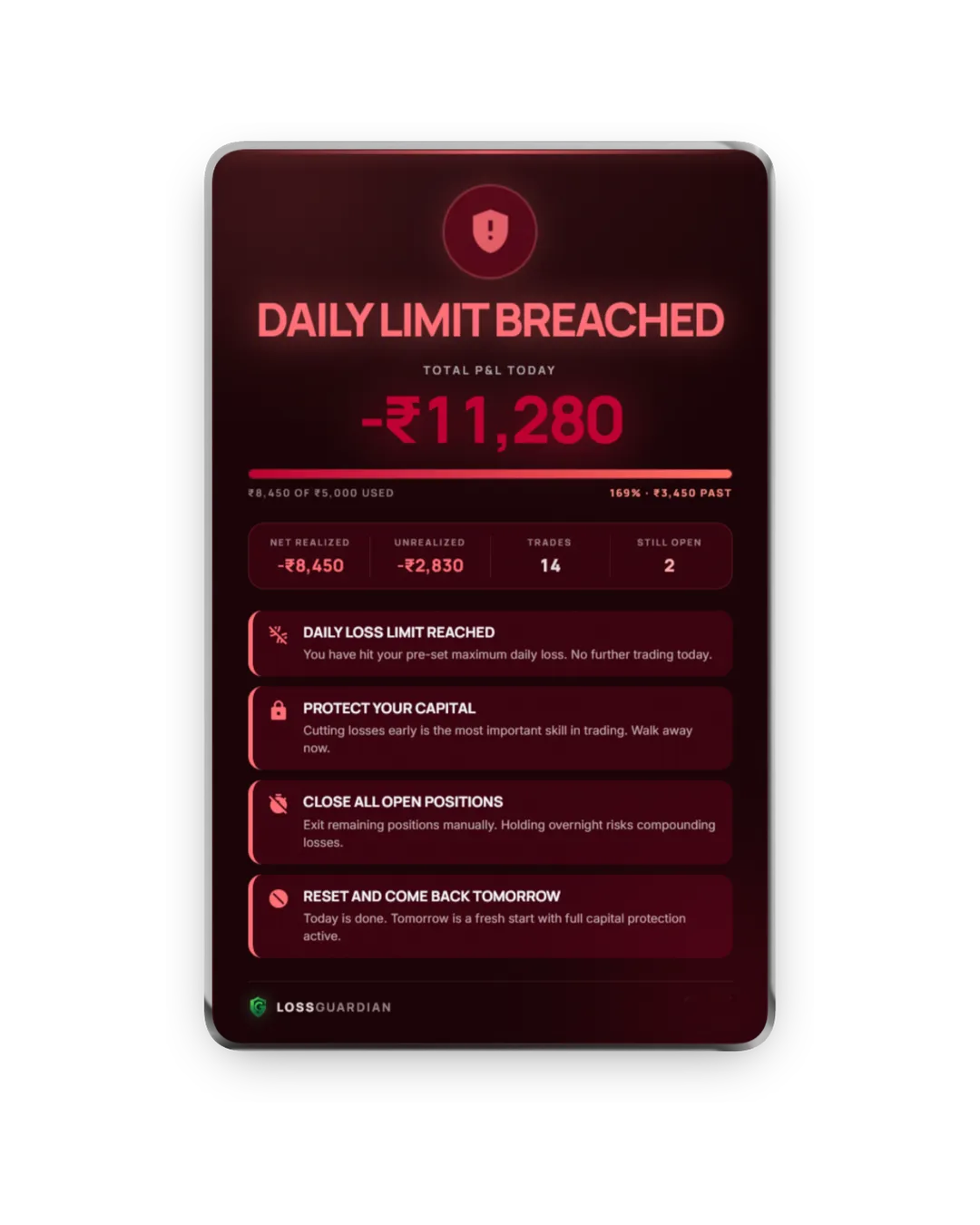
Look at what the alert above shows. Not just "limit hit". It shows the total loss, the part that is booked and the part still open, how many trades you took, and how far past your own line you went. Seeing "169% of your limit" in big red numbers hits differently than a thought in your head.
You also get a warning before you reach the limit. That is the moment to cut size or stop, while stopping is still cheap.
If you are not sure what your limit should be, the daily loss limit calculator works it out from your capital in a minute.
Your trade count
Most bad days are not one huge loss. They are ten small ones. You planned four trades and took eleven.
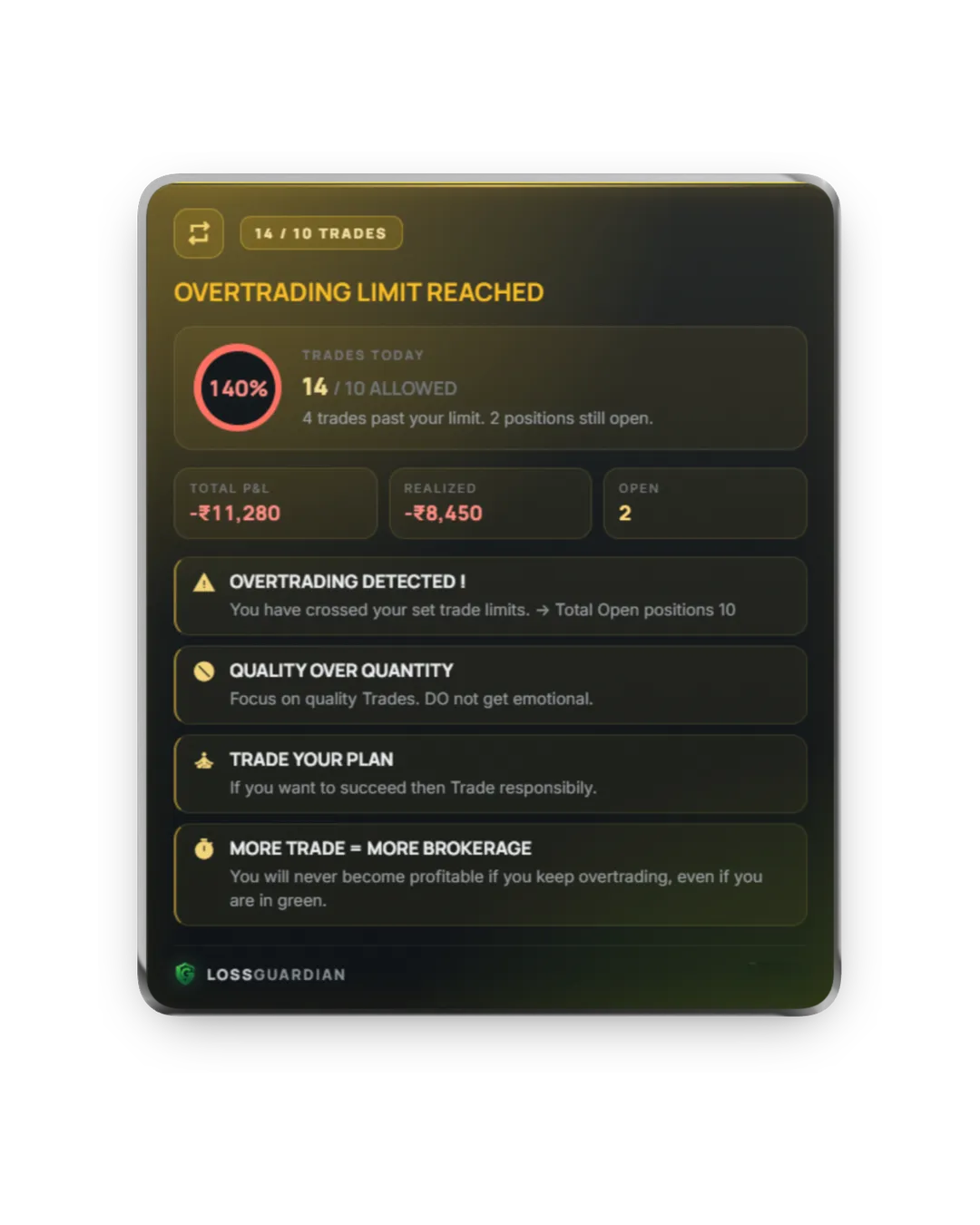
An overtrading alert counts every round trip for you and tells you the moment you cross your number. It sounds simple. It is also the single most common rule traders break, because trade number 9 never feels different from trade number 8. We wrote more on this in how to stop overtrading.
Losing streaks and fast re-entries
After two or three losses in a row, something changes in your head. You stop looking for good setups and start looking for a way back to zero. The next trade comes fast and usually bigger.
That pattern has a name, revenge trading, and it has its own warning signs. We cover them in detail in how to stop revenge trading. An alert that fires on a losing streak, or when you jump back in within minutes of an exit, catches it before it grows.
Your own custom alerts
Every trader has personal weak spots. Maybe you always give back profits after you are up ₹5,000. Maybe you trade badly after 2 PM. Generic rules do not know that about you.
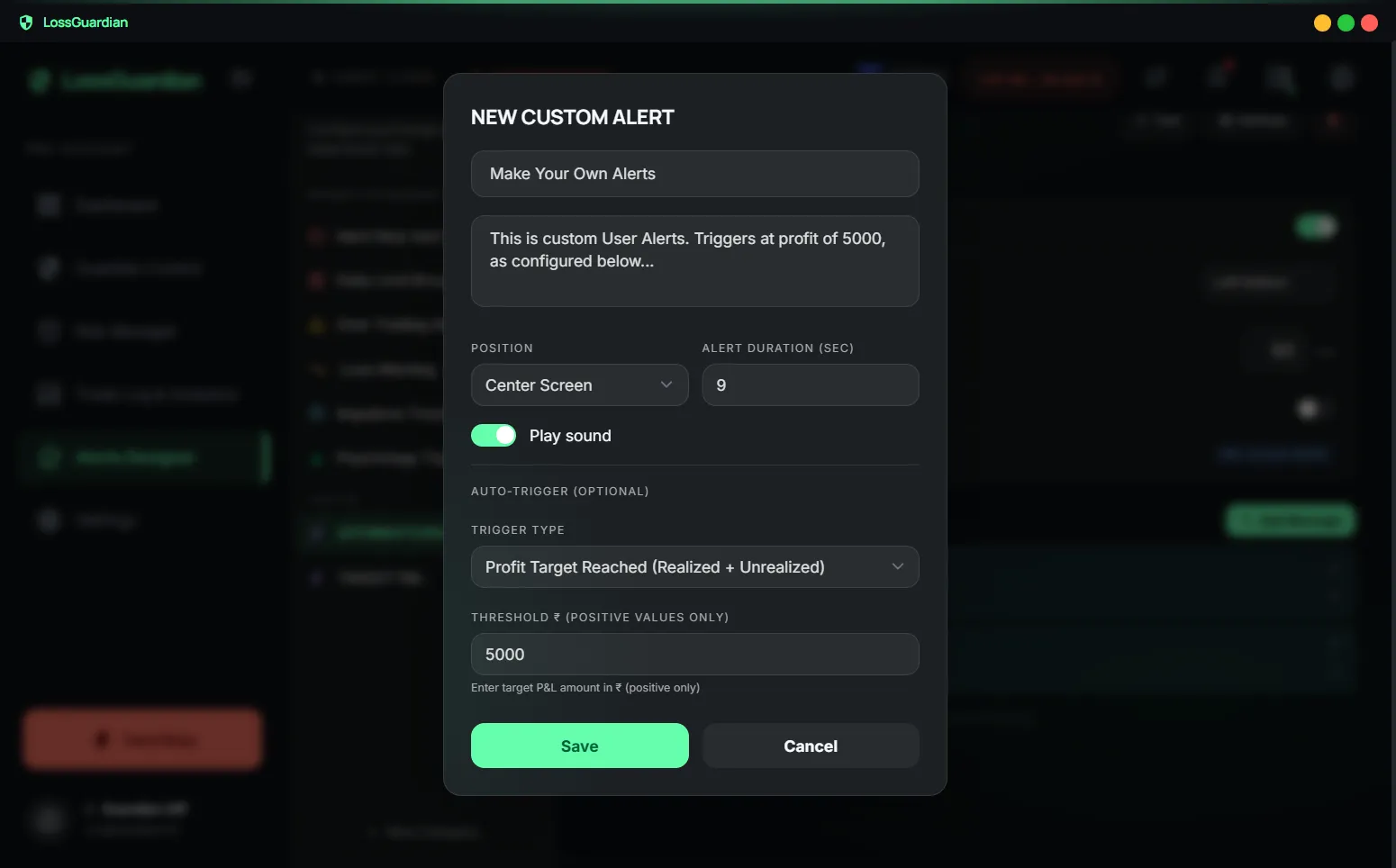
With custom alerts you write the rule for your own weakness. Set an alert for when your profit reaches a number, with a message you wrote to yourself on a calm day. Something like "You are up ₹5,000. This is a good day. Protect it." Hearing your own words at the right moment is surprisingly powerful.
Why alerts build discipline instead of replacing it
You might ask: why not just have software close your trades for you?
We thought about this a lot. We decided against it. LossGuardian never places, changes or closes an order. It is read-only on your account.
Here is why. If software exits for you, you learn nothing. The day the software is not there, you are the same trader as before. We explain this fully in why we will never square off your position for you.
An alert works differently. It shows you the truth at the moment you would rather not look. You still make the choice. And every time you choose to stop when the alert fires, that choice gets a little easier next time.
Do that for a few months and something shifts. You start to feel the limit coming before the alert fires. That is discipline. Not willpower, just a habit built one alert at a time.
Alerts become your data
Every alert that fires gets saved. At the end of the week, you can see which rules you broke, how often, and on which days.
That record is gold. It shows you your real patterns, not the ones you remember. In your trading data knows your mistakes we show how to read it and fix the mistake you repeat most.
Start small
You do not need twenty alerts. Start with three:
- A daily loss limit
- A maximum number of trades per day
- A limit on losing trades in a row
Set them before the market opens. Write them down. Then let something else do the watching, so you can focus on the chart.
The goal is not to trade less. It is to catch yourself early, every single time, until you do not need to be caught any more.
Questions traders ask
What is a trading alert?
A trading alert is a message that fires when something you care about happens, like your loss reaching a set amount or your trade count crossing your limit. Good alerts are about your behaviour, not just about price.
Why do I ignore trading alerts?
Because most alerts are small and easy to close. When you are losing and emotional, you click them away without reading. An alert only works if it is big enough and clear enough that you have to stop and look.
Can an alert stop me from placing a trade?
A LossGuardian alert does not block your broker or place any order. It is read-only. The alert makes sure you see the rule you set, and the decision stays with you. That is how the habit gets built.
What alerts should a beginner trader set?
Start with three. A daily loss limit, a maximum number of trades per day, and a limit on losing trades in a row. These three catch most of the bad days.
LossGuardian watches your positions across six Indian brokers and warns you the moment you cross your own daily loss limit. It is read-only: it never places, modifies or cancels an order.
Join the waitlist