 LossGuardian
How-to guides
How to stop overtrading: a beginner's guide
Overtrading is a design problem, not a character flaw. A simple step by step guide to count your real number, find the trades that cost you, and build a stop that holds.
Most advice about overtrading is useless. "Be patient." "Wait for A+ setups." "Trade less." Nobody has ever read that and stopped.
It is useless because it treats overtrading as a personality problem. It is not. It is a design problem. Nothing in your trading day tells you when to stop, so you keep going until the market closes or the money runs out. Fix the design and the behaviour follows.
Here is how to do that, in order.
Step 1: Find out how much you actually trade
Not what it feels like. The number.
Open your broker's tradebook, export the last thirty trading days, and count trades per day. Write down the list. Most people are surprised twice: the average is higher than they thought, and the spread is much wider than they thought. Five trades on a Tuesday, nineteen on a Thursday.
That spread is the whole story. Nobody finds nineteen good setups in one session. The extra fourteen were not opportunities. They were something else.
Step 2: Separate the planned trades from the rest
Go back through those thirty days and put every trade in one of two buckets.
Bucket A: I would take this again. The setup was one you can describe. You had a reason before you entered, not after.
Bucket B: everything else. Trades you cannot explain now. Trades taken within a few minutes of a loss. Trades in an underlying you do not normally touch. Trades where the size was wrong.
Now add up the P&L of each bucket separately.
Almost everyone gets the same result. Bucket A is somewhere between flat and nicely profitable. Bucket B is where the account bleeds. Your strategy was never the problem. The trades that were not part of your strategy were the problem.
This exercise takes about an hour and it is the most valuable hour you will spend on your trading this year. Do it before you read the rest of this.
Step 3: Know which kind of overtrading you have
There are three, and they need different fixes.
Tilt trading. You lost, and you are trying to get it back. This is the expensive one. It clusters after losses, the size grows, and it usually happens in the afternoon. If your Bucket B trades are bunched together right after a red trade, this is you. We wrote about the anatomy of it in why discipline fails at 1:30 PM.
Boredom trading. The market is quiet, you have been watching for two hours, and you take something just to be in the market. Cheaper than tilt, but it adds up, and it puts you in a position when the real setup finally arrives.
Fear of missing out. You skipped a move, it ran without you, and you enter late at a worse price. These are usually your largest single losses because you entered exactly where the risk was highest.
Look at your Bucket B list and label each one. The pattern is usually obvious within twenty trades.
Step 4: Set a trade count, not just a rupee limit
A daily loss limit in rupees is necessary. It is also slow.
Think about what a rupee limit actually does. It stays silent while you take trade six, seven, eight and nine. It only speaks up once those trades have already lost you enough money to hit the number. By then the day is over anyway.
A trade count is early. "Six trades, then I close the terminal" fires on the seventh attempt, before it has cost you anything.
It is also much harder to argue with. A rupee number invites negotiation, because the market is always about to turn. A count is just arithmetic. You have taken six or you have not.
Pick your number from Step 1. Take your median day, not your average, because the average is dragged up by exactly the days you are trying to eliminate. If your median is five, set six. Do not set two because it sounds disciplined. A limit you break on day one is worse than no limit, because now you have practised breaking limits.
Step 5: Add a cooldown after every loss
This is the single highest-value rule for tilt traders, and almost nobody has it.
After a losing trade, no new position for ten minutes.
That is it. It is aimed at one specific moment: the re-entry taken ninety seconds after a loss, which is where a normal red day turns into a bad one. Ten minutes is long enough for the urgency to drop and short enough that you will actually keep it.
Set a phone timer. Stand up. The rule only works if you leave the screen, because staring at the chart for ten minutes is not a cooldown, it is a countdown.
Step 6: Write the rules down before the market opens
Rules made during the session are not rules. They are negotiations you are having with yourself while losing money.
Write these three lines in a notebook, on paper, before 9:15:
- Maximum trades today: ___
- Maximum loss today: ₹___
- After a loss, I wait ___ minutes
Then sign it. This sounds childish. Do it anyway. There is a real difference between a rule you thought about and a rule you wrote and signed, and the difference shows up at 1 PM when you are looking for a reason to ignore it.
Step 7: Make sure something is actually watching
Here is the honest problem with everything above. All of it depends on you noticing, in the moment, that you have crossed a line you set. And the moment you cross that line is exactly the moment you are least able to notice.
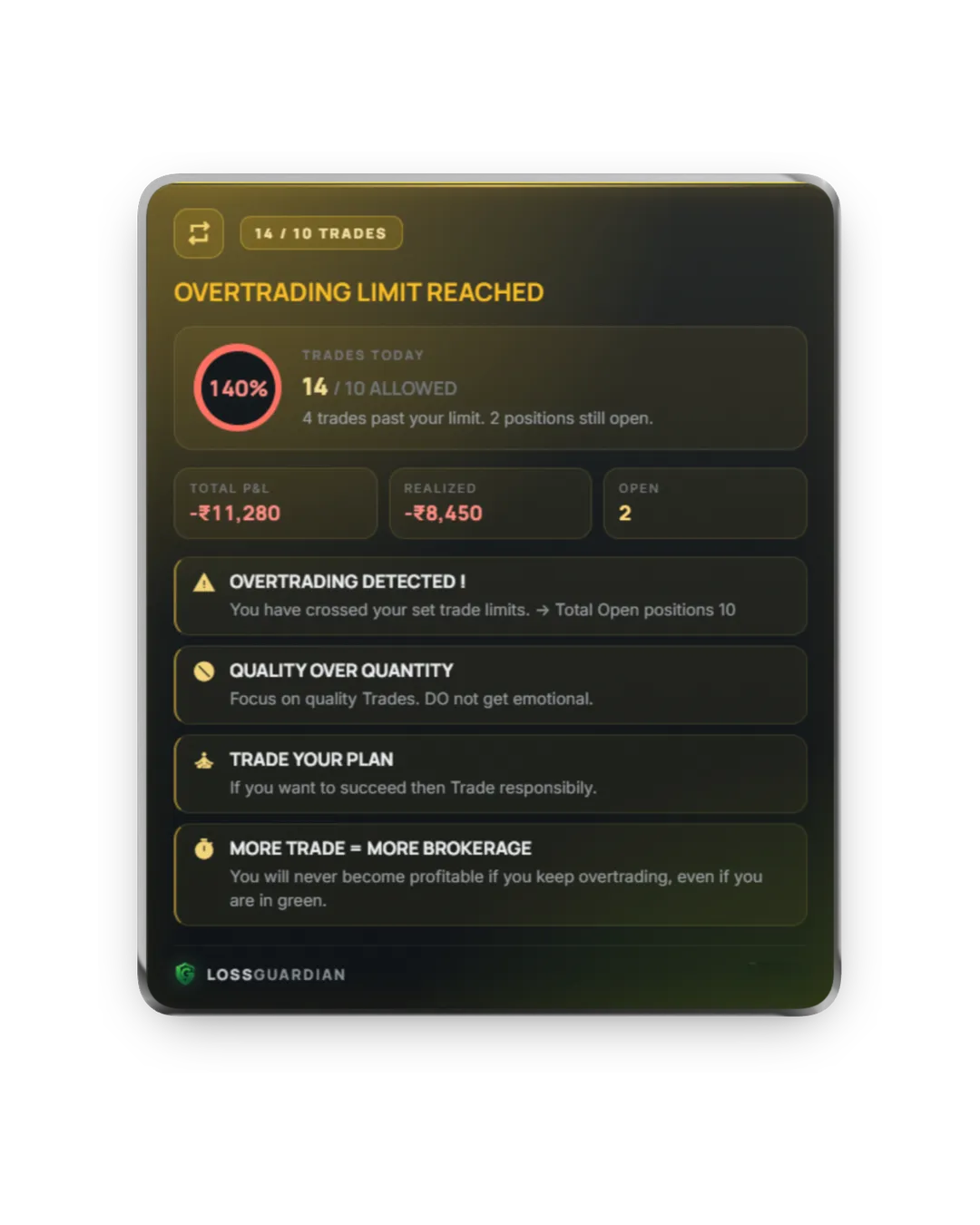
That is the gap LossGuardian fills. It reads your trades from your broker as they happen, counts them against the limits you set that morning, and puts an always-on-top alert in front of you when you cross one. Not a small notification in the corner that you dismiss by reflex. Something that stops what you are doing and quotes your own rule back at you.
It is read-only. It cannot place an order, change an order or close a position, and it never will. We have written about why we will never square off your position for you, and the short version is that being rescued does not make you a better trader. Being told, clearly, at the right moment, does.
Connecting takes a couple of minutes and works with the broker you already use. Zerodha traders can start at LossGuardian for Zerodha, and there is a comparison with other risk tools if you want to see how the approach differs.
What to expect
Your trade count will not drop to six on Monday. What usually happens is that the nineteen-trade days disappear first, and those were the ones doing the damage. The average comes down slowly after that.
Watch two numbers each week: trades per day, and the P&L of your Bucket B trades. The second one is the one that matters. When it stops being a big negative number, you have fixed the thing you set out to fix, whatever the trade count says.
Next: see what your extra trades cost with the overtrading cost calculator, read why you can't stop overtrading if the rules keep slipping, or see how the overtrading guard counts trades for you.
If you have not set your daily number yet, start with how to set a daily loss limit you cannot talk yourself out of, or run your own account through the loss limit calculator.
Stopping overtrading on your broker
Every broker shows your trades a little differently, so the steps differ slightly. Pick yours:
Questions traders ask
What is overtrading in the stock market?
Overtrading is taking more trades than your plan gives you real setups for. It usually comes from boredom, the urge to win back a loss, or the fear of missing a move.
How many trades a day should a beginner take?
Fewer than you think. Start with a hard limit of 2 to 3 trades a day. Once you can keep that for a month, adjust it based on how many real setups your strategy gives you.
Does overtrading really cost that much?
Yes. Every trade pays brokerage, STT, exchange charges, GST, stamp duty and slippage. SEBI found that in FY26 transaction costs made up 35% of the gross losses of loss-making F&O traders.
Is there an app to stop overtrading?
Yes. LossGuardian counts your real trades from your broker and shows an alert when you go past your daily limit. It is read-only, so it never blocks or places orders. It makes sure you notice.
LossGuardian watches your positions across six Indian brokers and warns you the moment you cross your own daily loss limit. It is read-only: it never places, modifies or cancels an order.
Download LossGuardian