 LossGuardian
Risk strategy
The real cost of overtrading: what extra trades take from your account
Every trade pays brokerage, STT, exchange fees, GST and slippage before it wins or loses. Here is how to add up what overtrading really costs you in a year.
Here is a question most traders never ask: how much did I pay just to take my trades this year?
Not how much did I lose on them. How much did it cost to place them at all.
Most people have no idea. The number shows up in small pieces, ₹60 here and ₹80 there, spread across hundreds of contract notes. Nobody adds it up. But when you do, it can be the whole difference between a losing year and a profitable one.
What you pay on every trade
When you buy and sell an option, you pay:
- Brokerage, often ₹20 per order, so ₹40 for a round trip.
- STT (Securities Transaction Tax) on the sell side.
- Exchange transaction charges.
- SEBI turnover fee.
- Stamp duty on the buy side.
- GST on brokerage and exchange charges.
And then there is slippage, the gap between the price you wanted and the price you got. It does not appear on any contract note, but it is real money.
For a small options trade with a discount broker, the charges alone often come to ₹50 to ₹100 for the round trip. Bigger size, more cost.
This is not a small number across India
SEBI's study of F&O traders, released in August 2026, put some big numbers on this:
- Individual traders paid about ₹25,000 crore in transaction costs in FY26.
- Between FY22 and FY26, it was about ₹1 lakh crore, with brokerage making up nearly half.
- For traders who lost money, transaction costs were 35% of their gross losses.
Read that last one again. For a lot of losing traders, more than a third of the loss was not the market. It was the cost of trading.
A simple example
Say your plan gives you 3 good setups on a normal day. But you usually take 8.
Those 5 extra trades each cost you around ₹60 in charges and ₹40 in slippage. That is ₹100 per extra trade.
- 5 extra trades × ₹100 = ₹500 a day
- × 20 trading days = ₹10,000 a month
- × 12 months = ₹1,20,000 a year
On a ₹3 lakh account, that is 40% of your capital spent on trades your own plan never asked for. Your account has to earn all of that back before it makes a single rupee of profit.
Try it with your own numbers in the overtrading cost calculator. It runs in your browser and nothing you type is sent anywhere.
Why the extra trades are the worst ones
It would be one thing if the extra trades were as good as the planned ones. They usually are not.
Extra trades tend to come from boredom, from wanting a loss back, or from chasing a move that already happened. So they cost the same charges as your good trades, but with a worse chance of working.
SEBI's data points the same way. Among option traders, the share of loss-makers rose with turnover, from about 86% for smaller traders to about 95% for the most active.
How to cut the cost
1. Find your real number. Export last month's tradebook. Count trades per day. Add up the charges. Divide to get your cost per trade.
2. Split planned from unplanned. Mark each trade: was it a setup from your plan, or not? Add up the P&L and the charges of each group. The unplanned group is usually where both the losses and most of the charges sit.
3. Set a daily trade limit. Base it on how many real setups you get, plus one. Write it down before 9:15. Our guide on how to stop overtrading walks through this step by step.
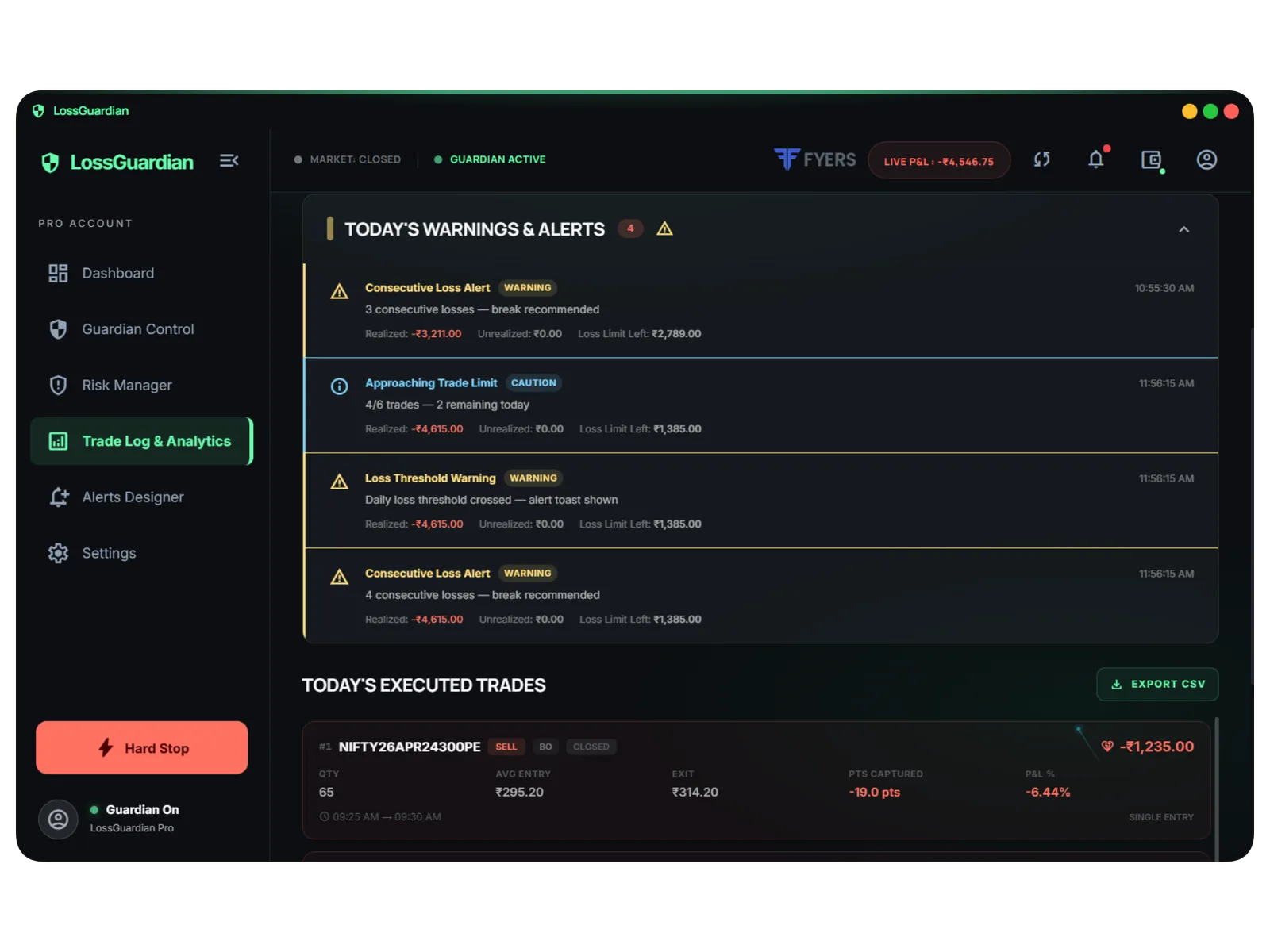
4. Let something count for you. It is hard to count your own trades while you are trading. LossGuardian reads your trades from your broker and counts real round trips, so partial fills do not confuse the number. It warns you as you get close to your limit and shows an alert when you go past it. It also shows your charges in rupees, so the cost is never hidden. Read more about the overtrading guard.
The cheapest trade is the one you skip
A cheaper broker saves you a few rupees per trade. Not taking a trade that was never in your plan saves you all of it: brokerage, taxes, slippage and the loss that usually comes with it.
Fewer, better trades is not only calmer. It is cheaper. And over a year, cheaper adds up to a very different account.
Questions traders ask
What charges do I pay on an F&O trade in India?
Brokerage, Securities Transaction Tax (STT), exchange transaction charges, SEBI turnover fee, stamp duty and GST. On top of that you lose some money to slippage on the way in and out.
How much do Indian F&O traders spend on charges?
SEBI found that individual traders paid about ₹25,000 crore in transaction costs in FY26 alone, and about ₹1 lakh crore between FY22 and FY26.
How do I find my real trading costs?
Add up the charges on your contract notes for a month, or check the charges section of your broker's P&L report. Then divide by the number of trades to get your cost per trade.
Is a cheaper broker the answer?
It helps a little. Taking fewer trades that were never in your plan helps much more, because it cuts every charge at once, including slippage.
LossGuardian watches your positions across six Indian brokers and warns you the moment you cross your own daily loss limit. It is read-only: it never places, modifies or cancels an order.
Join the waitlist