 LossGuardian
Trading psychology
Why can't I stop overtrading? The real reasons, and what helps
You know you trade too much. You have promised to stop many times. Here is why the promise keeps breaking, and the simple changes that finally make it stick.
You have probably said it to yourself many times.
"Tomorrow, only three trades."
And tomorrow you took nine. Not because you forgot. You remembered the rule the whole time. You just kept going anyway.
If that sounds familiar, you are not weak and you are not stupid. You are running into something almost every trader runs into. Let us look at what is really happening, because once you see it, fixing it gets a lot easier.
Reason 1: The rule lives in the wrong place
Your rule was made at 8 PM, relaxed, after dinner. It gets tested at 11:30 AM, with money on the line and your heart rate up.
Those are two different versions of you. The calm one makes the rules. The stressed one breaks them. And the stressed one is the one sitting at the screen.
A rule that only exists in your head can be quietly rewritten by the person who most wants to break it. "Three trades" becomes "three good trades". Then "this one does not count, it was a quick scalp".
What helps: write the rule down before the market opens, where you can see it. Better still, put it somewhere outside your head that speaks up when you break it.
Reason 2: Each trade feels like the only trade
Trade number 9 never feels like trade number 9. It feels like one clean setup you would be silly to miss.
That is the trap. You judge each trade on its own, and on its own it always looks fine. You never see the pile.
What helps: count. Out loud if you have to. Better, let software count your round trips for you and show the number next to your limit. "9 of 3" is very hard to argue with.
Reason 3: Boredom
Markets are slow most of the day. Watching a chart for two hours with nothing happening is uncomfortable. Taking a trade feels like doing your job.
But your job is not to trade. Your job is to wait for your setup, and then trade. A lot of trading is sitting on your hands.
What helps: give yourself a stop time. If your setups mostly come in the morning, stop taking new trades at noon or 2:30 PM. Close the terminal after that and go for a walk. You cannot overtrade a screen you are not looking at.
Reason 4: A loss you want back
This is the expensive one. You lose a trade and suddenly you need the next one. Not want. Need.
Those trades come fast, they are usually bigger, and they are usually in the same thing that just hurt you. That is revenge trading, and it is one of the biggest sources of overtrading. We cover it fully in how to stop revenge trading.
What helps: a fixed wait after every loss. Ten minutes minimum. The urge fades quickly if you give it a little time.
Reason 5: Fear of missing the move
The market moves without you and it feels like money was taken from you. So you jump in late, at a worse price, exactly where the risk is highest.
What helps: remind yourself that there is always another setup. The market opens again tomorrow, and the day after. Missing a move costs you nothing. Chasing one often costs a lot.
The numbers say this matters
It is easy to think a few extra trades are harmless. The data says otherwise.
SEBI's latest study of F&O traders, released in August 2026, found that the more people traded, the more likely they were to lose. Among option traders, the share of loss-makers rose steadily with turnover, from about 86% for smaller traders to about 95% for the most active ones.
And every trade costs money before it wins or loses. Brokerage, taxes and slippage add up quietly. You can see your own number with the overtrading cost calculator. Most people are shocked the first time.
Why "trying harder" does not work
Here is the honest bit. Most traders try to fix overtrading with willpower. Be stronger. Be more patient. Promise harder.
That works for a day or two. Then a bad morning comes along and willpower runs out, because willpower is weakest exactly when you need it most: when you are tired, frustrated or losing.
The traders who fix this do not rely on willpower. They change the setup so the right choice is easier:
- A small, written trade limit.
- A wait after every loss.
- A cutoff time for new trades.
- Something that watches the count for them.
A little help from outside your head
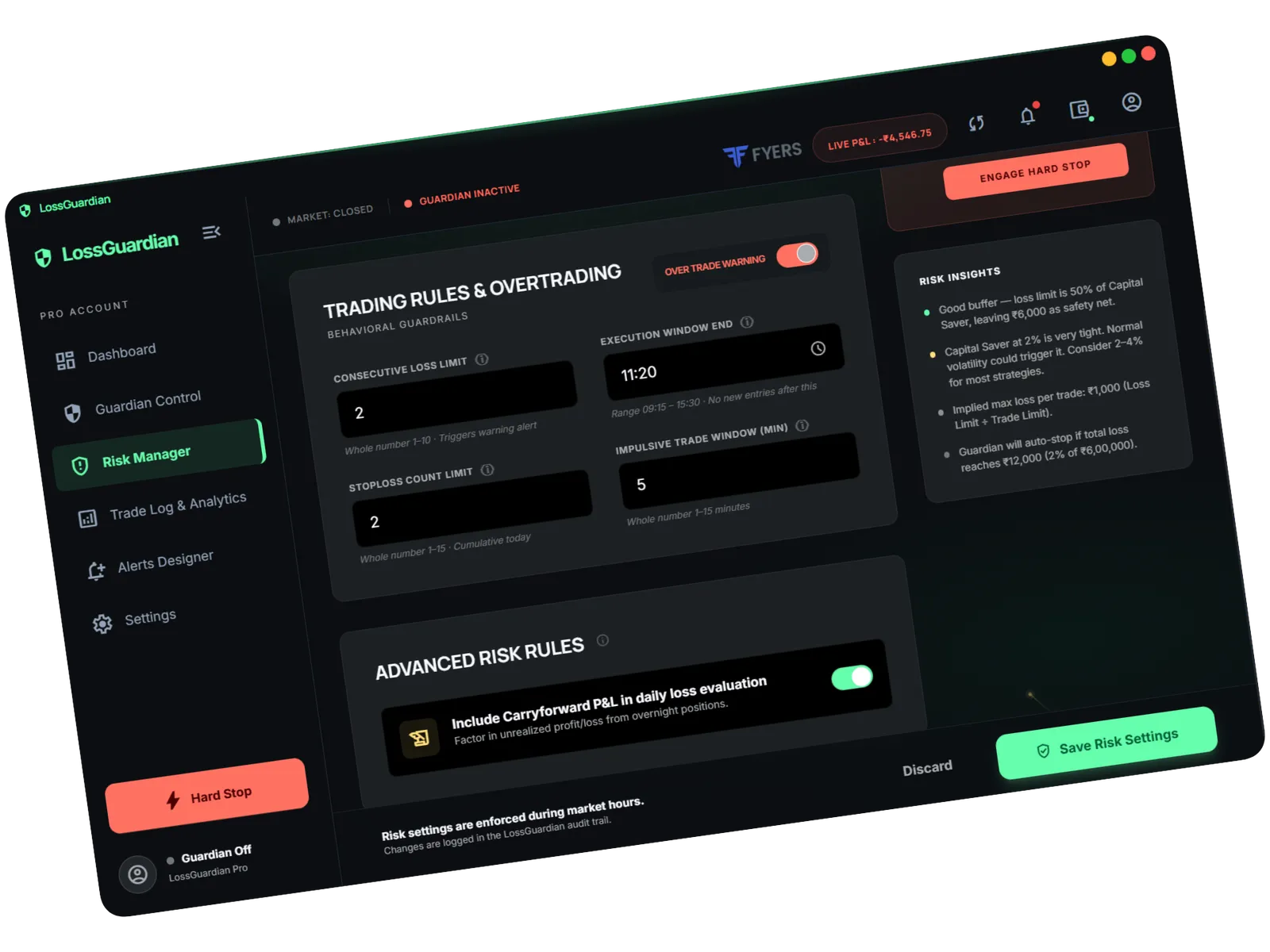
That last point is why we built LossGuardian. It reads your trades from your broker as they happen, counts real round trips, and warns you as you get close to your daily limit. Go past it and an overtrading alert shows exactly how far over you are.
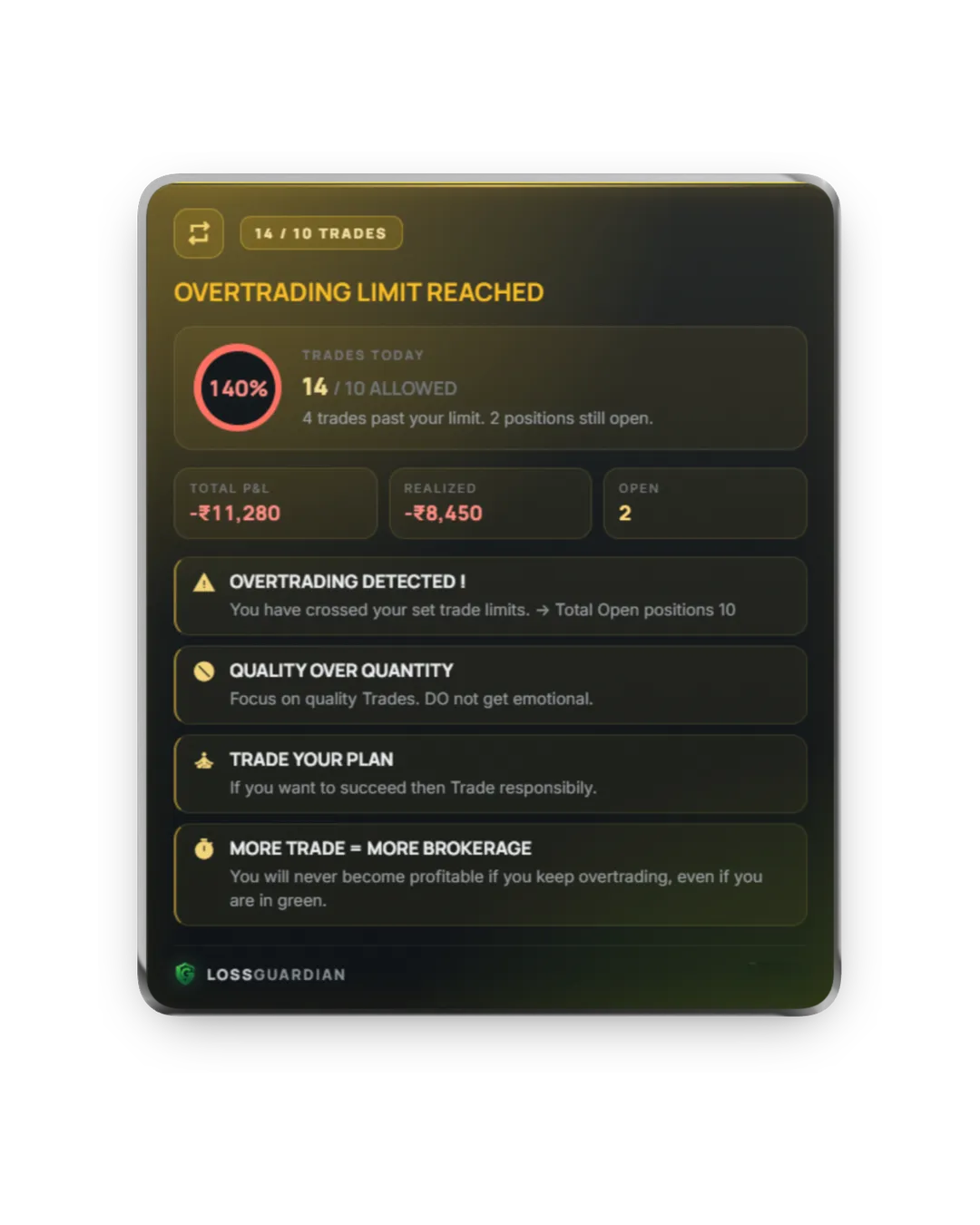
It does not block your broker or cancel anything. It is read-only. It just makes sure you notice, every single time. After a few weeks of that, something changes. You start noticing on your own, a trade or two before the alert. That is the habit forming.
If you want the full step by step method, start with how to stop overtrading. It takes about an hour with your own tradebook, and it is the most useful hour you will spend on your trading this month.
Questions traders ask
Why do I overtrade even when I know it is bad for me?
Because knowing is not the problem. Overtrading happens in the moment, driven by boredom, a recent loss or fear of missing a move. In that moment the part of you that knows the rules is not the part making the decision.
Is overtrading an addiction?
It can feel like one. Trading gives quick, unpredictable rewards, the same pattern that makes games hard to put down. If trading is hurting your money, sleep or relationships and you cannot cut back, talk to someone you trust or a professional.
What is the fastest way to stop overtrading?
Set a small daily trade limit, write it down before the market opens, and use something outside your own head to tell you when you reach it. Rules that depend on you noticing in the moment tend to fail.
Do more trades mean more losses?
SEBI's FY26 study found that the share of loss-making option traders rises with turnover, from about 86% for small traders to about 95% for the most active ones.
LossGuardian watches your positions across six Indian brokers and warns you the moment you cross your own daily loss limit. It is read-only: it never places, modifies or cancels an order.
Join the waitlist