 LossGuardian
Trading psychology
8 signs you are overtrading, and what to do about each
Overtrading rarely feels like overtrading while you are doing it. Here are 8 simple signs to check in your own tradebook, and one fix for each.
Most traders who overtrade do not think they overtrade.
Each trade felt reasonable at the time. There was a reason. The market was moving. It was only one more.
The problem only shows up when you look at the whole day, or the whole month. So here are 8 signs you can check in your own tradebook today. Be honest. Nobody else is looking.
1. You take more trades than your plan has setups
This is the clearest sign. If your strategy gives two or three real setups on a normal day, and your tradebook shows eight or ten trades, the extra ones came from somewhere else.
What to do: Count your setups for a normal day and set that as your daily trade limit. Our guide to stopping overtrading shows how to pick the number from your own trades.
2. You re-enter within minutes of an exit
You close a trade and almost at once open another, often in the same instrument. Sometimes after a loss, sometimes after a win.
Good setups rarely appear back to back. A trade taken two minutes after the last one is usually about the last trade, not the chart.
What to do: After every exit, wait ten minutes before the next entry. Use the time to write one line about the trade you just closed.
3. Your trade count goes up on losing days
Check your red days. Do they have more trades than your green days? For many traders they do. Each loss creates a need to win it back, and each new trade is the attempt.
What to do: Add a consecutive loss limit. After a set number of losses in a row, three is common, you stop for a break. Read more in consecutive losses in trading.
4. You also trade more on winning days
The opposite happens too. A good morning makes you feel sharp, and you keep going until the good morning is gone.
What to do: Keep the same trade limit whatever your P&L says. We cover this in why do I keep trading after I'm already winning.
5. You trade when there is nothing to trade
The market is flat. Nothing on your list has shown up. You trade anyway, because sitting and watching feels like wasting the day.
Boredom trades are some of the most expensive, because there is no edge in them at all.
What to do: Decide in advance what "no trade" looks like, and treat a no trade day as a good day. Not trading is a position too.
6. You lower your size rules without noticing
Your plan says one or two lots. After a loss, three lots feels fine, "just to get it back faster". Overtrading is not only more trades. It is also more risk per trade than you planned.
What to do: Fix your size before the day starts, based on your capital and stop loss. The position size calculator does the maths in a few seconds.
7. You keep trading after your cutoff time
You planned to stop at 2:30 PM. At 3 PM you are still in front of the screen, taking small trades in the last hour, often in cheap options near expiry.
What to do: Set a cutoff time and treat it as the end of your trading day. See why discipline fails at 1:30 PM for why the afternoon is the danger zone.
8. Charges are a big line on your P&L
Open your P&L statement and look at the charges. Brokerage, STT, exchange fees, GST, stamp duty. If that number surprises you, it is because of trade count.
At the market level this is not small. SEBI's FY26 study found that individual F&O traders paid about ₹25,000 crore in transaction costs in the year, and that these costs were 35% of the gross losses of traders who lost money.
What to do: Put your own numbers into the overtrading cost calculator and see what your extra trades cost in a year. Then read the real cost of overtrading.
How many signs did you find?
If you found one, that is normal. If you found three or more, overtrading is probably your biggest leak, bigger than any setup or indicator problem.
The good news is that overtrading is one of the easiest problems to measure. It is just a count. And what you can count, you can fix.
Where LossGuardian helps
The hard part is noticing these signs while they happen, not a week later. That is what LossGuardian is for.
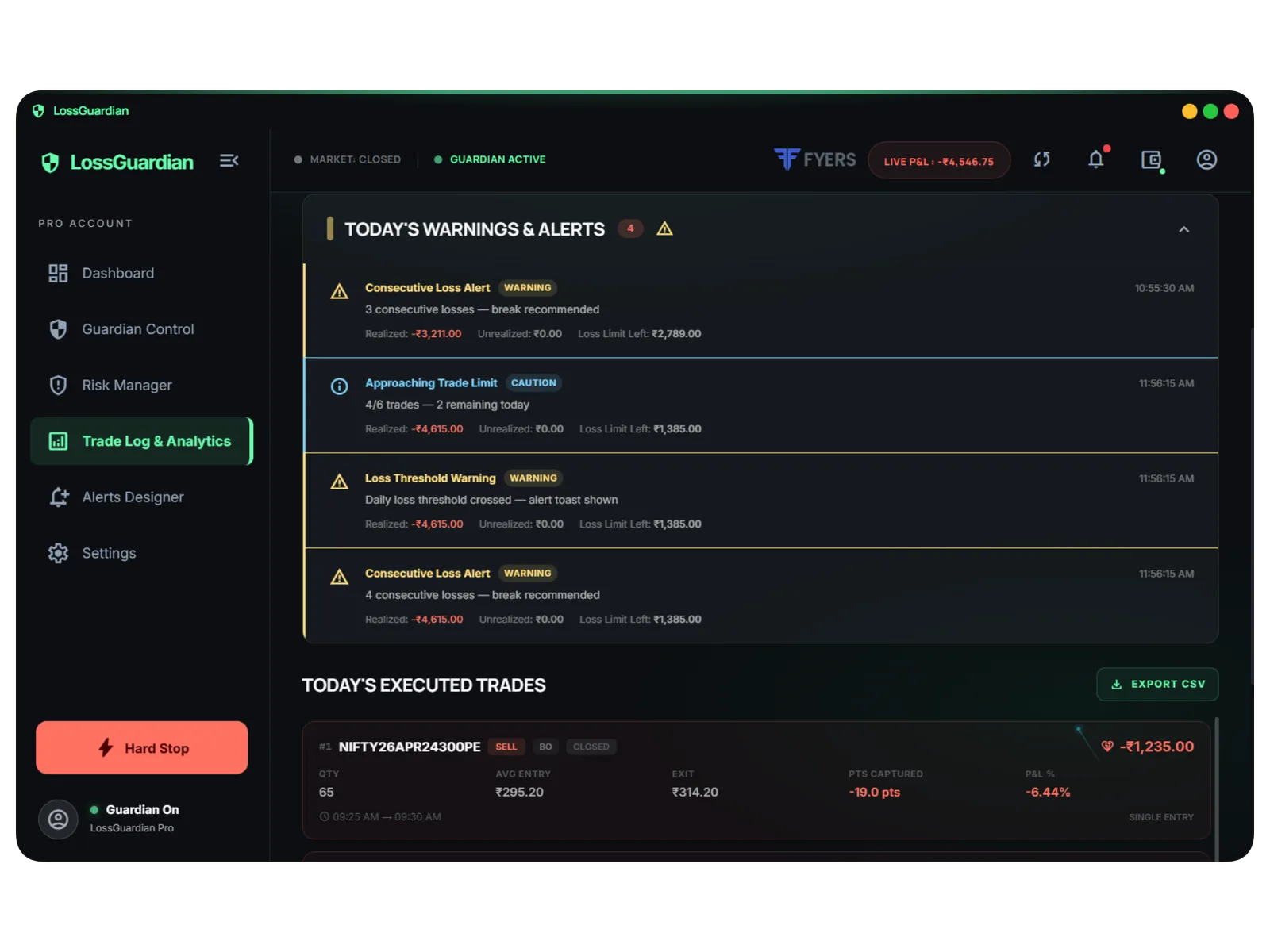
LossGuardian reads your trades from your broker and keeps a log of every warning through the day, such as a losing streak, getting close to your trade limit, or crossing your loss threshold.
You set a daily trade limit. LossGuardian counts your real trades, warns you as you get close, and shows an alert when you go past it. It never blocks an order or closes a trade. It is read-only. It just makes sure the trader in front of the screen knows what the plan was.
You can read more about the overtrading guard, the execution window and the discipline score that tracks these habits week by week.
Fewer trades, better trades
Overtrading feels like effort. It feels like you are working hard at trading. But the traders who last are usually the ones who trade the least, and wait the longest for each trade.
Start with one sign from this list. Fix that one. Then come back for the next.
Questions traders ask
How do I know if I am overtrading?
Compare the trades you take with the trades your plan needs. If you regularly take more, trade on days you planned to rest, re-enter within minutes of an exit, or size up after losses, you are overtrading.
How many trades a day is overtrading?
There is no single number. If your strategy gives three good setups on a normal day and you take eight, five of them are overtrading. The limit comes from your plan, not from a rule of thumb.
Is overtrading the same as revenge trading?
Revenge trading is one cause of overtrading. You can also overtrade from boredom, from FOMO, or after a big win. The result is the same, more trades than your plan asked for.
Does overtrading really cost much?
Yes. Every trade pays brokerage, taxes and slippage before it wins or loses. SEBI found that transaction costs made up 35% of loss-making traders' gross losses in FY26.
LossGuardian watches your positions across six Indian brokers and warns you the moment you cross your own daily loss limit. It is read-only: it never places, modifies or cancels an order.
Join the waitlist