 LossGuardian
Trading psychology
FOMO trading: why you chase moves and how to stop
The market runs without you and you jump in late, at the worst price. Here is what FOMO in trading really is, why it hits so hard, and simple ways to stop it.
Nifty jumps 80 points in ten minutes. You were watching, but you did not have a setup, so you stayed out.
Now the call option you looked at is up 60%. Every candle makes it worse. You can feel your hand moving to the buy button.
You buy. It turns. You are now holding a trade you never planned, at the highest price of the day.
That is FOMO trading. Almost every trader knows the feeling. Very few have a plan for it.
What FOMO in trading really is
FOMO means fear of missing out. In trading, it is the urge to enter a move because it is already moving, not because your plan said so.
The key word is already. A FOMO trade is always late. You see the move once it is big enough to notice, and by then most of it is gone.
It feels like opportunity. It is usually the end of somebody else's opportunity.
Why FOMO hits so hard
Missing out feels like losing. Your account did not go down when you stayed out. But your brain counts the move you missed as money you lost. So you try to "get it back" by jumping in.
Price on screen is loud. A green candle that keeps growing is hard to ignore. Options make this worse, because in percentage terms a premium moves much faster than the index, especially close to expiry. A small move in Nifty can look huge in an option.
Other people seem to be winning. Telegram groups, screenshots, a friend who caught the move. Nobody posts the trades they missed or the FOMO trade that went wrong.
Expiry day turns up the volume. On expiry day, cheap options can double in minutes. SEBI's study of FY26 found that 59% of index options turnover happened on expiry day itself. That is a lot of traders chasing the same fast moves. We cover this in expiry day trading risk.
What a FOMO trade looks like
You can usually spot one by checking a few things after the fact:
- It was not in your plan for the day.
- You entered after a big move, not at the start of one.
- You did not know where your stop loss was when you clicked buy.
- You took a bigger size than usual, because "this one is running".
- You felt rushed. Waiting even one minute felt impossible.
If three or more of these are true, it was a FOMO trade, even if it made money.
How to stop FOMO trading
Accept that you will miss moves
This is the most important one. The market moves every day. You will miss most of those moves, and so does every professional.
Your job is not to catch every move. Your job is to take the trades your plan gives you. A missed move costs you nothing. A chased move can cost you a lot.
Write your setups down before the market opens
Before 9:15 AM, write down what you are looking for. Which levels, which pattern, which direction. If a move does not match what you wrote, it is not your trade.
This sounds too simple. It works because it turns "should I jump in?" into "is this on my list?", which is a much easier question when your heart is racing.
Wait before any trade you did not plan
Give yourself a rule: any unplanned trade waits five minutes. Set a timer. If the setup is still good after five minutes, you can think about it.
Most FOMO trades do not survive five minutes. The urge passes, or the move stalls and you see it clearly.
Decide your size and stop before you look at the chart again
FOMO trades almost always break your risk rules. So fix the rules first. Know your size and your stop before you click. Our position size calculator shows how many lots fit your risk for a given stop.
Keep a daily trade limit
FOMO adds trades. A fixed number of trades a day puts a ceiling on how much damage it can do. When you have used your trades, you are done, however exciting the market looks. Read signs of overtrading to see if FOMO has already turned into a habit.
Where LossGuardian helps
LossGuardian cannot stop you clicking buy. It is read-only and never places or blocks an order. What it can do is make sure you notice.
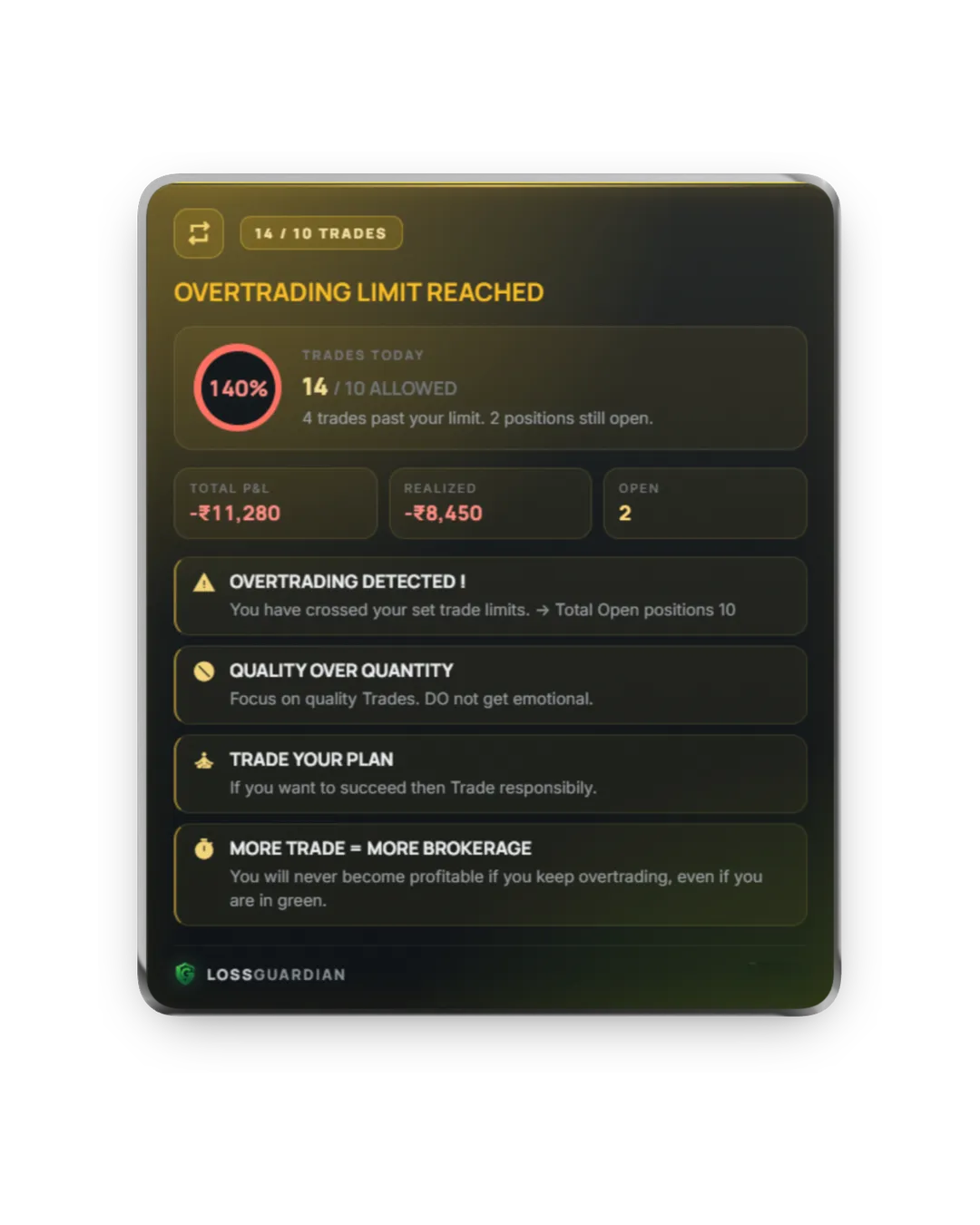
You set a maximum number of trades for the day. LossGuardian counts your real trades from your broker, warns you as you get close, and shows an overtrading alert when you go past your number.
It also watches the time between trades. If you jump into a new trade within minutes of closing one, it is flagged as an impulse trade, which is often what FOMO looks like right after a loss. See the overtrading guard and revenge trading detection.
Over time, your discipline score shows how often this happens. Most traders are surprised by how many of their trades were never in the plan.
The move you missed is not your money
Next time a move runs without you, say it out loud: "That was not my trade."
Then wait for the next one that is. There will always be another move. There will not always be capital left to trade it with if you chase every one.
Questions traders ask
What is FOMO in trading?
FOMO means fear of missing out. In trading it is the urge to jump into a move because it is already running and you are afraid of being left behind, not because your setup appeared.
How do I stop FOMO trading?
Write down your setups before the market opens and only take those. Accept that you will miss moves every day. Keep a daily trade limit, and wait a few minutes before entering any trade you did not plan.
Why does FOMO make me buy at the top?
You notice a move once it is already big. By the time it feels safe and obvious, most of it has happened, so you enter late, at a poor price, with a stop that is far away or missing.
Is FOMO worse on expiry day?
Often, yes. Option premiums can move very fast on expiry day, so a missed move looks huge on screen. SEBI found that 59% of index options turnover in FY26 happened on expiry day itself.
LossGuardian watches your positions across six Indian brokers and warns you the moment you cross your own daily loss limit. It is read-only: it never places, modifies or cancels an order.
Join the waitlist