 LossGuardian
Trading psychology
How to control emotions in trading: a simple guide for Indian traders
Fear, greed, anger and boredom cost traders more than bad strategies. Here is how to manage emotions in trading with simple rules, not willpower.
Every trading book says the same thing: control your emotions.
Great advice. Nobody tells you how.
Because here is the truth: you cannot switch emotions off. You are a human being with money on the line. Fear, greed, anger and boredom will show up. They show up for professional traders too.
So the goal is not to feel nothing. The goal is to stop your feelings from choosing your trades. And that is a very learnable skill.
The four emotions that cost the most
Frustration after a loss
The urge to win it back, right now. It leads to fast, bigger trades in the same thing that just hurt you. This is revenge trading, and for many traders it is the single most expensive habit they have. We explain why it happens in why you feel compelled to trade after a loss.
Overconfidence after a win
You are up nicely, you feel sharp, and suddenly half setups look good enough and bigger size feels safe. A great morning turns into a flat day. More on this in why you keep trading after you are already winning.
Boredom
Nothing is happening, you have been watching for two hours, and a trade feels like doing your job. Boredom trades are rarely big losers, but they add up, and they cost charges every single time.
Fear of missing out
The market moves without you. You chase it, late, at the worst price. These trades often become your biggest single losses.
Why willpower is not enough
The usual advice is "be disciplined". Try harder. Stay strong.
The problem is that willpower is weakest exactly when you need it most. When you are tired, frustrated or losing, the calm part of your brain is not the part in charge. Trying to out-think a strong emotion in the moment rarely works.
So instead of fighting emotions in the moment, set things up in advance so the right choice is the easy one.
Seven simple ways to manage emotions in trading
1. Write your rules before the market opens. Your daily loss limit, your trade limit, your wait after a loss, your cutoff time. Written, on paper, before 9:15. Rules made in the moment are just feelings with a reason attached.
2. Fix your position size. Decide your normal size and never go above it after a loss. Emotions love to play with size. Take that option away.
3. Wait after every loss. Ten minutes minimum. The urge to jump back in fades fast if you give it a little time.
4. Have a profit rule too. Stop, or halve your size, after a good profit target. Greed needs a rule just as much as fear does.
5. Set a cutoff time. No new trades after a set time, like 2:30 PM. Tired, late-day trades are where a lot of emotional decisions happen.
6. Step away from the screen. Physically. A walk, water, anything. You cannot trade on impulse from the kitchen.
7. Review your data every week. Look at which rules you broke, when, and what it cost. Feelings fade from memory. Data does not. See how in your trading data knows your mistakes.
Messages from your calm self
One idea that works surprisingly well: write messages to yourself on a calm day, to be read on a bad one.
Things like:
- "You have hit your limit. Tomorrow is a new day."
- "Is this trade in your plan, or are you chasing?"
- "Good day. Protect it."
Then make sure you actually see them at the right moment.
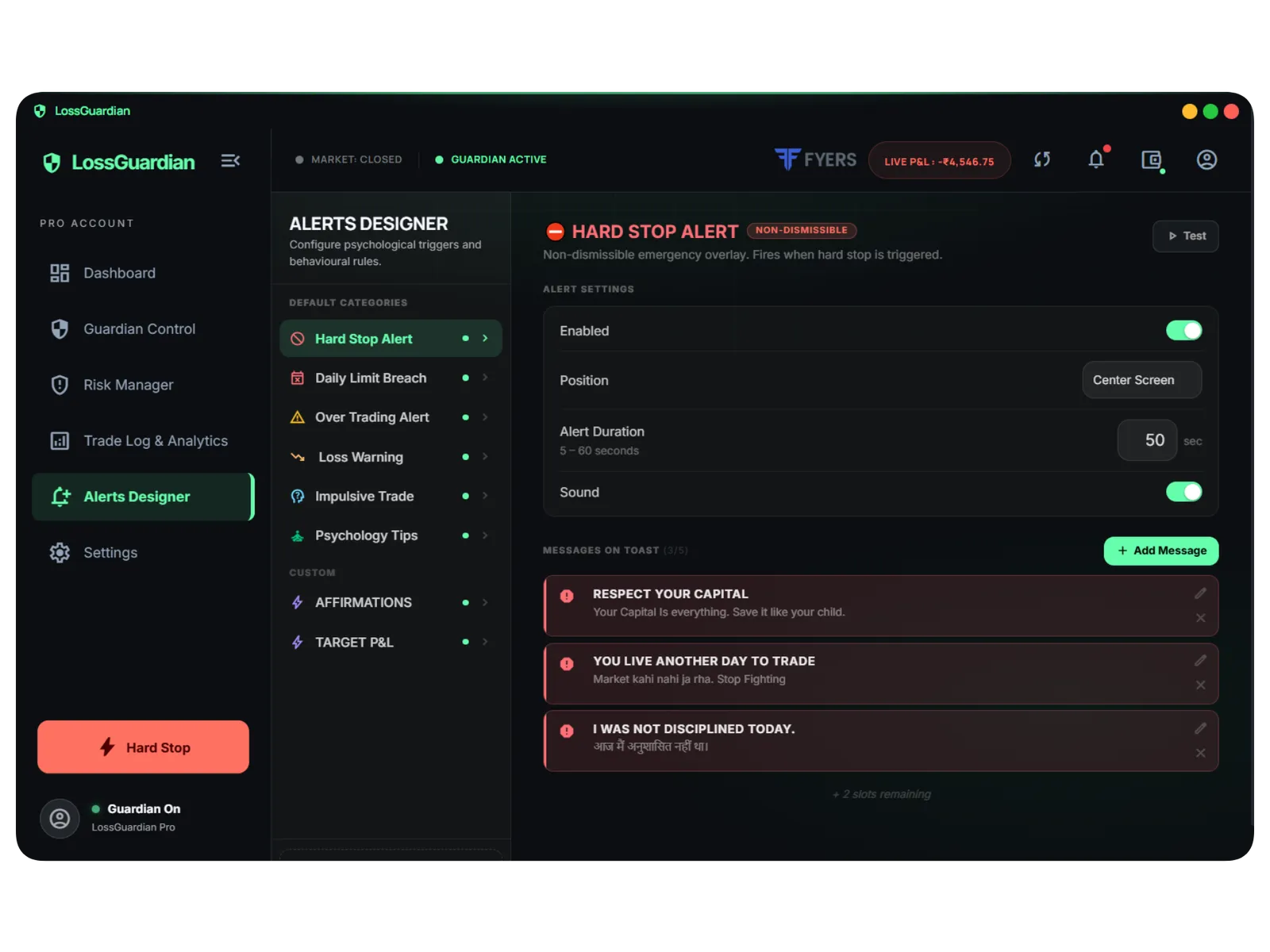
That is one of the things LossGuardian does. In its Alerts Designer you can rewrite the messages on every alert, in English, Hindi or both, and create your own alerts for your personal weak spots. When you hit your loss limit, cross your trade limit or jump back in too fast after a loss, you see your own words on screen, not a generic warning.
It is read-only and never touches your trades. It is just a very well-timed reminder from the version of you that was thinking clearly. Read more about custom alerts.
Emotions are information
One last thing. Your emotions are not your enemy. Frustration tells you the market today is not matching your plan. Boredom tells you there is no setup. Overconfidence tells you to be careful.
Listen to them. Just do not let them place the order.
The next step is building the habits that make this automatic. That is what how to be a disciplined trader is about.
Questions traders ask
Can you remove emotions from trading?
No, and you do not need to. Every trader feels fear, greed and frustration. The goal is to stop those feelings from choosing your trades, with rules you set while calm.
What emotions cause the most trading losses?
Frustration after a loss, which leads to revenge trading, and overconfidence after a win, which leads to bigger size and weaker trades. Boredom and fear of missing out also cause a lot of unplanned trades.
How do professional traders control emotions?
Mostly with structure, not willpower. Fixed position sizes, daily loss limits, trade limits and regular reviews of their own data. The rules make decisions so emotions do not have to.
Does meditation help with trading emotions?
It can help you notice feelings sooner. But on its own it rarely stops a trader mid-loss. It works best together with clear written rules and something that reminds you of them in the moment.
LossGuardian watches your positions across six Indian brokers and warns you the moment you cross your own daily loss limit. It is read-only: it never places, modifies or cancels an order.
Join the waitlist