 LossGuardian
Trading psychology
Why do I feel compelled to trade after a loss?
That urgent need to jump back in after a losing trade is normal, and it is predictable. Here is what is happening in your head, and how to let it pass without acting on it.
You take a loss. Maybe ₹2,000, maybe ₹20,000. And within seconds, something shifts.
Your chest feels tight. Your focus narrows to the chart. And there is a voice, very calm and very sure: "Just get it back. The next trade will fix this."
If you have felt that, you are completely normal. Nearly every trader has. It is not a character flaw. It is how human brains respond to losing something.
The good news is that it is predictable. And predictable things can be handled.
What is happening in your head
To your brain, losing money feels a lot like a threat. It does not really know the difference between "lost ₹5,000 on Nifty" and "something is wrong, act now".
So it does what it does with threats. It pushes you to act quickly. Thinking slows down. Doing speeds up. And the easiest action in front of you is the buy button.
Add to that a very human feeling: losses hurt more than wins feel good. Losing ₹5,000 feels much worse than winning ₹5,000 feels good. So your brain is extra keen to make the pain go away, and the fastest way it can imagine is winning it back right now.
That is the urge. It is strong, it is fast, and it arrives before any real thinking does.
Why acting on it goes badly
The trade you take in that state is almost never your plan. It tends to be:
- Fast. Within a few minutes of the loss.
- Bigger. More lots, because a normal win will not cover the hole.
- The same. Same index, same direction, as the trade that just hurt.
You are not trading the market any more. You are trading your feelings about the last trade. That is revenge trading, and it is where a small red day turns into a bad one. We go through it step by step in how to stop revenge trading.
The urge fades if you let it
Here is the most useful thing to know: the urge is strongest in the first few minutes and fades quickly.
It is a wave. It builds, peaks and falls away. If you can get through ten minutes without acting, most of the time you will look at the chart and think, "Why did I want that trade?"
So the goal is not to never feel the urge. The goal is to not act during the wave.
Simple ways to ride the wave
1. Make a waiting rule, before the market opens. After any losing trade, no new trade for 10 minutes. After two in a row, 30 minutes. After three, done for the day. Write it down in the morning, when you are calm.
2. Physically move. Stand up. Get water. Walk to another room. Staring at the chart for ten minutes is not a break. It is a countdown to your next trade.
3. Name it. Say it to yourself: "This is the urge to win it back." Just naming the feeling puts a little distance between you and it.
4. Check your size. If you do trade after the wait, your size can never be bigger than normal. Many traders halve it after a loss.
5. Let something else hold the timer. When you are upset, it is easy to decide the wait is already over. A timer outside your head keeps you honest.
A timer that stays on screen
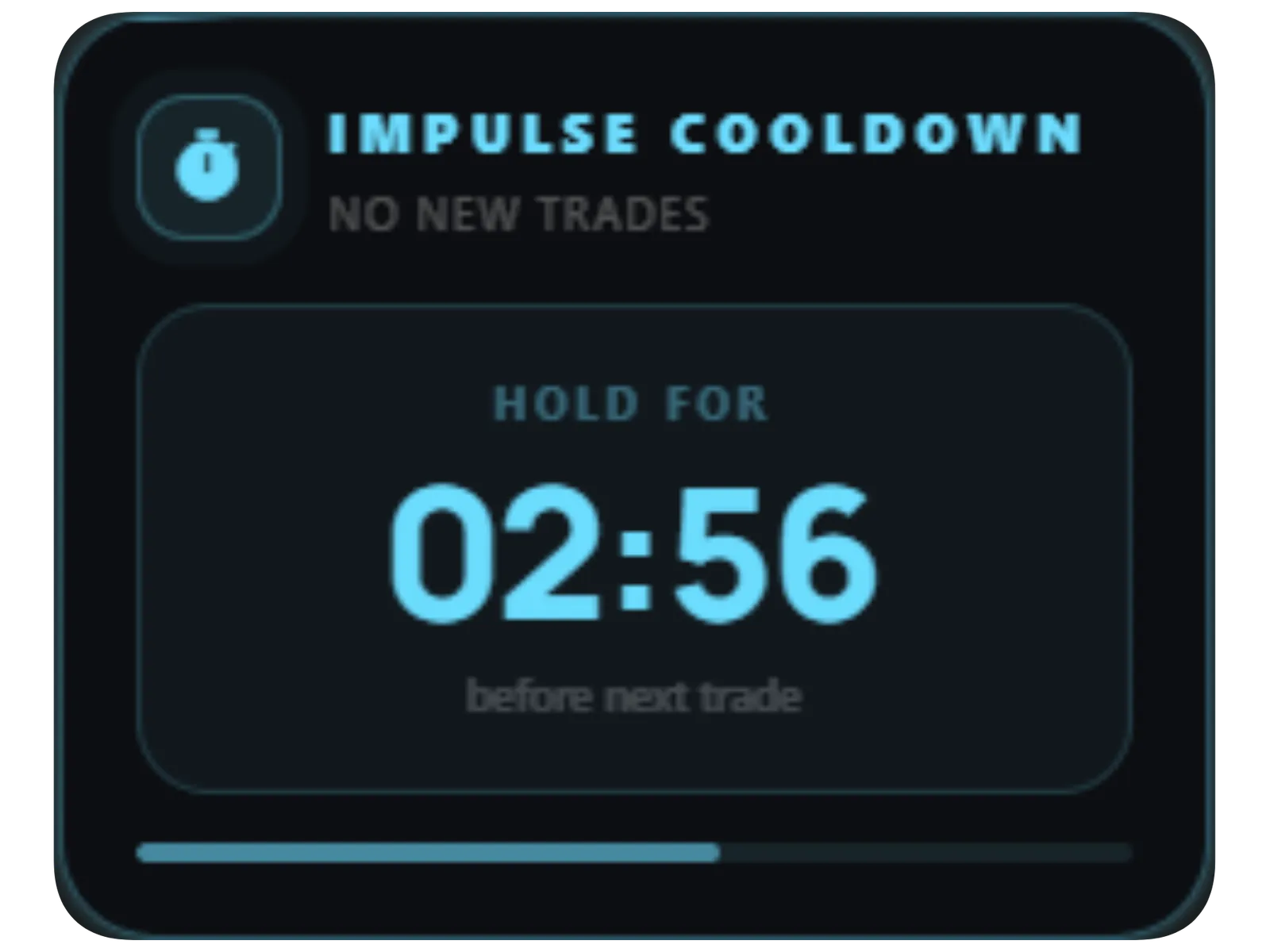
This is exactly the moment LossGuardian was built for. If you jump back into a trade within a set time after an exit, 10 minutes by default, it flags it as an impulse trade. After a losing streak, an alert tells you to step away, and a cooldown timer counts down in the corner of your screen, above your charts.
It does not block your broker or stop you from trading. It is read-only. What it does is make the wave visible. You see the timer, you remember why it is there, and you choose to wait. Each time you choose to wait, the next time gets easier. You can read more about revenge trading detection.
Be kind to yourself about this
You will still feel the urge sometimes, even after years of trading. The best traders do too. The difference is that they have learned to notice it and let it pass.
A loss is just a cost of doing business. It becomes a problem only when you let it choose your next trade. Take the loss, take the break, and come back when the setup is real.
If losses tend to come in a row for you, read what to do after three losses in a row next.
Questions traders ask
Why do I want to trade immediately after a loss?
A loss feels like a threat, and your brain wants to fix it fast. That urge to act is strongest in the first few minutes after the loss and fades if you give it time.
Is it normal to feel angry after a losing trade?
Yes. Almost every trader feels it. The feeling is not the problem. Acting on it with a fast, bigger trade is the problem.
How long should I wait after a losing trade?
At least 10 minutes after a single loss. After two or three losses in a row, take a longer break or stop for the day.
How do I stop myself from trading after a loss?
Decide your waiting rule before the market opens, step away from the screen after a loss, and use a timer or an app that tells you when the wait is over.
LossGuardian watches your positions across six Indian brokers and warns you the moment you cross your own daily loss limit. It is read-only: it never places, modifies or cancels an order.
Join the waitlist