 LossGuardian
Risk strategy
Why traders blow up their accounts (it is rarely one trade)
Why do traders blow up their trading accounts? Five common paths in F&O, the maths of a deep loss, and simple rules that stop one bad day becoming the last one.
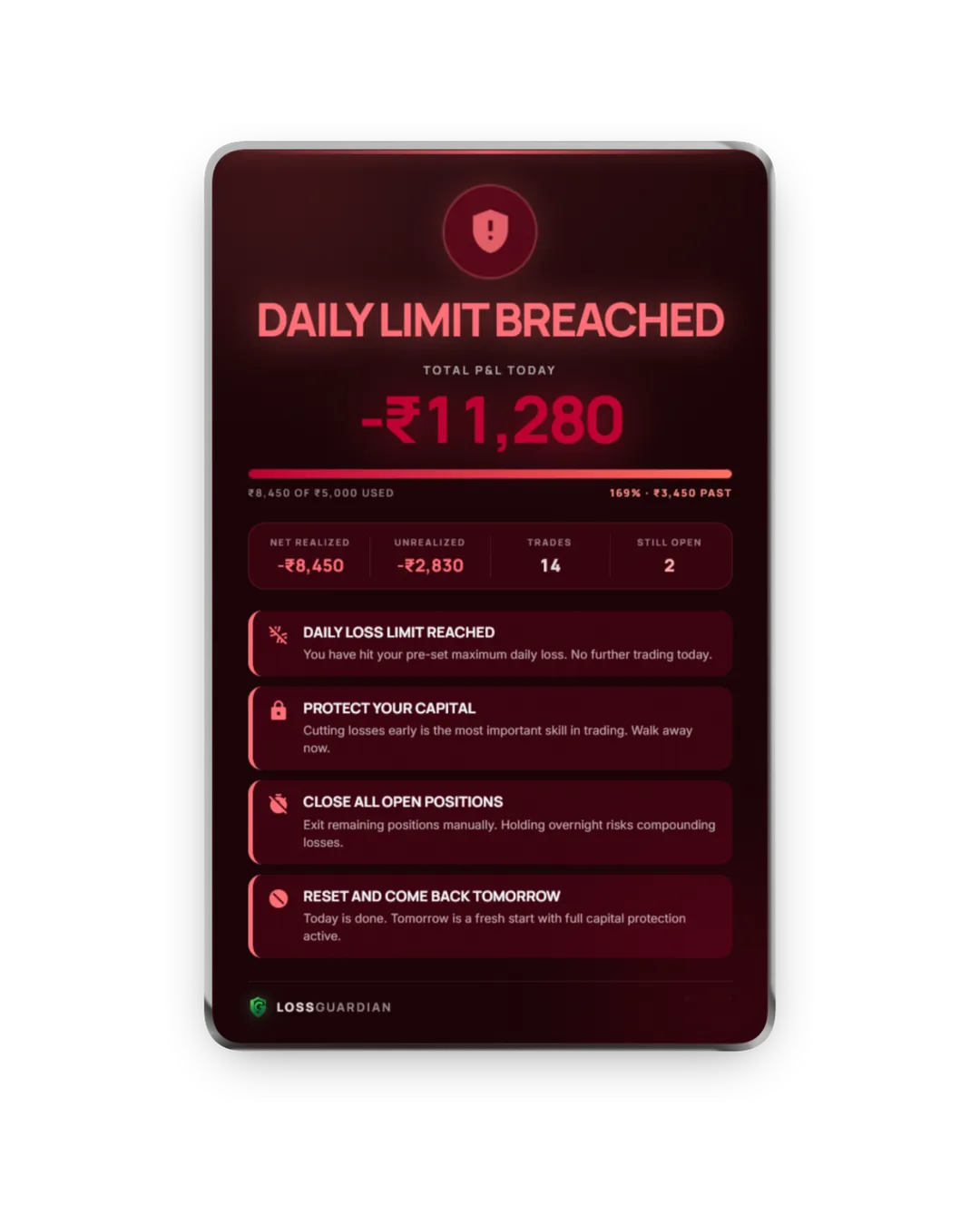
Almost nobody blows up a trading account with one trade.
They blow it up with one bad day that nobody stopped. A loss, then a bigger trade to fix it, then another. By 3 PM the account is half of what it was at 9:15.
If you want to avoid blowing up your trading account, it helps to know the usual paths there.
The 5 common ways traders blow up accounts
1. No daily loss limit
Without a daily limit, a bad day has no bottom. Every loss makes the next trade feel more urgent. Read how to set a daily loss limit if you trade without one.
2. Sizing up after losses
One lot loses. Two lots to win it back. Then four. This is revenge trading with a calculator, and it is the fastest way to blow up an options account. See how to stop revenge trading.
3. Averaging a losing option
In stocks, averaging down sometimes works. In options, time decay works against you every minute. Buying more of a falling option is how a small loss turns into the whole premium.
4. Expiry day bets
Cheap options on expiry day can double in minutes, or go to zero. SEBI found that 59% of index options turnover in FY26 happened on expiry day. Many accounts die there. More in expiry day trading risk.
5. Charges that pile up
Twenty trades a day at small cost each adds up fast. SEBI found that transaction costs were 35% of the gross losses of loss-making traders in FY26. Overtrading drains an account slowly, even on "small loss" days. Try the overtrading cost calculator on your own numbers.
The maths of a hole
Losses and recoveries are not equal:
| Loss | Gain needed to get back |
|---|---|
| 10% | 11% |
| 25% | 33% |
| 50% | 100% |
| 75% | 300% |
After a 50% loss, you need to double your money just to get back to where you started. This is why the first job of any trader is to keep losses small. A blown account cannot recover.
The losses are concentrated
SEBI's FY26 study found that 87.7% of individual F&O traders lost money. But about 23% of traders made up about 90% of the losses.
So most of the damage comes from a smaller group taking very large losses. That is good news in a way. Big account-ending losses are not random. They come from the habits above, and habits can change. Full numbers in our SEBI F&O study breakdown.
The fix is boring
Three numbers, written before the market opens:
- Risk per trade: 1% to 2% of capital. Work out lots with the position size calculator.
- Daily loss limit: the most you can lose today. Use the loss limit calculator.
- Losing streak limit: after three losses in a row, you pause.
Our guide on how to manage risk in trading explains each one in detail.
Where LossGuardian helps
Rules are easy to write and hard to follow at 2 PM after three losses. LossGuardian reads your trades from your broker, read-only, and alerts you when you break your own rules.
It warns you at your daily loss limit, starts a cooldown after a losing streak, and flags revenge trades taken minutes after a loss. It never places or closes a trade for you. It makes sure you see the moment a bad day starts turning into a blown account.
Survive first
The traders who last are rarely the ones with the best entries. They are the ones who never let one day decide their whole account.
Questions traders ask
What does it mean to blow up a trading account?
It means losing most or all of your trading capital, so you can no longer trade the way you planned. In options it often happens in a few sessions, not over months.
Why do most traders blow up their accounts?
Usually not because of one bad trade. It is a bad day with no daily loss limit, followed by bigger size, averaging a losing option and more trades to win it back.
How do I avoid blowing up my trading account?
Fix three numbers before you trade. Risk per trade, a daily loss limit, and a maximum number of losses in a row. Then stop when you hit any of them.
How much of my capital should I risk per trade?
Many traders keep it at 1% to 2% of capital per trade. At 1%, even ten losing trades in a row leave most of your account intact.
LossGuardian watches your positions across six Indian brokers and warns you the moment you cross your own daily loss limit. It is read-only: it never places, modifies or cancels an order.
Download LossGuardian