 LossGuardian
Trading psychology
How to recover from trading losses: stop the bleeding first
Lost big in F&O? Here is how to recover from trading losses step by step, starting with stopping new damage, not winning it back fast.
You lost big yesterday. Maybe a week of profits, maybe a month of salary.
This morning there is one thought in your head: get it back today.
That thought is the most expensive one in trading. If you want to know how to recover from trading losses, the first step has nothing to do with making money. It is stopping the loss from growing.
Step 1: Stop the bleeding
After a big loss in trading, your judgment is not normal. You are angry, scared, or both. That is exactly when traders take the biggest risks of their life.
So for the next few days, do one of two things:
- Do not trade at all, or
- Trade only one lot, with a strict stop loss and a small daily loss limit.
The goal for this week is zero new damage. A flat week after a big loss is a good week.
Step 2: Know the real number
Open your P&L and write down the full loss, including brokerage, STT and other charges. Not "I lost on that one Bank Nifty trade". The real total.
Then write what it is as a share of your capital. Losing ₹40,000 on a ₹4 lakh account is 10%. That number decides how careful the next month needs to be.
Many traders skip this because it hurts. Skipping it is how the same loss happens again.
Step 3: Find out how the loss happened
Look at your tradebook and ask:
- Was it one big trade, or many small ones?
- Did you move your stop loss, or trade without one?
- Did you size up after the first loss?
- Did you keep trading after three losses in a row?
Most big trading losses are not one bad call. They are a bad call followed by revenge trades. If that sounds familiar, read how to stop revenge trading and what to do after consecutive losses.
Step 4: Rebuild with small size and hard limits
When you come back, come back smaller. Use a per-trade risk of 1% or less, and work out your lots with the position size calculator before every trade.
Set a daily loss limit and decide now what happens when you hit it: you stop for the day. Our guide on how to set a daily loss limit walks through the numbers.
Small size feels slow. It is supposed to. Slow is how you recover losses in trading without creating new ones.
Why "win it back fast" makes it worse
The maths works against you. Lose 20% and you need 25% to get back. Lose 50% and you need 100%.
Traders who try to recover from a loss quickly take bigger positions, and bigger positions make bigger losses. SEBI's FY26 study found that the average loss of losing traders was ₹1.47 lakh, while the average profit of winning traders was ₹1.22 lakh. Losses running bigger than wins is the pattern, and chasing is a big part of it. More in our SEBI F&O study breakdown.
Where LossGuardian helps
LossGuardian is read-only. It never places, blocks or squares off a trade. What it does is warn you before a bad day becomes a disaster.
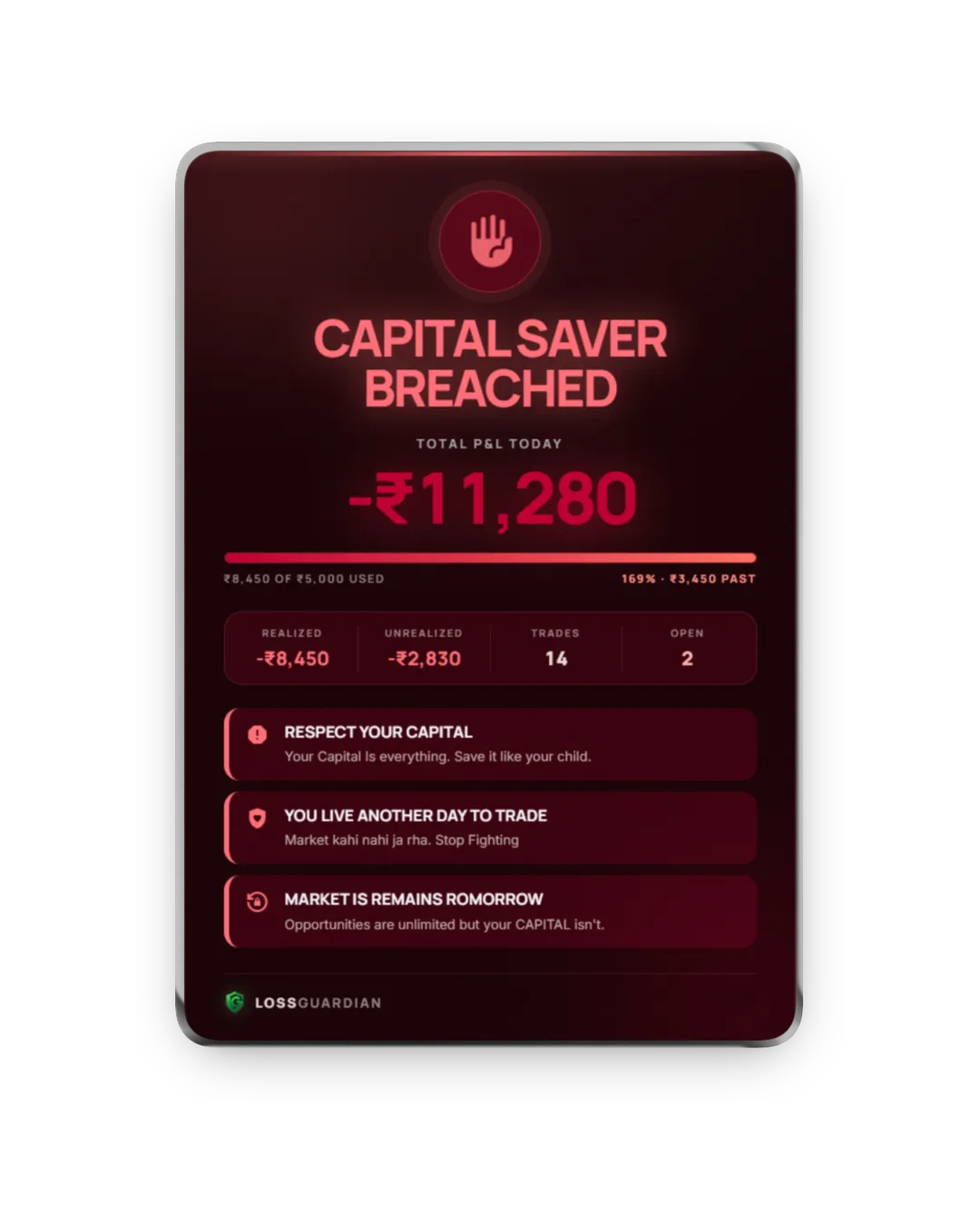
Your daily loss limit alert tells you when you hit your number. Capital Saver sits above it as a loss limit tied to your whole account, and it cannot be raised in the middle of a bad session. The consecutive loss limit starts a cooldown after a losing streak, which is when revenge trades usually begin.
These alerts will not recover your money. They help make sure the next loss is a small one.
A slow recovery is still a recovery
Write your loss down, take a short break, come back with one lot and a hard limit.
Nobody gets back a big loss in one day. But a trader who keeps losses small gets plenty of time to recover them.
Questions traders ask
How long does it take to recover from trading losses?
There is no fixed time, and anyone who promises one is guessing. A loss you try to recover in a week usually gets bigger. Plan in months, with small size and a hard daily loss limit.
Should I stop trading after a big loss?
Take at least a few days off, or trade one lot only. The goal of the first week after a big loss in trading is no new damage, not profit.
Should I increase my position size to recover losses faster?
No. Bigger size after a loss is how one bad day becomes a blown account. Recover with the same or smaller size, and let time do the work.
Is it normal to lose money in F&O trading?
Yes, sadly. SEBI found that 87.7% of individual F&O traders lost money in FY26. Losing does not make you unusual. What you do next is what decides whether you last.
LossGuardian watches your positions across six Indian brokers and warns you the moment you cross your own daily loss limit. It is read-only: it never places, modifies or cancels an order.
Download LossGuardian