
Trading psychology
Trading psychology for Indian traders: a simple guide to the mind behind your trades
Trading psychology in plain words. The 6 feelings that cost Indian traders the most, what each one makes you do, and the simple rule that answers it. With links to go deeper.
Quick answer: trading psychology is how your feelings change your trades. Six feelings cost Indian traders the most: anger after a loss, FOMO, overconfidence after a win, boredom, fear, and hope. Each one has a simple rule that answers it. You cannot switch your feelings off. You can stop them from clicking buy.
Ask a trader why they lost big and you will rarely hear "my strategy failed". You will hear "I got angry", "I could not sit and watch it run", "I thought it would come back".
That is trading psychology. Not a theory. The few minutes between a feeling and a click.
This guide is the map. Each section is short, and links to a full article if that one is your problem.
1. Anger after a loss
What it makes you do: jump straight back in to win it back. Often bigger, often in the same contract, often within minutes.
The rule: a fixed wait after every loss. Ten minutes away from the screen. The urge is strong, but it fades fast if you give it a little time.
Go deeper: how to stop revenge trading and why you feel compelled to trade after a loss.
2. FOMO, the fear of missing out
What it makes you do: buy a move because it is already running, at the worst price of the day, with no plan for it.
The rule: only trade setups you wrote down before the open. If it was not on the list, it is not your trade.
Go deeper: FOMO in trading, and revenge trading vs FOMO if you are not sure which one you have.
3. Overconfidence after a win
What it makes you do: trade bigger and looser because you feel you cannot lose today. Then give the whole day back.
The rule: decide in the morning how much of a good day you will keep, and stop when you give back more than that.
Go deeper: why you keep trading after winning.
4. Boredom
What it makes you do: trade because you are sitting at the screen, not because there is a setup. Many of these trades happen in the slow middle of the day.
The rule: a daily trade limit, and a time after which you take no new trades.
Go deeper: signs of overtrading and why discipline fails at 1:30 PM.
5. Fear
What it makes you do: skip a good setup after a few losses, or close a good trade far too early. Then feel worse when it runs without you.
The rule: a size small enough that one loss does not scare you. Fear usually means the size is too big.
Go deeper: position sizing for Nifty options.
6. Hope
What it makes you do: hold a losing trade, move the stop loss further away, or buy more of an option that keeps falling, because "it will come back".
The rule: the stop is decided before the entry and never moved further away.
Go deeper: how to set a stop loss in options.
Why knowing this is not enough
You probably knew most of the above already. Knowing is not the problem.
The problem is that your rules are written by the calm you, in the morning, and tested by the stressed you, at 1:30 PM. The stressed you is very good at finding reasons. "This one is different." "Just one more."
So the real work of trading psychology is putting your rules somewhere outside your head, where they speak up at the right moment. How to control emotions in trading has seven simple ways to do that.
Where LossGuardian helps
LossGuardian is read-only. It never places, changes or cancels an order. It reads your trades from your broker and keeps your own rules in front of you, at the moment a feeling is about to take over.
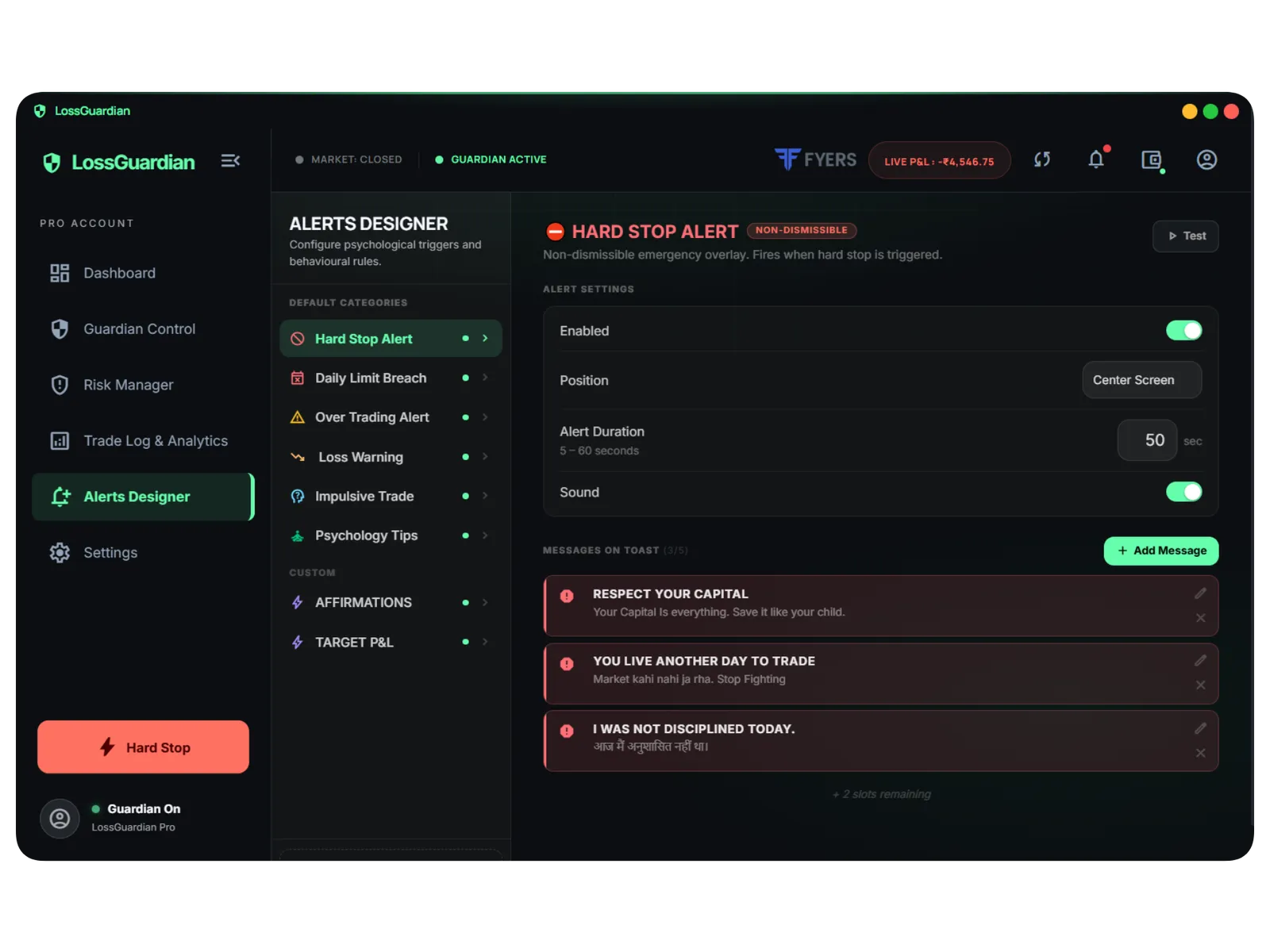
You can write your own messages on the alerts, on a calm day, for the version of you who will need them:
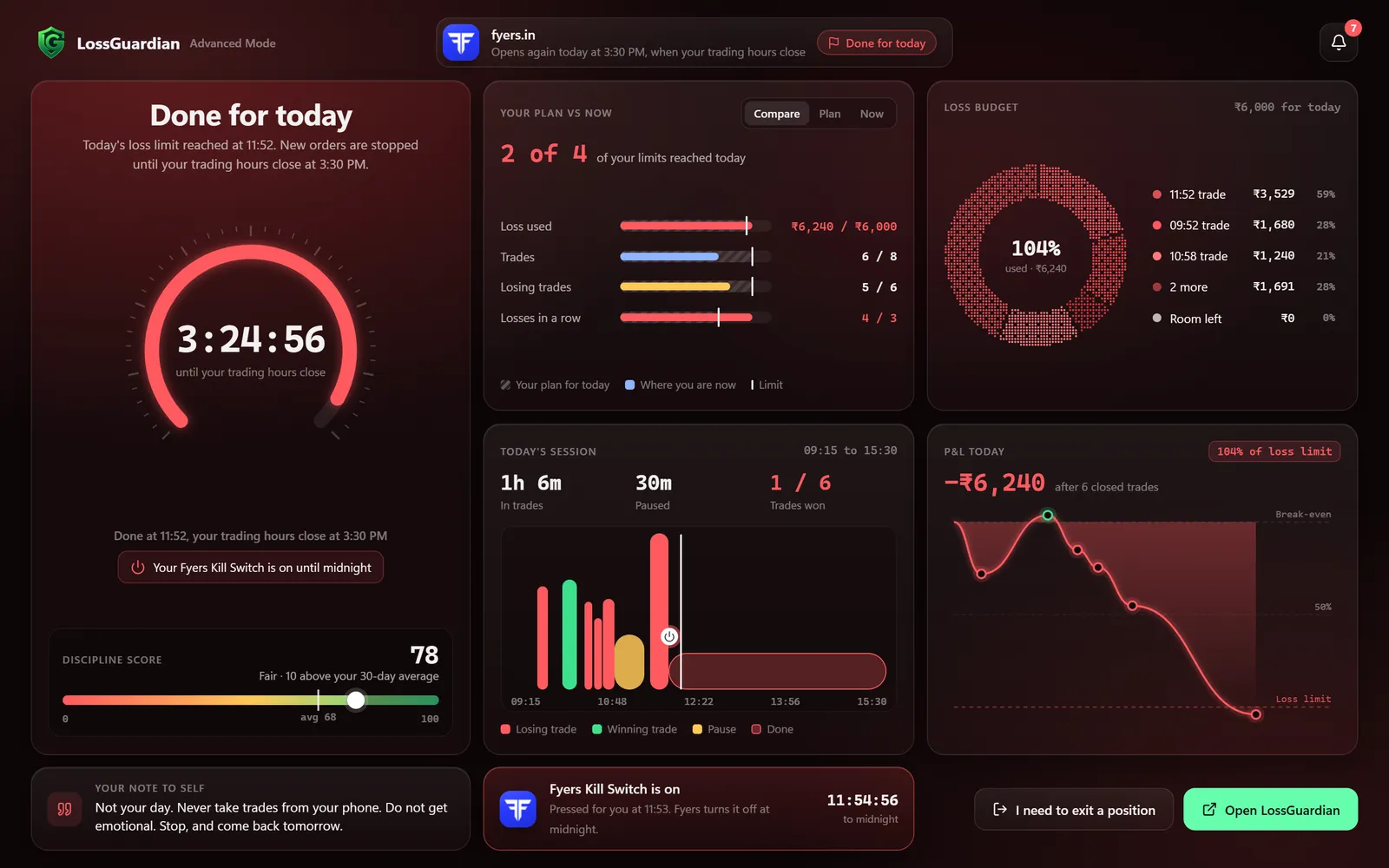
With Advanced Mode on, when you are done for the day, new orders pause on your computer and you see your own day instead of a chart. Your note to self, written in the morning, is right there:
Over weeks, your discipline score and the mix of rules you break show which feeling costs you most. That is the one to work on first.
Feelings are information
Anger, fear and greed are not your enemies. They tell you something: you are tired, you are too big, you are trading for the money and not the setup.
Listen to them. Just do not let them place your trades.
LossGuardian has a free 10-day trial, no card needed. Download it here.
Questions traders ask
What is trading psychology?
It is how your feelings change your trading decisions. Fear, greed, anger after a loss and overconfidence after a win all push you away from your plan. Trading psychology is learning to notice that push and having a rule ready for it.
Why is trading psychology so important?
Because most big losses do not come from a bad strategy. They come from what you do after a loss or a win, like a quick revenge trade or a bigger size. The strategy was fine. The trader was not calm.
How can I improve my trading psychology?
Write your rules before the market opens, keep your size fixed, wait after every loss, stop at a set time, and review your own trades every week. You cannot switch feelings off, but you can stop them from placing your trades.
Is trading psychology more important than strategy?
You need both. But a good strategy traded on tilt still loses money, while an average strategy traded calmly often survives. Most traders spend years on strategy and almost no time on this part.
Can an app help with trading psychology?
LossGuardian helps you act on it: a rule for each costly feeling, your own calm words at the hard moments, and data that shows which feeling costs you most.
LossGuardian watches your positions across six Indian brokers and warns you the moment you cross your own daily loss limit. It is read-only: it never places, modifies or cancels an order.
Download LossGuardian