
Trading psychology
Revenge trading vs FOMO trading: how to tell which one it is
Revenge trading and FOMO feel the same in the moment, but they start in different places and need different fixes. A short self-test to tell which one you are doing right now.
Quick answer: Revenge trading starts from a loss and wants the money back. FOMO starts from a missed move and wants in. They feel the same, a hurry in your chest and a hand on the buy button, but the cure is different. For revenge, wait and stop after losses. For FOMO, trade only from a written list and cap your trades.
The pain
You are in a trade you did not plan. Your heart is going. The size is bigger than normal.
Later you ask yourself, "Was that revenge or FOMO?" It is hard to say. Both felt like pressure. Both felt like "now or never".
This matters because you cannot fix what you have named wrong. A trader who treats FOMO with a loss rule gets nowhere. A trader who treats revenge with a setup list gets nowhere either.
If you want the full story of each one on its own, we have written them: how to stop revenge trading and FOMO in trading. This article is only about telling them apart.
The idea: look at what came just before
Two things can sit behind a rushed trade.
Revenge trading comes after a loss. The market took money from you. You want it back. The trade is about the last trade.
FOMO comes after a missed move. The market ran and you were not in it. You want a piece of it. The trade is about a move you do not own.
So revenge looks backward at your own loss. FOMO looks sideways at someone else's profit. That one difference decides everything that follows.
A short self-test
Answer these in order. Be honest. Nobody is watching.
1. What happened in the last few minutes? If you took a loss, lean toward revenge. If you watched a move run and stayed out, lean toward FOMO.
2. What is the trade trying to fix? "I need to make back my loss" is revenge. "I cannot sit out this move" is FOMO.
3. Which trade is it in your head? Revenge is usually the same index or stock as the loss, often the same direction. FOMO is whatever is moving fastest on the screen, often something you do not normally trade.
4. Where is it in the move? Revenge does not care about the move. It cares about the rupees. FOMO always enters late, after the candle is already big.
5. How does a win feel? If you pictured the win as "back to zero", it is revenge. If you pictured it as "I caught that one", it is FOMO.
If you score mostly on one side, you have your answer. If you score on both, you probably have both, and the loss came first. Treat it as revenge. A loss makes every missed move look bigger, so the FOMO is often riding on top of it.
A different fix for each
If it is revenge trading
The trouble is the loss, so the fix is about what you do after a loss.
- Wait. After a losing trade, no new entry for a set time. The urge is strongest in the first few minutes and fades. We explain the wave in why you feel compelled to trade after a loss.
- Stop after losses in a row. Pick a number before the market opens. When you reach it, you step away.
- Never bigger after a loss. Your next size can match your normal size, not more.
- Know your daily loss limit. It puts a floor under a bad day. See how to set a daily loss limit.
If it is FOMO
The trouble is a move you do not own, so the fix is about what counts as your trade.
- Write your setups before 9:15. If a move is not on your list, it is not your trade.
- Accept that you will miss moves. You will, every day. So does everyone else. A missed move costs nothing.
- Make an unplanned trade wait five minutes. Most FOMO trades do not survive five minutes.
- Cap your trades for the day. FOMO adds trades. A number you set in the morning limits the damage.
Notice what is not in both lists. Waiting after a loss does nothing for FOMO if you have had no loss. A setup list does little for revenge, because a revenge trade often is a setup you like, just taken for the wrong reason.
Where LossGuardian helps
LossGuardian is read-only. It never places, changes or cancels an order and never closes a position. It cannot tell if you feel revenge or FOMO. What it can see is what you did, and some of that points to one or the other.
For revenge trading:
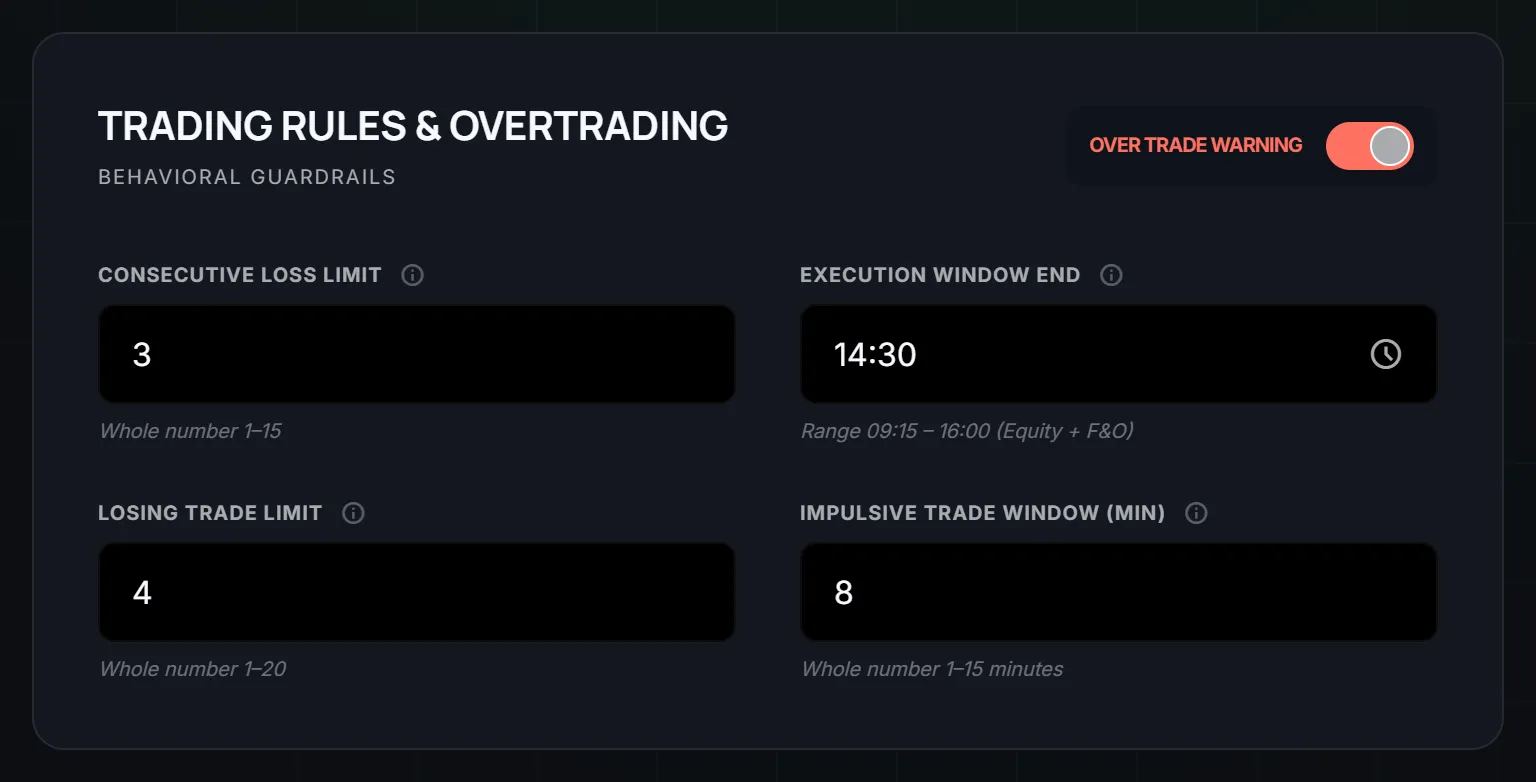
In Risk Manager you set an impulsive trade window, from 1 to 15 minutes. If you trade again inside it, the trade is flagged as an impulse trade. This needs the Over Trade Warning switch on. That switch turns on impulse detection, which spots going back into a contract minutes after you exited it, or adding straight after a loss.
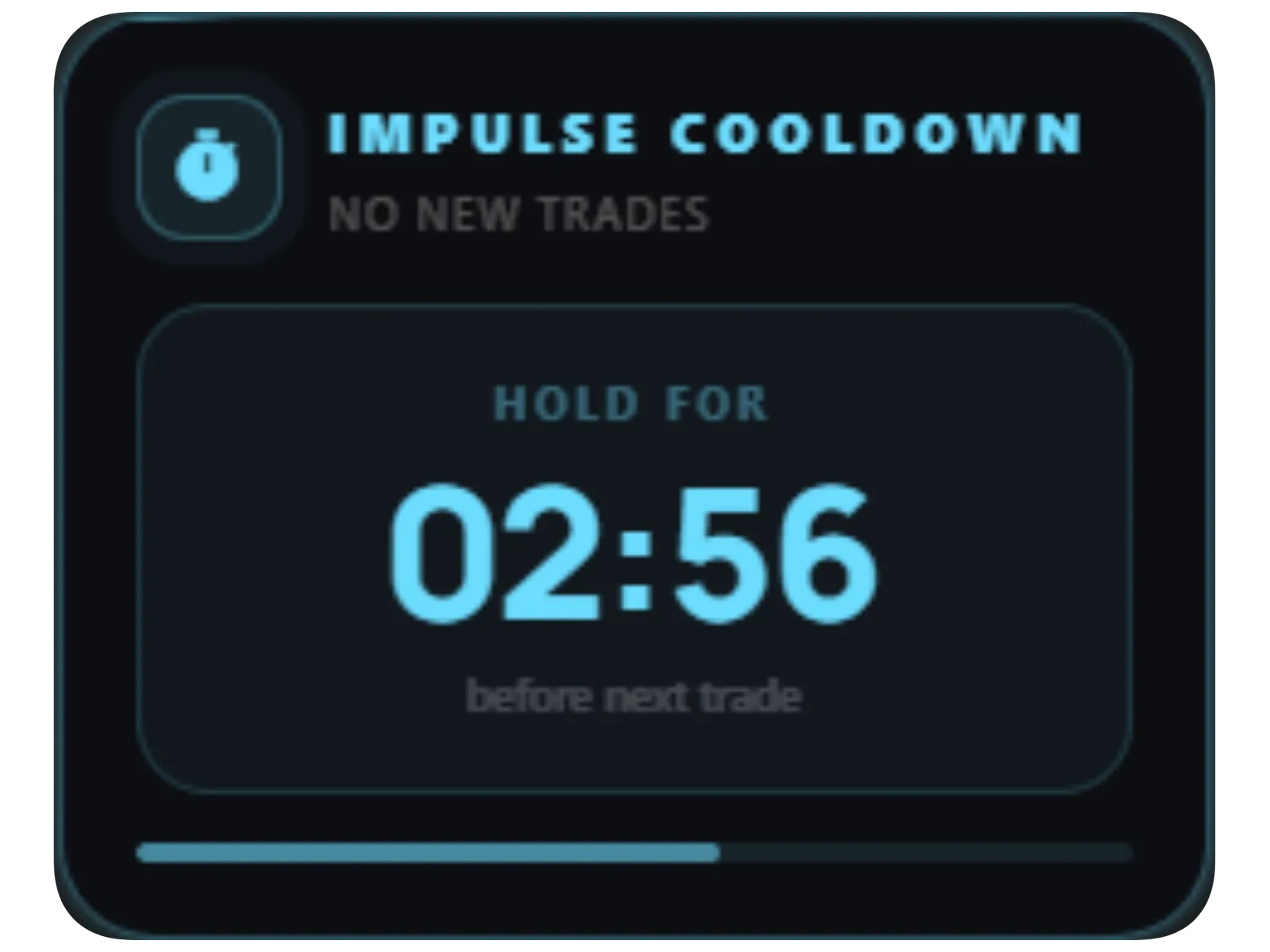
The Impulsive Trade alert then starts a cooldown countdown in the top right of your screen. In Alerts Designer you can set that cooldown from 5 to 60 minutes.
You can also set a consecutive loss limit, from 1 to 15. It warns you when you reach your number of losses in a row.
For FOMO:
You set a daily trade limit, from 1 to 25. LossGuardian counts your real trades from your broker, warns you as you get close, and tells you when you go past it. That is the ceiling a FOMO day needs. You can also set an execution window end, a time after which you take no new trades, for the hours when chasing is worst.
For both:
In Alerts Designer you can write your own message for an alert. That is useful here, because the right words are different for each. A revenge message might say, "You just lost. This trade is about the loss, not the market." A FOMO message might say, "That was not my trade." You wrote them calm, so they are there when you are not. The Alerts Designer guide shows how, and the Risk Manager guide lists every limit.
If you want to see how these fit as a full set of habits, read 7 rules to stop revenge trading. Most of them help with FOMO too.
What LossGuardian does not do
It does not decide for you. It does not know your setups, so it cannot tell a planned trade from a chased one. It only shows the timing, the count and the streak. You read the pattern.
Nothing here promises results. Rules do not remove losses. They change what you do next.
What you gain
You gain a name for the feeling. That sounds small. It is not.
"I just took a loss and I want it back" is a thought you can wait out. "I missed that move and I want in" is a thought you can check against your list. Either one is much easier to handle once you have said it plainly. An unnamed urge pushes you. A named one is just a thing you notice.
Over time you stop needing the self-test on paper. You feel the hurry, ask what came just before it, and know. The software holds the rules while you build that habit. The aim is that you need it a little less each month.
Questions traders ask
What is the difference between revenge trading and FOMO?
Revenge trading starts from a loss. You want the money back. FOMO starts from a move you missed. You want in before it is gone. Both are a hurry to act, but the starting point is different, so the fix is different too.
Am I revenge trading or FOMO trading?
Ask what happened just before the urge. If you just took a loss, it is revenge. If you just watched a move run without you, it is FOMO. If both happened, treat it as revenge first, because a loss makes FOMO louder.
Can revenge trading and FOMO happen together?
Yes. You take a loss, then the market runs the other way and you feel you missed the real move. That mix can happen, and it is why the self-test matters. Name the first feeling, and fix that one.
Is the fix for FOMO the same as the fix for revenge trading?
Not quite. Revenge trading needs a wait and a stop after losses. FOMO needs a written list of setups and a cap on trades. A few tools help with both, like a daily trade limit.
Can software tell the difference for me?
LossGuardian does not read your feelings. It sees what you did. It flags a quick re-entry after an exit, or a new trade straight after a loss, and it counts your trades. It is read-only and never places or cancels an order. Reading the pattern is still your job.
Can an app tell if I am revenge trading or FOMO trading?
LossGuardian flags quick re-entries after losses, the revenge pattern, and counts unplanned trades against your limit, the FOMO pattern. Past performance shows which one shows up more.
LossGuardian watches your positions across six Indian brokers and warns you the moment you cross your own daily loss limit. It is read-only: it never places, modifies or cancels an order.
Download LossGuardian