
Trading psychology
How to become a good trader: it is mostly about the bad days
How to become a good trader in India. It is less about finding better entries and more about how you handle losing days. Protect your capital, review, and repeat.
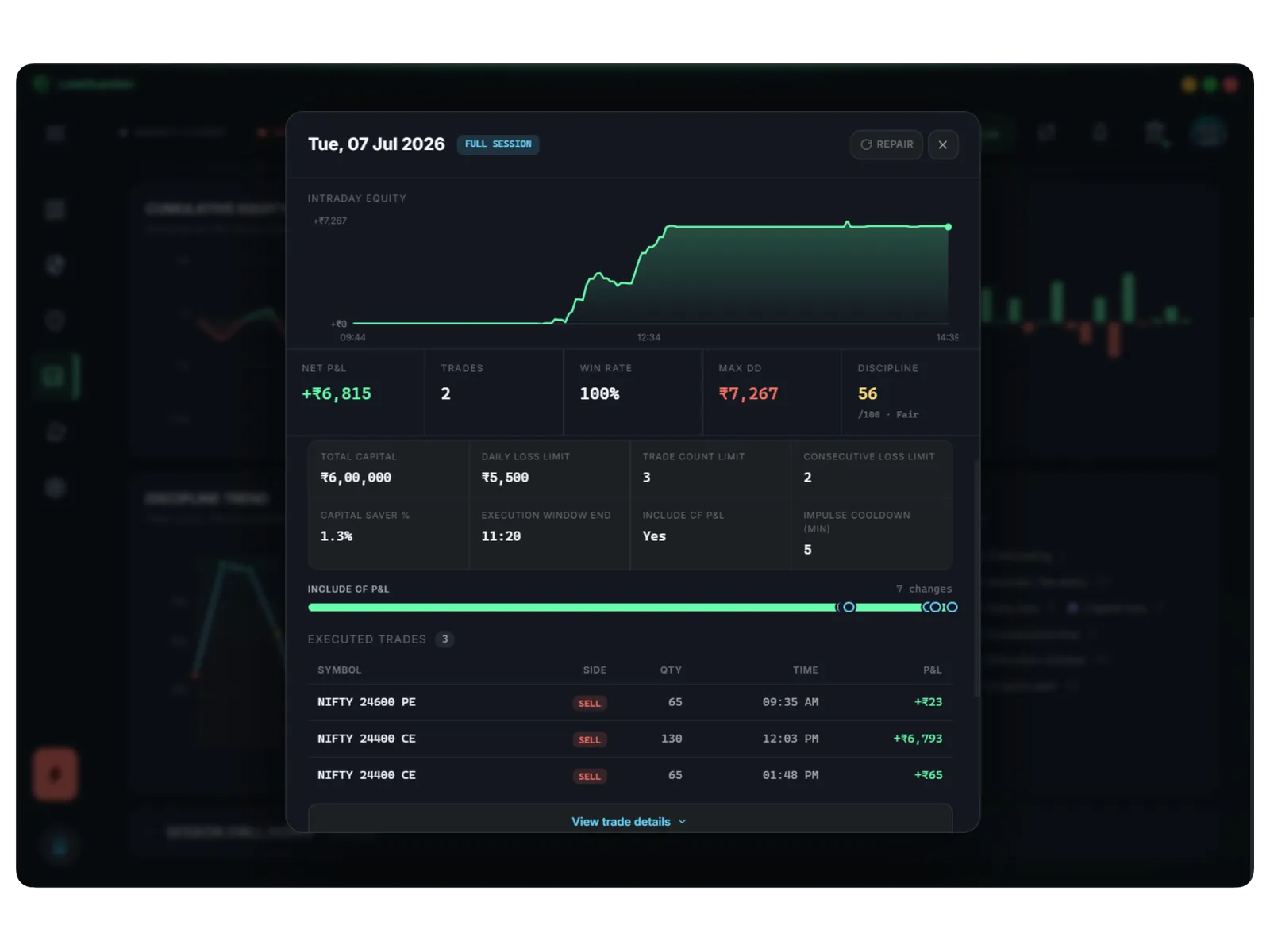
Quick answer: a good trader is not the one with the sharpest entries. It is the one whose bad days stay small. Decide your loss limit before the market opens, stop when you reach it, look at what happened, and come back tomorrow. Do that for long enough and the rest starts to improve.
Think about the last time you had a great trade. Now think about the last time you had a really bad day.
Which one changed your account more?
For most of us, it is the bad day. One good trade adds a bit. One bad day can take away a month. So if you want to know how to become a good trader, it makes sense to start where the damage happens.
The usual advice looks the wrong way
Search for how to become a good trader and you will mostly find advice about entries. Which indicator. Which pattern. Which time frame.
That advice is not useless. But it looks at the 20 minutes when you are right, and ignores the 20 minutes when you are tired, angry and sure that the next trade will fix everything.
SEBI's study for FY26 found that 87.7% of individual F&O traders lost money. That number is not about people with bad charts. It is about people who, one day at a time, could not stop a bad day from growing. We broke down the study in SEBI F&O study FY26: what the data really says.
What a good trader actually does on a bad day
A bad day usually does not start with a big mistake. It starts with a small loss, and then a second trade taken too fast.
A good trader does a few plain things here.
- Stops at the number they chose in the morning. Not the number they feel like at 1:30 PM.
- Takes a break after a loss. Even five minutes helps the urge fade.
- Does not make the next trade bigger to win the loss back.
- Closes the screen. The day is allowed to end badly.
None of this is exciting. It does not make a good reel. But it is the reason their account is still there next month. If you want the habit side of this in detail, read how to be a disciplined trader. If you want to see how a bad day turns into a ruined account, read why traders blow up their accounts.
Step 1: Protect your capital first
Your capital is your chance to keep learning. Without it, you cannot practise, and without practice you do not improve.
So the first job is not to make money. It is to still be here in a year.
Two numbers do most of the work:
- How much you risk on one trade. Small enough that a few losses in a row do not hurt.
- How much you can lose in one day. Small enough that you can lose it and still feel fine tomorrow.
The second number is the one most people skip. We have a full guide on how to set a daily loss limit, and a loss limit calculator if you want help picking the figure.
A number only helps if it is in place before the market opens. In LossGuardian, you set these once in Risk Manager. You enter your capital, your daily loss limit and the most trades you want to take, from 1 to 25. From then on, your live trades from your broker are checked against them.
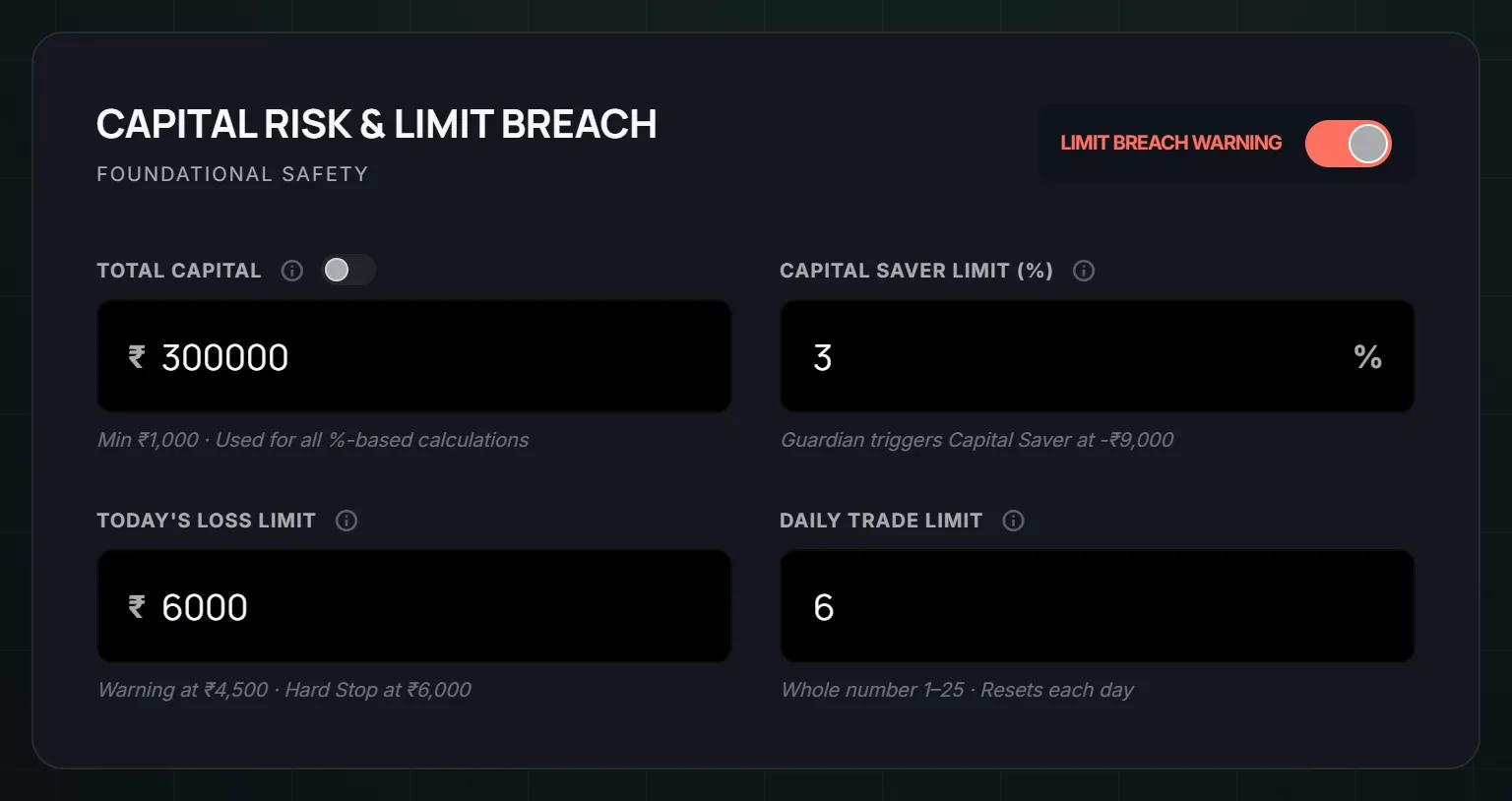
The amounts in that picture are only an example. Your numbers should come from your own capital and your own comfort.
Step 2: Make the stop easy to keep
Agreeing to stop at your limit is easy. Doing it when the loss is real is hard.
The reason is simple. At the moment you most need to stop, you are the least able to decide it. You want that money back. It feels like fixing a mistake, not taking a new risk. We wrote about this feeling in why you feel compelled to trade after a loss.
So give the stop some help.
LossGuardian can warn you as you get close to your limit and tell you clearly when you cross it. It never places, changes or cancels an order, and it never closes a position. It is read-only, so the decision to stop stays yours.
If a warning has not been enough for you, there is Advanced Mode. You choose it yourself. When you break a rule you set, it can pause your new trades for a short time, or end your day, while your exits stay open. And if you want your broker to refuse new orders too, there is the Automatic Kill Switch. With your consent, LossGuardian presses your broker's own Kill Switch for you. It is optional, and you stay in charge of whether to use it.
Some traders need that extra step for a few months. Some never do. Both are fine.
Step 3: Look at the day, not just the P&L
P&L tells you what happened. It does not tell you why.
You can finish green after breaking three rules, and you can finish red after following every rule. If you only look at the money, the green day teaches you the wrong lesson.
So look at the behaviour. After the close, ask:
- Did I stop at my limit?
- Did I take trades that were not in my plan?
- Did I trade again right after a loss?
- At what time did the day start to slide?
LossGuardian keeps this record for you, from your broker, without you writing anything. The Trade Log and Analytics page shows each day with your trades, your discipline score out of 100, and the limits you had set that morning. The score measures how well you kept your own rules. It does not measure profit.
If you want to turn that record into action, find your mistakes with trading analytics walks through it.
Step 4: Change one thing a week
This is where the improvement actually happens.
Once a week, spend ten minutes with your last five or six days. Find the one rule you broke most often. Only one. Then change something small to help with it. Make the limit a bit tighter, or add a note to yourself, or take a longer break after a loss.
Next week, look again.
It will feel slow. But a trader who fixes one real habit each week is a different trader in a few months. A trader who reads another strategy video each week is the same trader with more screenshots.
Step 5: Be kind about the slips
You will break your rules again. You will have a day where you did everything wrong.
That does not mean you are not cut out for this. Check the trend. Are the bad days getting smaller? Are you stopping a little sooner? Do you notice the mistake a little earlier? That is what getting better looks like.
If you are coming off a hard stretch right now, how to recover from trading losses is a good place to go next.
What you gain
You get a smaller worst day. You get a record of your own habits that you can actually learn from. And you get to keep trading, which is the one thing every other skill depends on.
The honest goal is that you slowly need the help less. The rules become yours. The pause after a loss becomes normal. Software, if you use it, is just the training wheels while that happens.
Nobody can promise you results in trading, and we will not. What you can do is make sure that your bad days teach you something, and do not end your journey.
Questions traders ask
How do I become a good trader?
Learn to handle your bad days. Decide your daily loss limit before the market opens, stop when you reach it, and review your trades every week. Good entries matter, but a trader who keeps losses small gets many more chances to improve.
How can I become a successful trader in India?
Start by staying in the game. Risk a small part of your capital on each trade, keep a daily loss limit, and write down why you took each trade. SEBI's FY26 study found 87.7% of individual F&O traders lost money, so surviving long enough to learn is already a real win.
What are the habits of good traders?
They write their rules before the market opens. They stop at their daily limit. They take a break after a loss. They review their trades every week and change one thing at a time.
Do good traders never have bad days?
Every trader has bad days. A good trader keeps them small, does not try to win the loss back in the same session, and learns something from each one.
Can software make me a good trader?
No. Software cannot give you skill. LossGuardian only watches your trades from your broker, read-only, and shows you your own rules and mistakes, so you can build the habits yourself.
How can I handle bad trading days better?
Decide the limits before the open and let something hold them. LossGuardian watches your daily loss, losing streaks and re-entries live, and with Advanced Mode on can end the day on your computer.
LossGuardian watches your positions across six Indian brokers and warns you the moment you cross your own daily loss limit. It is read-only: it never places, modifies or cancels an order.
Download LossGuardian