
Trading psychology
How to write a trading plan you will actually follow (one page, with a template)
A trading plan you follow is one page, written in numbers while you are calm. Here is a plain fill-in template for what you trade, when, how much you risk, when you stop and what you do after a loss.
Quick answer: a trading plan you follow is one page, written in numbers, and written when the market is closed. It answers five questions. What do I trade? When do I trade? How much do I risk? When do I stop? What do I do after a loss? If a line cannot be checked at the end of the day, it is a wish, not a rule.
Why most plans do not get followed
Most plans fail for a simple reason. They are long, and they are made of wishes.
"I will be patient." "I will only take good setups." "I will not revenge trade." These sound fine on a Sunday. But in the middle of a losing morning, you cannot check them. Nobody can say if you were patient enough. So the plan gives you no signal at the exact moment you need one.
A plan you follow is different. It is short enough to read in a minute. Every line has a number or a yes or no. You write it while you are calm, so the version of you that is stressed has less to decide.
This article is about the plan itself. If you want habits that make a plan stick, read how to be a disciplined trader. If you want to work out the risk numbers in detail, read how to manage risk in trading. Here we only put the pieces on one page.
The five questions
1. What do I trade?
Name the instrument and the one or two setups you take. Not "whatever looks good." For example: Nifty weekly options, and only the opening range breakout. If you are new, pick one instrument and one setup and stay with them for a while.
A long list of things you might trade is a way to say you have no plan. Fewer choices means fewer decisions on a hard day.
2. When do I trade?
Write a start time and an end time. For example, 9:30 to 14:30. Write the days you skip, if any, such as expiry day if it has hurt you before.
The end time matters more than the start. The late hours are where a bad morning turns into a bad day, because you want the money back. A fixed cut-off takes that argument away.
3. How much do I risk?
Two numbers. How much you risk on one trade, and how much you can lose in one day. Write them in rupees, not feelings.
If you do not know what daily number is right, the free loss limit calculator and the position size calculator can help you work it out. For the long version, see how to set a daily loss limit.
4. When do I stop?
This is the line most plans skip. Write the exact conditions that end your day. A daily loss in rupees. A number of trades. A number of losses in a row. Any one of them is enough.
5. What do I do after a loss?
The loss itself is rarely the problem. The next trade is. So write the steps in advance. Stand up for ten minutes. Look at the chart again. Take the next trade only if it matches your setup. Or, if it was your second loss in a row, close the screen.
If losses are the part you struggle with, how to recover from trading losses goes deeper.
The one-page template
Copy this into a note. Fill every blank. The numbers below are only examples of the shape, not advice. Your numbers depend on your capital and what you can afford to lose.
MY TRADING PLAN  (written on: ____ , when calm)

1. I trade:        ______ (instrument), only ______ (setup)
2. I trade from:   ____ to ____ . I do not trade on: ______
3. I risk:         Rs ____ per trade, Rs ____ per day
4. I stop for the day if ANY of these happens:
                   - I lose Rs ____ in the day
                   - I have taken ____ trades
                   - I have lost ____ trades in a row
5. After a loss I: ______________________ (one action)
   My note to self: ______________________ (one line)
6. After the close I: write one line about what I did well
That is the whole plan. If it runs onto a second page, cut it.
Where each line becomes a real setting
A plan on paper still depends on you remembering it at 1:30 PM. That is where it usually breaks. So it helps to put the same numbers somewhere that does not depend on your mood.
LossGuardian is a read-only app. It watches your trades and compares them with the limits you set. It never places, changes or cancels an order, and it never closes a position. Here is where each line of the template lives. Every field below is in Risk Manager.
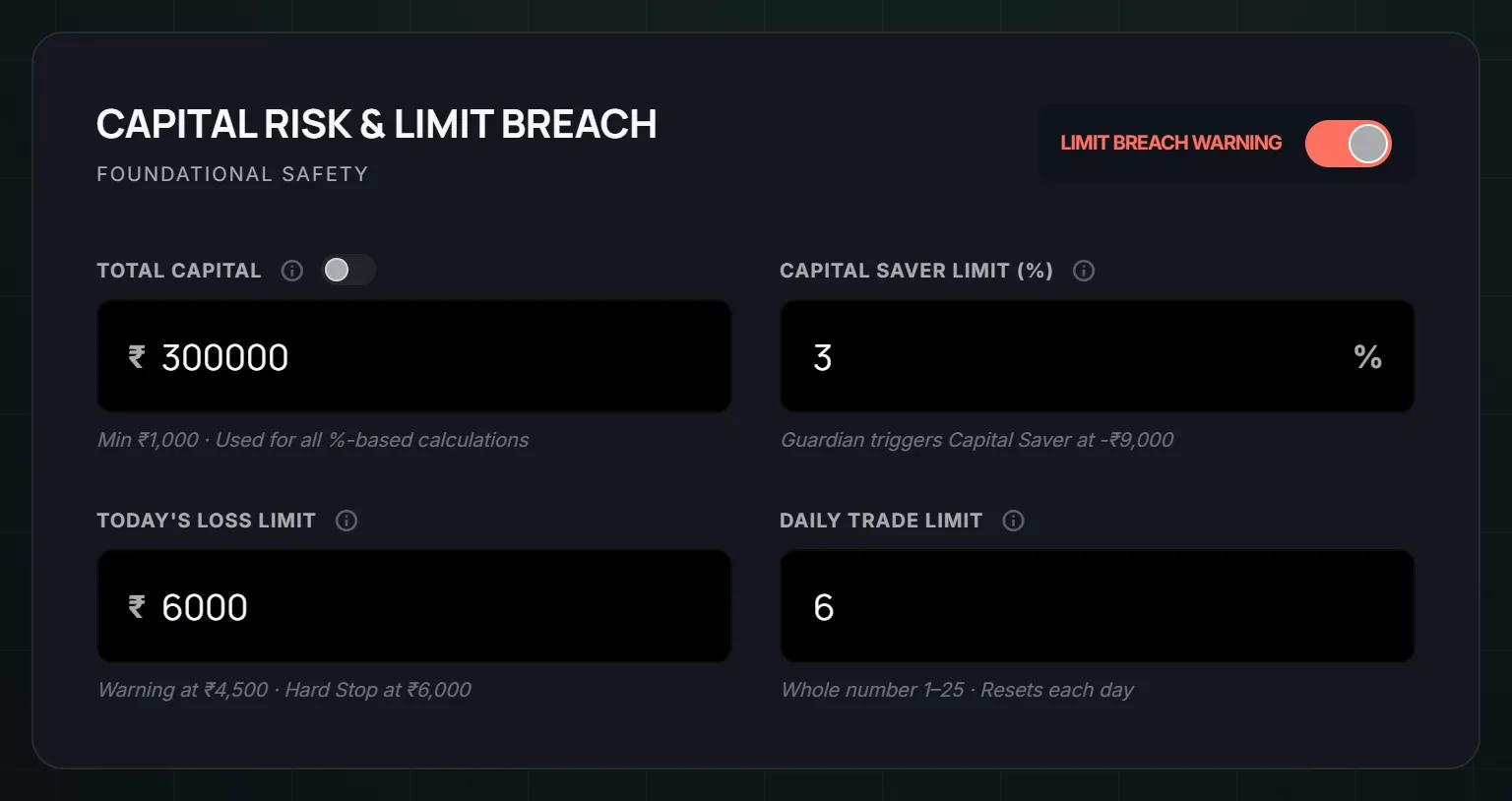
- Line 3, "Rs ____ per day" becomes Today's loss limit, in rupees. You get a warning on the way and a stop when you reach it. It can be changed once a day.
- Your outer wall becomes the Capital Saver limit, a percentage of your capital. It sits above your daily loss limit and protects the account itself. When it breaks, the day is over, with no reset.
- Line 4, "I have taken ____ trades" becomes the Daily trade limit, from 1 to 25.
- Line 4, "lost ____ in a row" becomes the Consecutive loss limit, from 1 to 15. There is also a Losing trade limit, from 1 to 20, for the total number of losing trades in a day.
- Line 2, the "to" time becomes the Execution window end, for example 14:30. No new trades after that time.
- Line 5, after a loss can become the Impulsive trade window, from 1 to 15 minutes. If you trade again within that window, it is flagged as an impulse trade.
One thing to know. The Over Trade Warning switch is about impulse patterns only, such as going back into a contract minutes after you exited it. Your trade-limit warnings are separate and keep working if you turn it off.
The note to yourself
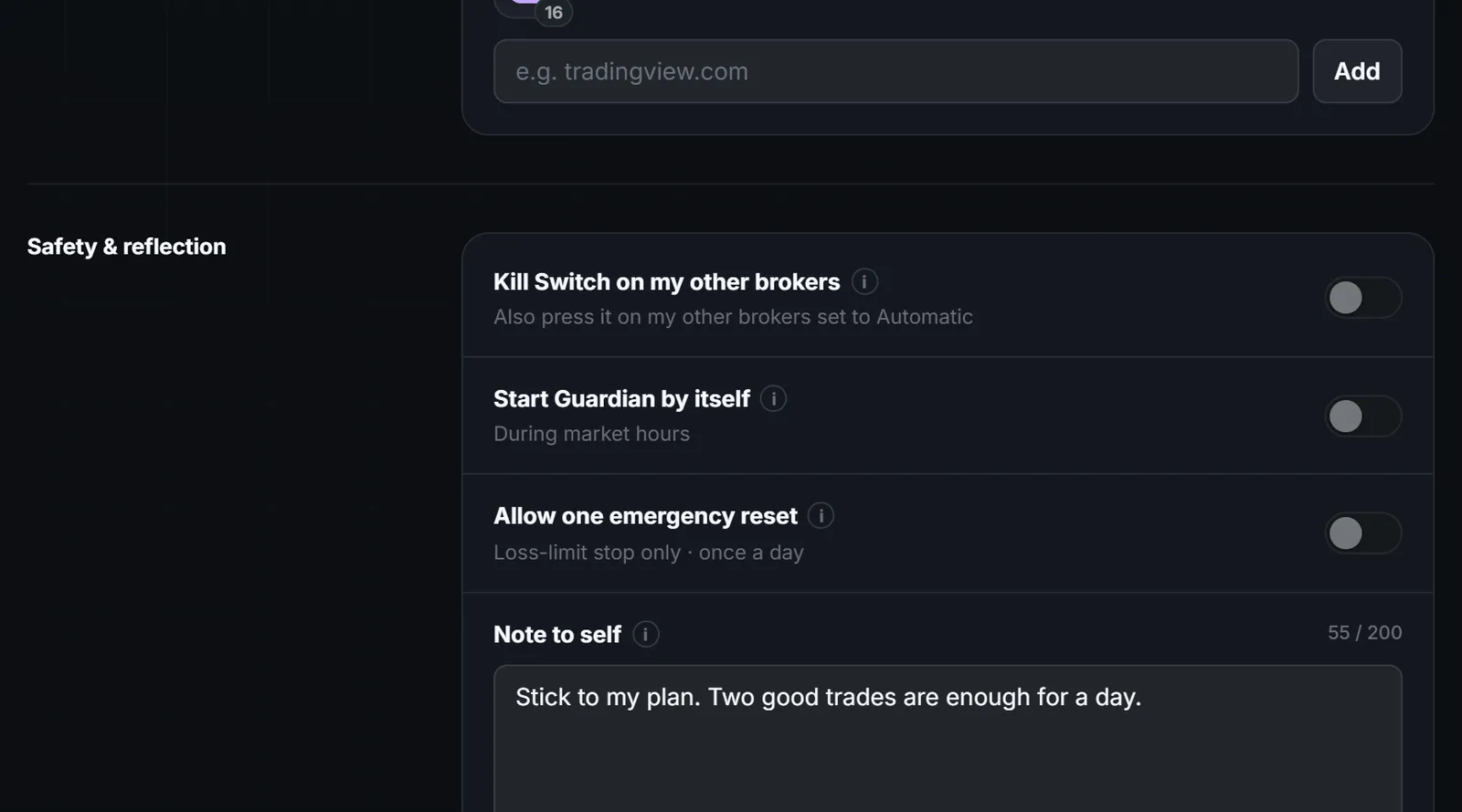
The last line of your plan is the one you will see when it counts. In Advanced Mode, Settings has a Note to self, up to 200 characters. It is shown when you are paused or done. Write it while you are calm. Something plain like: "Two losses is enough today. The next trade is not the one that fixes it."
Pause or Done
Advanced Mode is optional. If you turn it on, each rule gets an action. A Pause lasts 15, 20, 30 or 60 minutes. Done ends your day until your trading hours close. Rules that last all day, like the loss limit and the trade limit, always end the day. Capital Saver is always on.
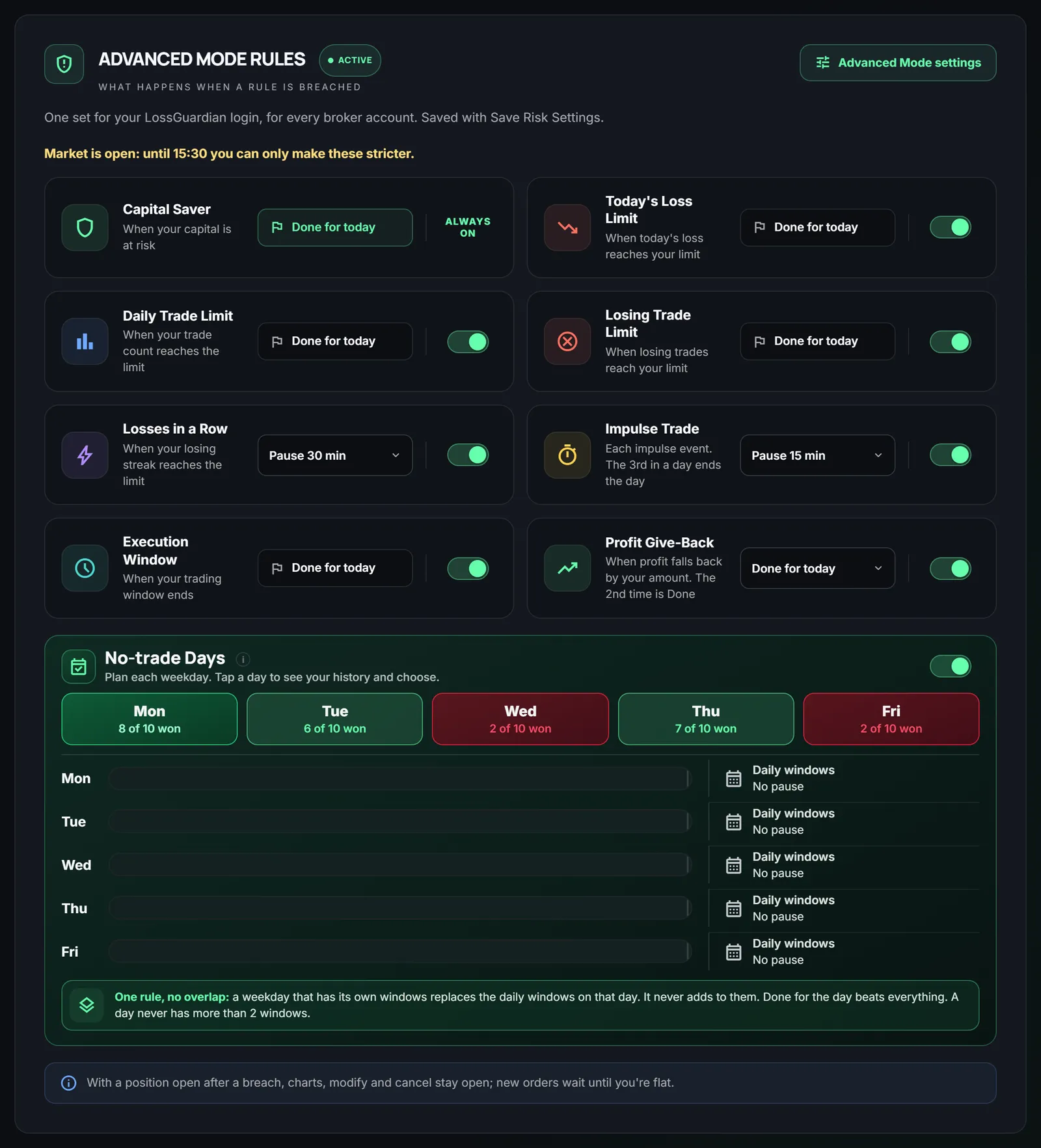
This is your "what do I do after a loss" line, written once and applied the same way every day. The full steps are in the Advanced Mode setup guide.
During market hours, you can only make these rules stricter. You can loosen them after the close. That is on purpose. It means a bad moment cannot undo a plan you made calmly.
How to keep the plan honest
Three small habits keep a one-page plan useful.
Read it before the open. It takes a minute. You are not learning it. You are reminding yourself that you already decided.
Review it at the close. For each line, ask: did I do this? Yes or no. No story needed. A broken line is information, not a verdict on you.
Change it only after the close. If a number feels wrong, fix it in the evening, not in the middle of a trade. One change at a time, so you can tell what helped.
If you are a beginner
Start smaller than the template. Three lines are enough: one instrument, one daily loss in rupees, and one time to stop. Add the rest as you go. A plan you keep at three lines is better than a plan you drop at thirty.
You also do not need the software to do any of this. A note on your phone works. The settings only help in the moments when you would otherwise forget. The aim is that, over time, you need them less, because the plan is now your habit.
Start here
Open a blank note and write five lines, one for each question. Use numbers. Put a time on it, and read it again tomorrow before the market opens. If a line does not give you a yes or no at the end of the day, rewrite it until it does.
Questions traders ask
How do I write a trading plan?
Keep it to one page and use numbers. Write what you trade, when you trade, how much you risk, when you stop for the day and what you do after a loss. Write it when the market is closed and you are calm.
What should a trading plan include?
Five things. Your instrument and setup, your trading hours, your risk per trade and per day, your stop rules, and your steps after a loss. If a line cannot be checked with a number or a yes or no, rewrite it.
Do I need a trading plan as a beginner?
Yes, and a small one is enough. A beginner plan can be five lines. It gives you something to measure your day against, so you learn from your trades instead of only feeling good or bad about them.
Why do I not follow my trading plan?
Usually the plan is too long, too vague or written during a bad moment. Wishes like "be patient" cannot be checked. Numbers like "no new trades after 14:30" can. Shorter and stricter plans are easier to keep.
Can LossGuardian follow my plan for me?
It can watch your trades against the numbers you set in Risk Manager and warn you or pause you when you cross them. It is read-only. It never places, changes or cancels an order, and you make every decision.
Can an app help me follow my trading plan?
LossGuardian holds the numbers in your plan, alerts you when the day leaves it, and shows each day next to the limits you set that morning.
LossGuardian watches your positions across six Indian brokers and warns you the moment you cross your own daily loss limit. It is read-only: it never places, modifies or cancels an order.
Download LossGuardian