
How-to guides
How to protect your trading capital: stop one bad day from ending your account
Your trading capital is your business. Five simple layers that protect it, from risk per trade to a hard limit for the day, so one bad day cannot end your account.
Quick answer: to protect your trading capital, cap the loss before you take it. Risk a small, fixed share per trade, set a daily loss limit, add one hard limit for the day that has no reset, keep trading money separate from your savings, and never trade bigger to win back a loss. Set all of this when you are calm, before the market opens.
Most accounts do not die slowly. They die on one day.
A normal loss. Then a bigger trade to fix it. Then a bigger one. By 2 PM a month of work is gone, and sometimes more. You did not plan that day. You just did not plan against it either.
That is what capital protection is for. Not to make you rich. To make sure you are still here next month.
Your capital is your business
Think of your trading capital the way a shop owner thinks of stock. If the stock is gone, the shop is closed, no matter how good the owner is.
Losses are a normal cost of trading. Every trader has them. The question is only how big each one is allowed to get.
SEBI's latest study found that about 23% of F&O traders made about 90% of all the losses in FY26 (SEBI study, August 2026). The losses are not spread evenly. A small group loses very big. The layers below are how you stay out of that group.
Why a big loss is so hard to fix
The maths is not kind.
- Lose 10%, and you need about 11% to get back.
- Lose 30%, and you need about 43%.
- Lose 50%, and you need 100%. You have to double what is left.
So a small loss is a cost. A big loss is a hole. The whole job of capital protection is to keep you out of holes. Why traders blow up their accounts shows the usual ways people fall in.
Layer 1: a small, fixed risk per trade
Decide how much one trade can lose, in rupees, before you enter. Many traders use about 1% of their capital.
On ₹2 lakh, that is ₹2,000 a trade. Your stop loss and your lot size come from that number, not from how sure you feel. Position sizing for Nifty options shows the simple formula, and the position size calculator does the maths for you.
Layer 2: a daily loss limit
One trade is not the danger. Five trades after a loss are.
A daily loss limit is the most you allow yourself to lose in a day. When you reach it, the day is done. Many traders keep it around 2 to 3 times their per-trade risk, so a few losses end the day before panic starts.
How to set a daily loss limit walks through picking the number, and the free loss limit calculator works it out from your own capital.
Layer 3: one hard limit with no reset
Here is the honest problem with a daily loss limit. On a bad day, you are the one who has to respect it. And on a bad day, you are not at your best.
So add one more line above it. A hard limit for the day, as a share of your whole capital, that you agree in the morning you will never move. Your normal limit is the stop. This one is the wall behind it.
Layer 4: keep trading money separate
Keep a fixed amount for trading, and keep the rest of your money out of reach.
- Do not top up the trading account after a loss. That is how a trading loss becomes a family loss.
- If the account shrinks, trade smaller. Your size should follow the account, not your mood.
- Some traders move part of a good month's profit out of the account. That is a choice, but it keeps a good month safe.
Layer 5: rules you set when you are calm
All of these layers fail in one way. You change them in the middle of a bad trade.
So set them before the market opens, and make them hard to change during the day. A rule you can loosen at 1:30 PM, while you are down, is not a rule. It is a wish.
Where LossGuardian helps
LossGuardian is read-only. It never places, changes or cancels an order, and it never closes a position. It watches your trades from your broker and keeps your own rules in front of you.
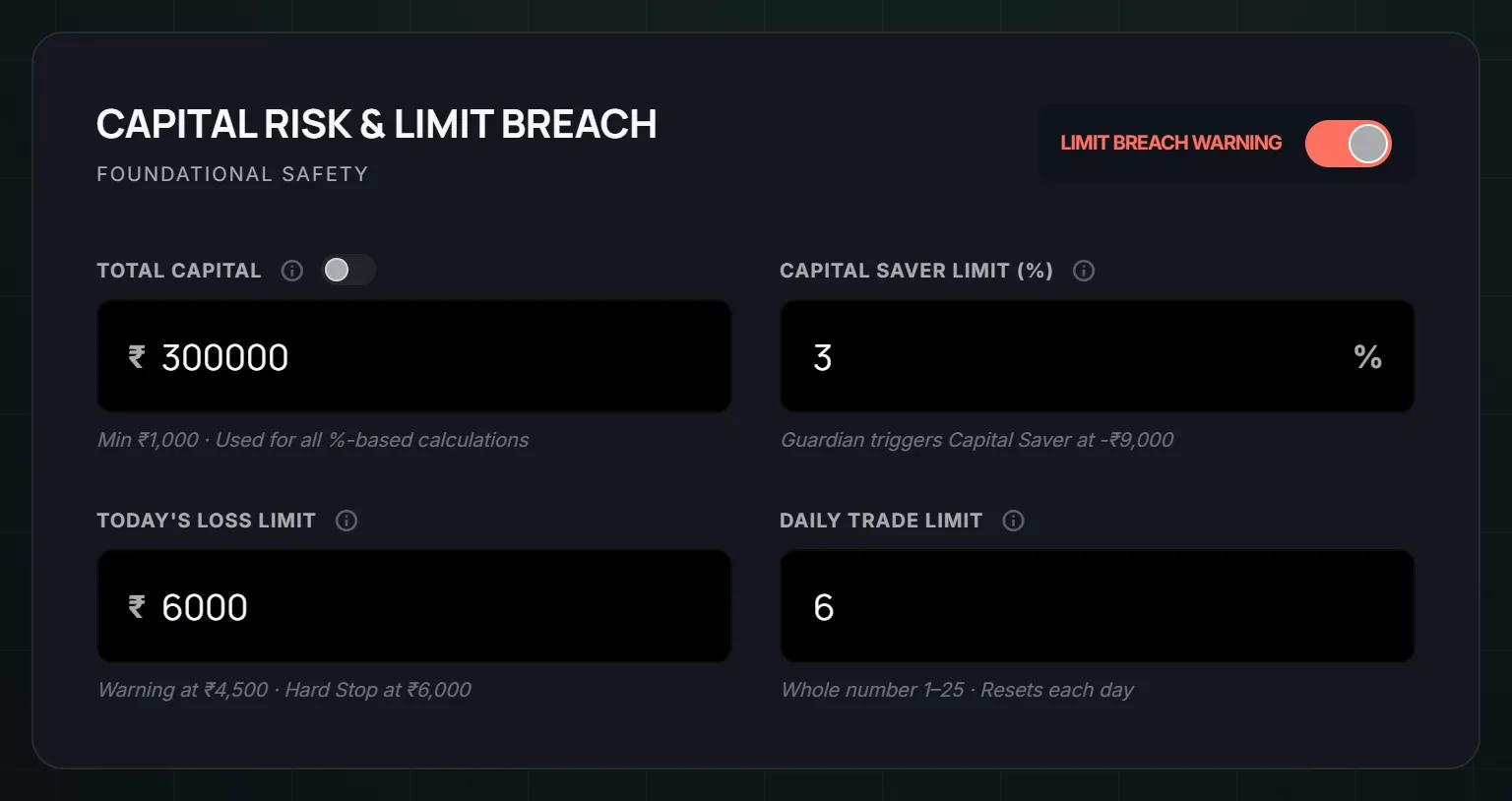
You write your money limits once, in the Risk Manager:
- Today's loss limit is your normal stop. You get a warning on the way and a hard stop when you reach it. After a hard stop you get one reset a day, to a new limit that stays under your Capital Saver.
- Capital Saver is the wall. It is a share of your capital, up to 10% (20% if your capital is under ₹10,000). When it breaks, the day is over, with no reset.
- During market hours, Capital Saver and your total capital cannot be changed at all. Some other limits can be changed only once a day. That is on purpose. Your rules are set by the calm you, not the losing you.
When Capital Saver breaks, you see it plainly:
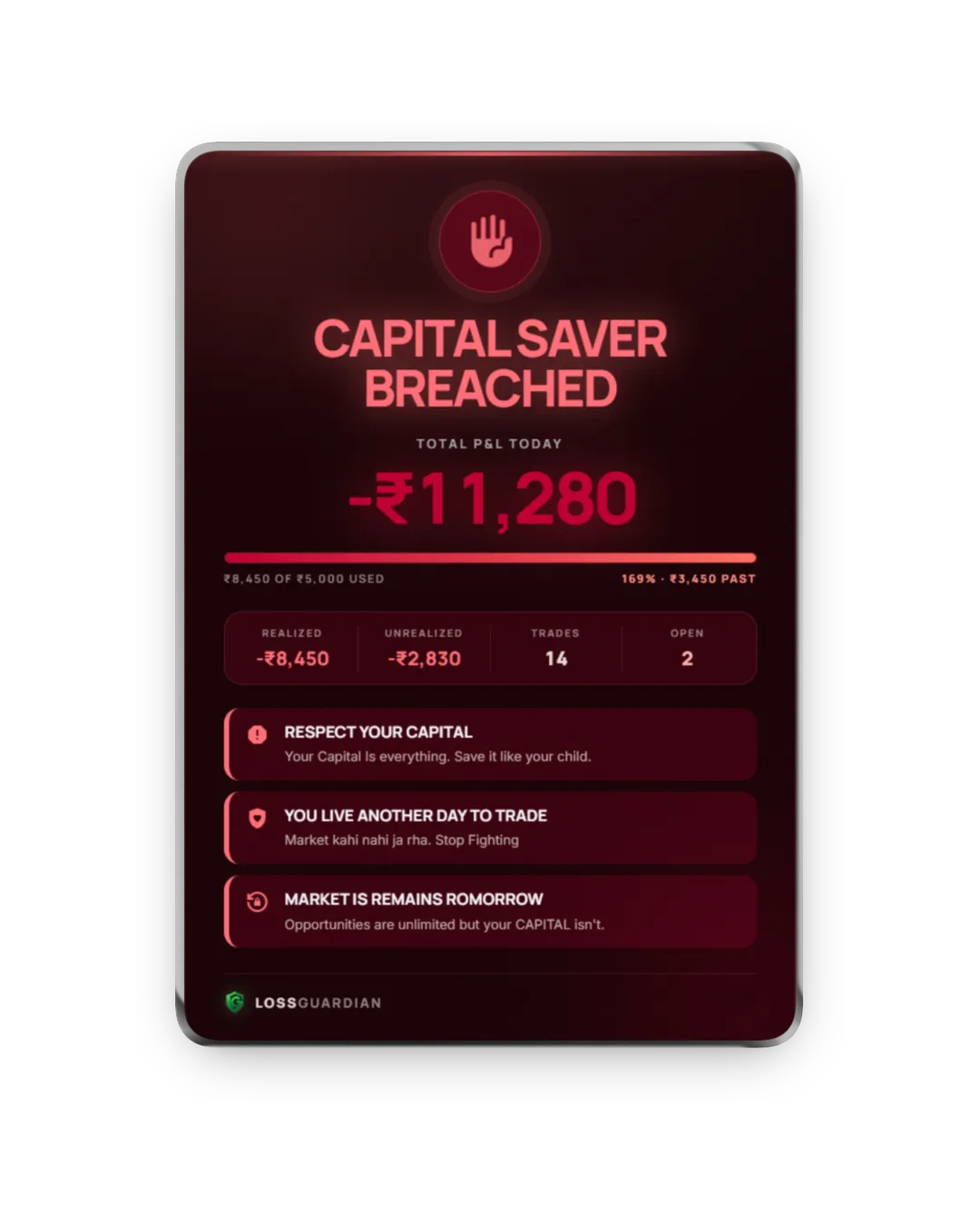
With Advanced Mode on, the day also ends on your computer: new orders pause until your trading hours close, and exits always stay open. If you choose, and give your consent, LossGuardian can also press your broker's own Kill Switch for you. The Risk Manager guide explains every field, and the Automatic Kill Switch page explains that part.
What you gain
You stop losing big. That is the whole gain, and it is a big one.
A trader with small losses can learn. A trader with one huge loss usually stops trading, or worse, tries to win it all back at once. Protecting your capital buys you time, and time is what turns a beginner into a steady trader.
LossGuardian has a free 10-day trial, no card needed. Download it here.
Questions traders ask
What is capital protection in trading?
It means setting rules that cap how much of your trading money you can lose in one trade and in one day, before you start. The goal is simple. No single trade and no single day should be able to end your account.
How much of my capital should I risk per trade?
Many traders keep it around 1% of their trading capital per trade. On ₹2 lakh, that is ₹2,000. Pick a number that lets you take ten losses in a row and still be in the game.
What is the difference between a daily loss limit and Capital Saver in LossGuardian?
The daily loss limit is your normal stop for the day, and you get one reset a day. Capital Saver sits above it, as a share of your capital. When Capital Saver breaks, the day is over, with no reset.
Should I add money from my savings after a loss?
No. Topping up the account after a loss is how a trading loss becomes a family loss. Keep trading money separate, and let the account size tell you the truth.
How can an app protect my trading capital?
LossGuardian sets a daily loss limit and a Capital Saver above it as a share of your capital, and holds them during market hours. It is read-only and never closes a trade.
LossGuardian watches your positions across six Indian brokers and warns you the moment you cross your own daily loss limit. It is read-only: it never places, modifies or cancels an order.
Download LossGuardian