
How-to guides
How to follow your trading rules: a simple one-page template
You have trading rules. You break them anyway. A one-page trading rules template you can copy, why rules get broken, and 5 simple ways to actually follow them.
Quick answer: to follow your trading rules, keep them few, make every rule a number or a time, write them on one page before the market opens, and put them somewhere that speaks up when you break one. Then count your breaks every week. Below is a one-page template you can copy today.
Most traders do not lack rules. They have them in a notebook, in a WhatsApp note to themselves, in their head.
And they break them. Not on calm days. On the days that matter, after a loss, after a fast move, at 1:30 PM.
If that sounds like you, the problem is rarely the rules. It is how they are written and where they live. If you have not written a plan at all yet, start with how to write a trading plan you will actually follow. This article is about keeping the rules you already have.
Why rules get broken
They are vague. "Do not overtrade" cannot be checked. "Six trades, then stop" can.
They live in your head. A rule in your head can be quietly rewritten by the person who most wants to break it. "Six trades" becomes "six good trades".
There are too many. Twenty rules means you remember three of them, and pick which three on the day.
Nothing happens when you break one. No alert, no record. So it barely registers, and next time it is easier.
The one-page trading rules template
Copy this. Fill in the blanks the evening before, or before 9:15. Keep it next to your screen.
Date: ________

MONEY
Risk per trade:              ₹ ______
Daily loss limit:            ₹ ______  (then I stop for the day)

BEHAVIOUR
Most trades today:             ______
Losses in a row, then break:   ______  (break of ___ minutes)
Wait after any loss:           ______ minutes
No new trades after:           ______ (time)

SETUPS I WILL TRADE TODAY
1. ______________________
2. ______________________

WHEN A RULE IS HIT
I close the chart, stand up, and write one line about why.
Every line is a number or a time. That is on purpose. You cannot argue with a number.
5 ways to actually follow them
1. Keep it to one page. If a rule does not fit on the page, you do not need it yet.
2. Write them before the market opens, never during. A rule changed in the middle of a losing day is not a rule. It is a feeling with a reason attached.
3. Put them outside your head. On paper next to the screen at the very least. Better, somewhere that warns you at the moment you break one.
4. Decide what happens when a rule is hit. "I stop" is not enough. Say what you do: close the chart, stand up, write one line. A plan for the moment makes the moment easier.
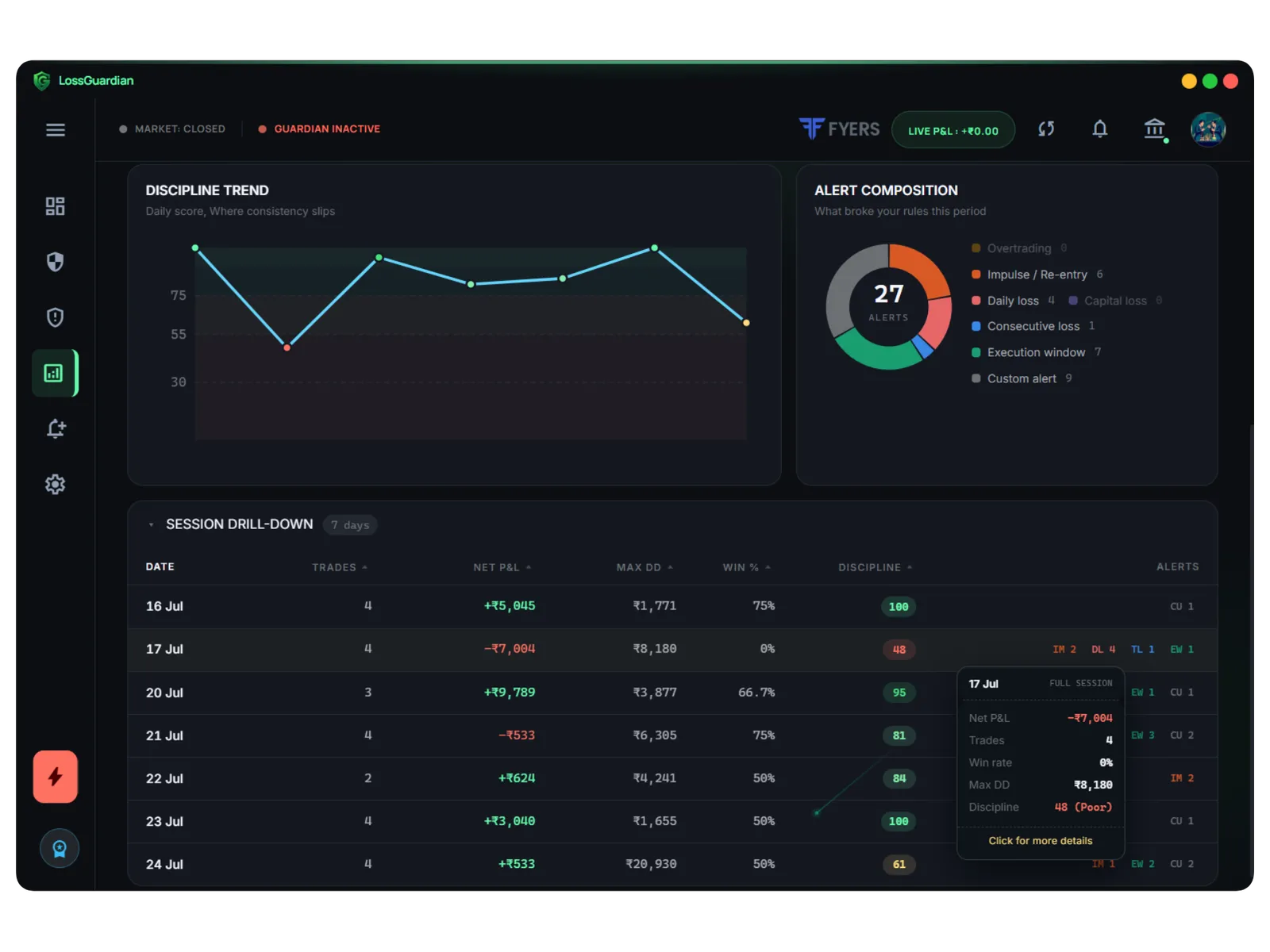
5. Count your breaks every week. Not your profit. Your breaks. Which rule, how often, on which days. What a discipline score is explains why this number tells the truth when P&L does not.
Where LossGuardian helps
LossGuardian is read-only. It never places, changes or cancels an order. It turns your one-page rules into numbers it watches for you, from your broker, all day.
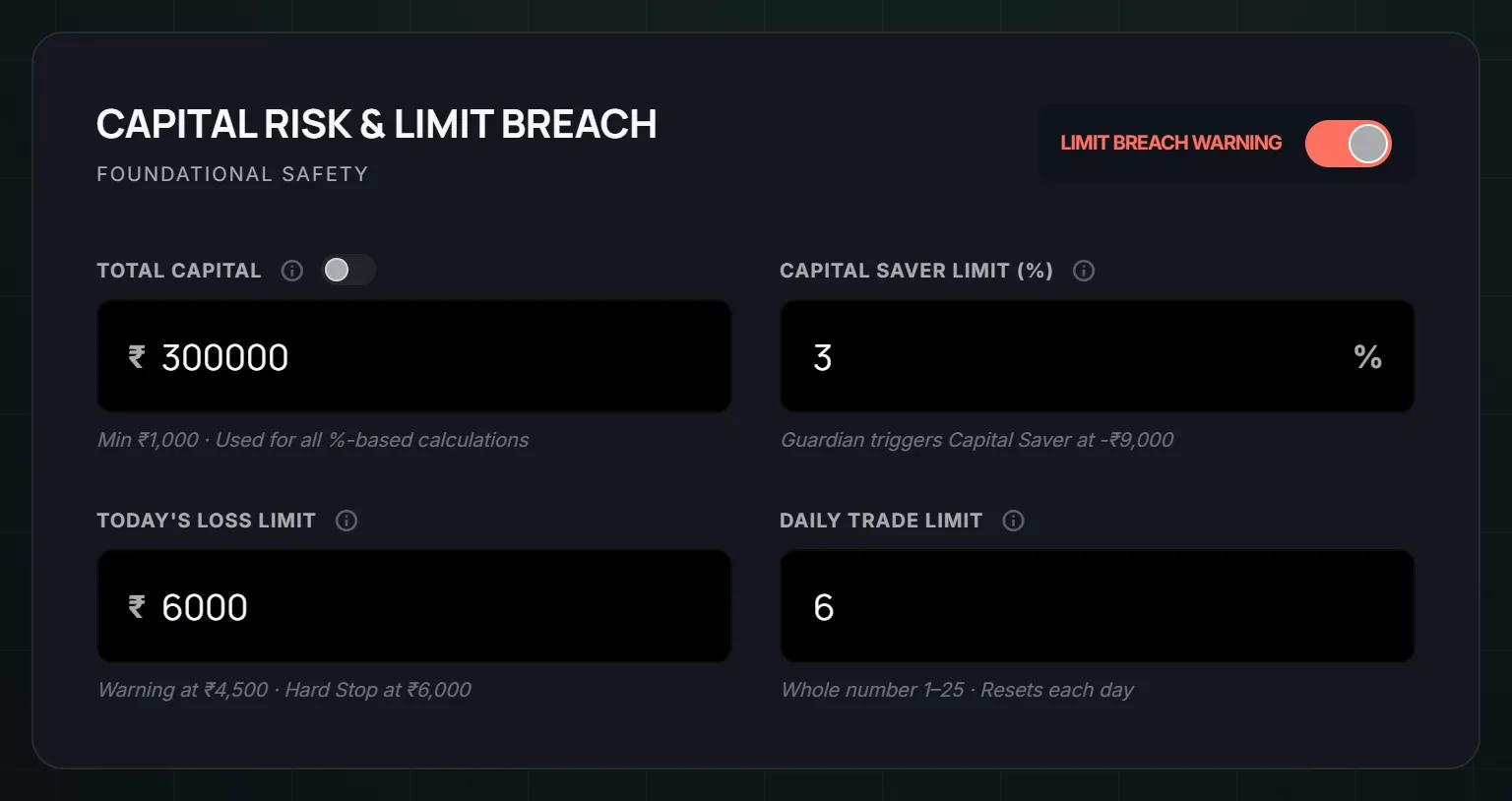
Your money rules go in one card:
Your behaviour rules go in the next:
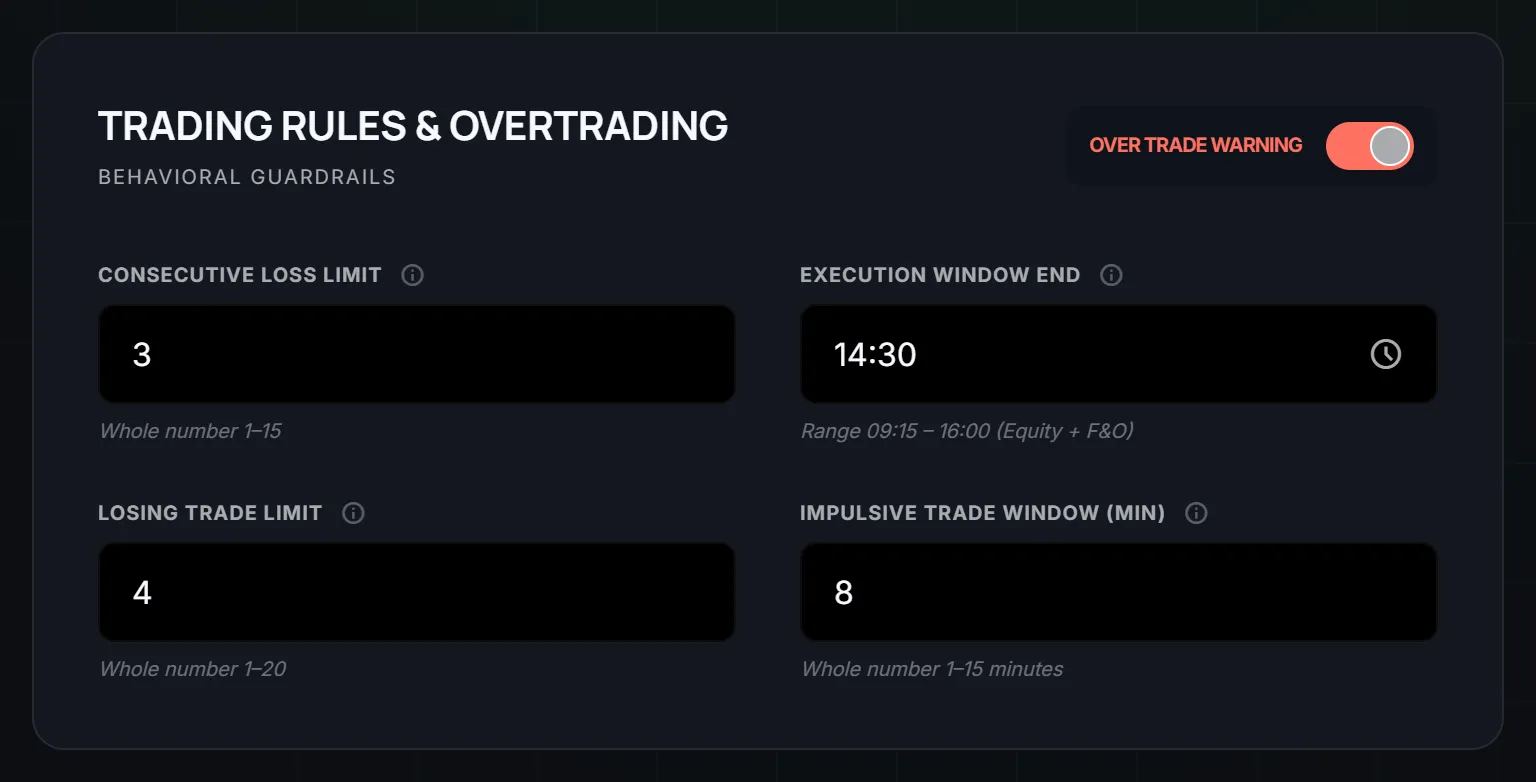
During market hours, some of these can be changed only once a day, and Capital Saver not at all. That is point 2 above, built in. When you break a rule, you see it at once:
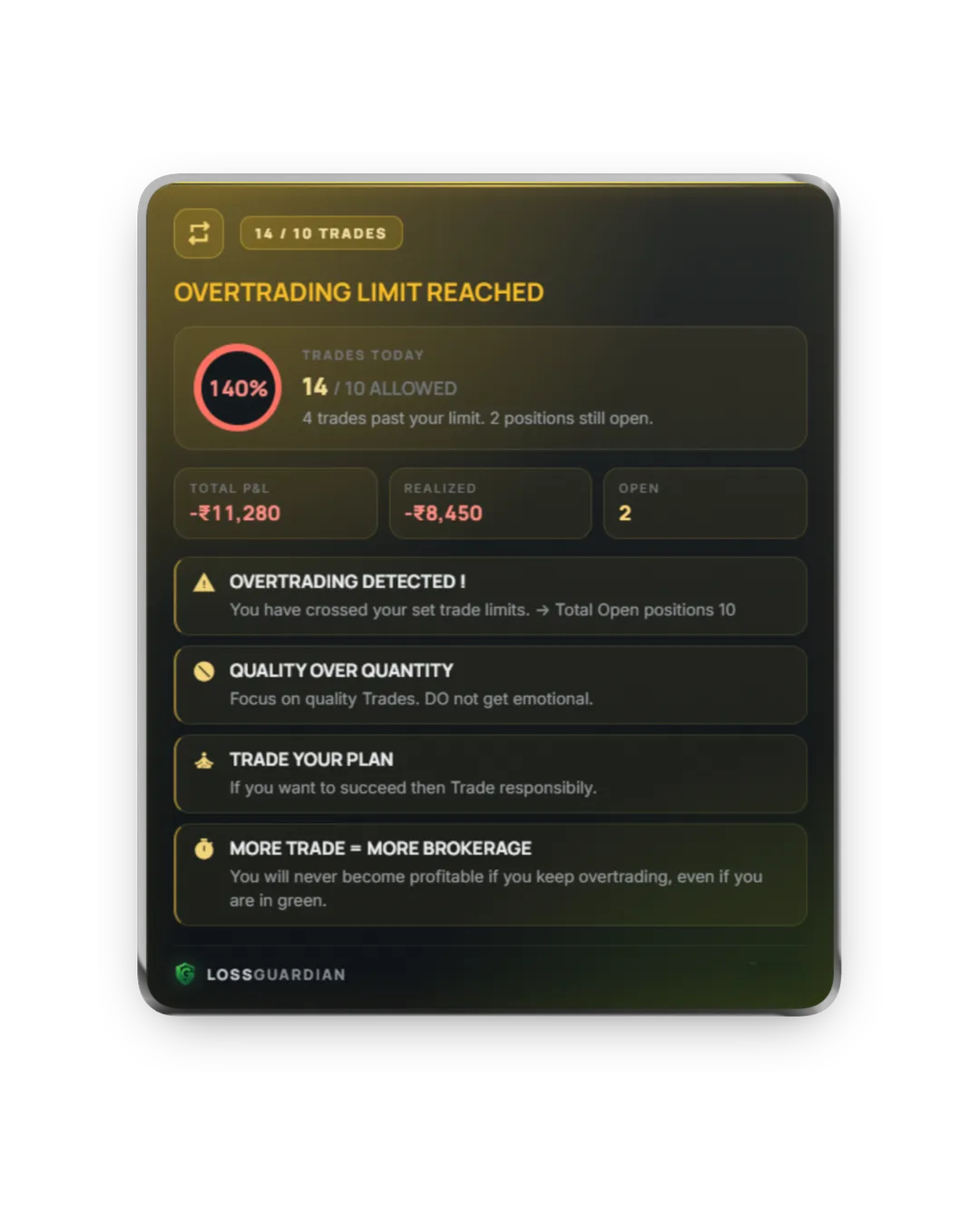
And point 5 is done for you. Past performance shows which rule you break most, day by day:
With Advanced Mode on, a broken rule can also pause new orders on your computer for a while, or end your day. Exits always stay open. The Risk Manager guide explains every field.
Rules are a promise to yourself
Every rule you keep makes the next one easier. Every rule you break quietly makes the next break easier too.
Start with one page. Keep it for a week. Count the breaks. That is how discipline is built: not in one great day, but in many small promises kept.
LossGuardian has a free 10-day trial, no card needed. Download it here.
Questions traders ask
Why do I keep breaking my trading rules?
Because the rules are written when you are calm and tested when you are not. After a loss or a fast move, your mind finds a reason why this time is different. Rules that live only in your head are easy to rewrite in the moment.
How many trading rules should I have?
Few. Five or six clear rules you can check in ten seconds work better than twenty you cannot remember. Every rule should be a number or a time, not a feeling.
What should a trading rules list include?
Your risk per trade, your daily loss limit, your maximum trades per day, a wait after a loss, a time after which you take no new trades, and what you do when a rule is hit.
What should I do after I break a trading rule?
Do not punish yourself and do not trade bigger to make up for it. Write down which rule, when and why. Next week, look for the pattern. One broken rule is a mistake. The same rule broken every Tuesday is a lesson.
Is there an app that helps me follow my trading rules?
LossGuardian holds your rules as numbers it watches from your broker, makes some of them hard to loosen during the day, and counts every break so you can see the pattern.
LossGuardian watches your positions across six Indian brokers and warns you the moment you cross your own daily loss limit. It is read-only: it never places, modifies or cancels an order.
Download LossGuardian