
How-to guides
How to control risk in F&O trading: 8 simple rules
F&O moves fast and losses grow faster. 8 simple rules to control risk in futures and options trading, with rupee examples for Nifty, from sizing to expiry days.
Quick answer: to control risk in F&O, know your maximum loss before you enter, size every trade from your stop loss, set a daily loss limit and a trade limit, be extra careful on expiry days and with overnight positions, never average a losing option, and stop at a fixed time. Write these rules down before the market opens, and make them hard to change during the day.
F&O is not like buying shares. One Nifty lot is 65 units. A 20 point move against you is ₹1,300 in a few minutes. Ten of those, on a bad day, is a month of savings for many people.
SEBI found that 87.7% of individual F&O traders lost money in FY26 (SEBI study, August 2026). A strategy is not enough. What decides how much you lose is what caps the damage on the days the strategy does not work.
If you are new to the idea, start with how to manage risk in trading, which covers the four basic numbers. This article is about what makes F&O different.
Rule 1: know your worst case before you enter
Before every F&O trade, answer one question: what is the most this can cost me?
- Buying an option: the most you can lose is the premium. Buy 1 Nifty lot at ₹100 and your worst case is 65 × 100 = ₹6,500.
- Selling an option: you collect the premium, but the loss has no such cap. Sell 1 lot at ₹100, and if it runs to ₹400, you lose 65 × 300 = ₹19,500.
- Futures: every point is 65 rupees per Nifty lot, both ways, for as long as you hold.
If you cannot say the worst case in rupees, you are not ready to take the trade.
Rule 2: size from your stop, not your feeling
Decide your rupee risk first, usually about 1% of capital. Then let the stop decide the lots.
With ₹3 lakh and 1% risk, you can lose ₹3,000. A 20 point stop on Nifty risks ₹1,300 per lot, so 2 lots fit. A 40 point stop fits 1. Position sizing for Nifty options has the formula, and the position size calculator does it for you.
Rule 3: every trade has a stop loss
An option without a stop loss is a hope. Decide the exit before the entry, and do not move it further away once you are in. How to set a stop loss in options shows simple ways to pick one.
Rule 4: a daily loss limit, and a trade limit
One loss rarely hurts an F&O account. A chain of them does.
Set a daily loss limit, the most you allow yourself to lose in a day. Set a trade limit too. When either is reached, the day is done. How to set a daily loss limit helps you pick the number.
Rule 5: treat expiry day as a different day
On expiry day, cheap options can go to zero in minutes, or jump ten times. It feels like an opportunity. For most traders it is where the biggest losses happen.
SEBI found that 59% of index options turnover in FY26 happened on expiry day itself. If you trade expiry, trade smaller, take fewer trades, and set a firm stop time. More in expiry day trading risk.
Rule 6: respect overnight risk
A position you carry overnight can open far away from where you left it. Your stop loss cannot protect you from a gap.
If you carry F&O positions overnight, count them in your daily loss, and size them smaller than your intraday trades.
Rule 7: never average a losing option
Buying more of an option that is falling feels like getting a better price. In reality you are doubling a trade the market has already told you is wrong, and time decay works against you every hour you wait.
If the trade hits your stop, it is over. A new trade needs a new reason, not a lower price.
Rule 8: stop at a fixed time
Late in the day, patience is gone and the plan is old. That is when many traders take the trades they regret. Pick a time after which you take no new trades, and keep it. Why discipline fails at 1:30 PM explains why the afternoon is so dangerous.
Where LossGuardian helps
Writing these rules is easy. Keeping them at 1:30 PM, while you are down, is the hard part. That is where LossGuardian helps.
LossGuardian is read-only. It never places, changes or cancels an order, and never closes a position. It reads your trades from your broker and holds your own rules up in front of you.
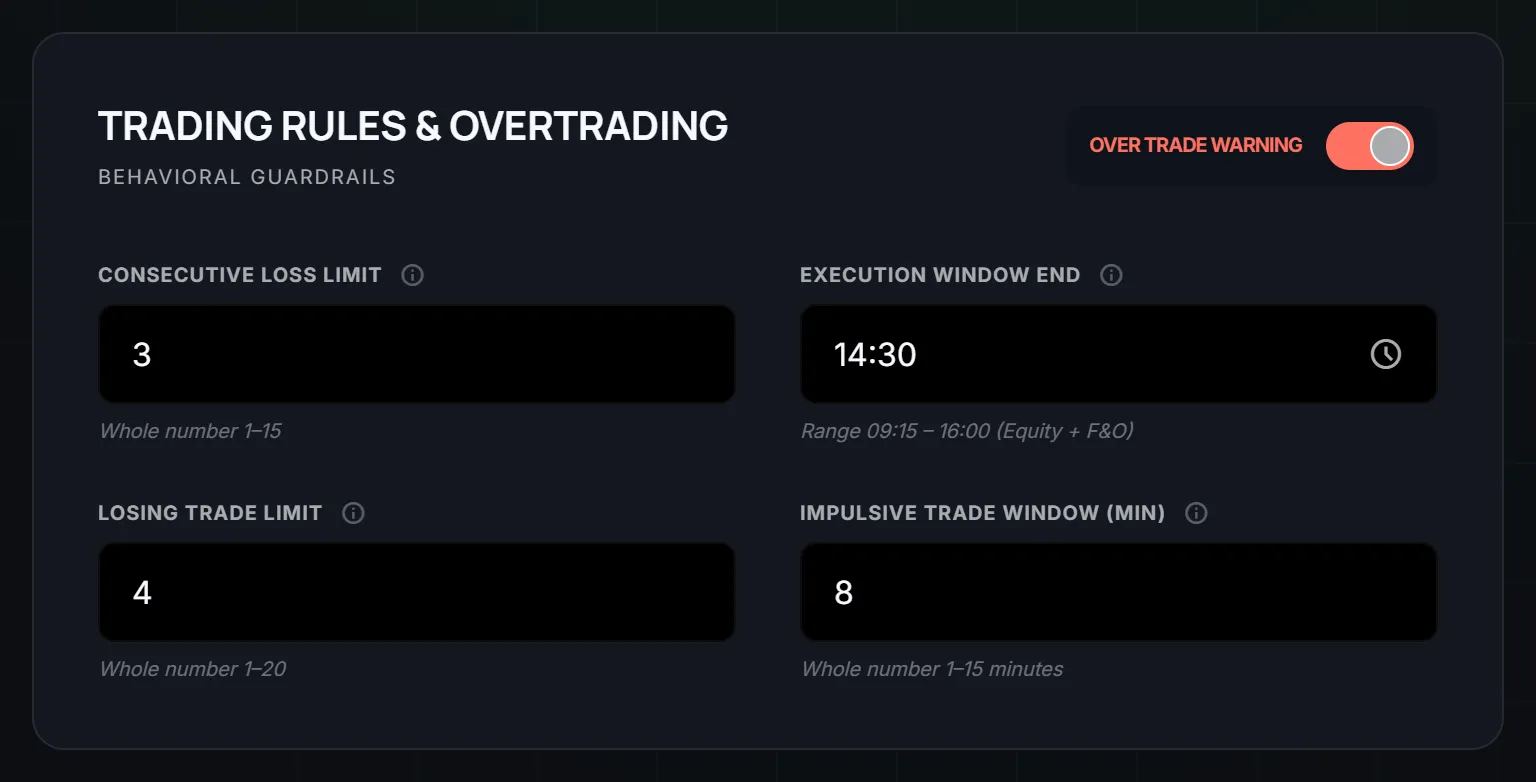
Your behaviour rules live in the Risk Manager:
- Execution window end is Rule 8: no new trades after the time you set.
- Consecutive loss limit and losing trade limit catch the chain of losses in Rule 4.
- Impulsive trade window flags a trade taken within minutes of the last one, which is often how averaging and revenge trades start.
Overnight risk from Rule 6 is one switch:
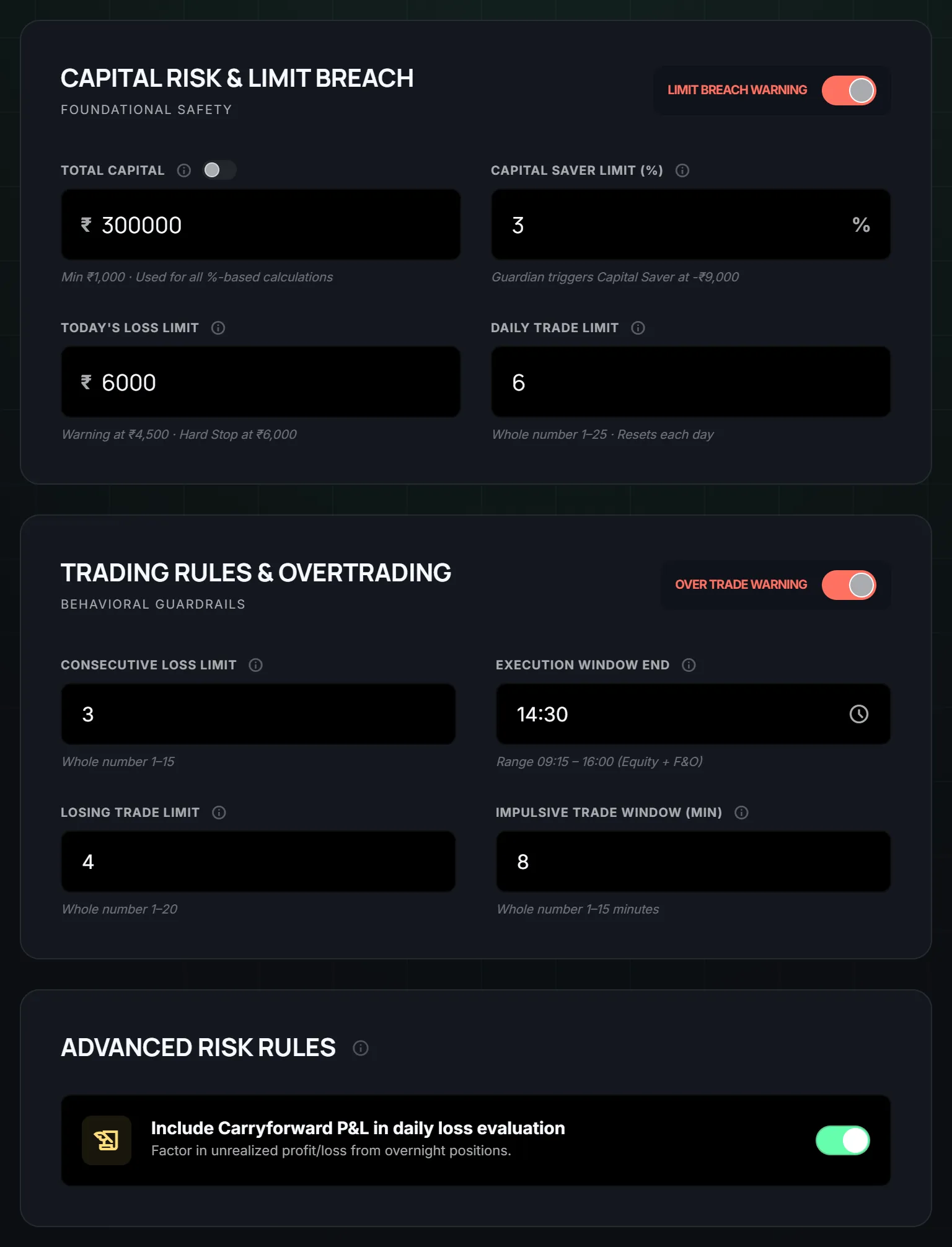
Your daily loss limit, Capital Saver and trade limit sit in the same screen. The Risk Manager guide explains every field. With Advanced Mode on, a broken rule can pause new orders on your computer or end your day, and exits always stay open. How to protect your trading capital explains how these limits stack.
What you gain
F&O will always have losing days. Risk control does not remove them. It makes them small, and small losses are the price of staying in the game long enough to get good.
The rules above are boring. That is the point. Boring rules, kept every day, are what protect you on the days your strategy fails.
LossGuardian has a free 10-day trial, no card needed. Download it here.
Questions traders ask
How do I control risk in F&O trading?
Know your maximum loss before you enter, size each trade from your stop loss, set a daily loss limit, cap your trades, be extra careful on expiry days and with overnight positions, and stop trading at a fixed time. Set all of it before the market opens.
Is option buying less risky than option selling?
The risk is different. When you buy an option, the most you can lose is the premium you paid. When you sell an option, you collect a premium, but your loss can be many times that if the market moves hard against you.
How much should I risk per F&O trade?
Many traders keep it around 1% of their trading capital per trade. On ₹3 lakh, that is ₹3,000. Your stop loss and lot size come from that number.
Why is F&O riskier than buying shares?
Because one lot controls a large amount, small moves make big rupee swings, and options lose value with time. SEBI found that 87.7% of individual F&O traders lost money in FY26.
Is there an app to control F&O trading risk?
LossGuardian watches your F&O limits live from six Indian brokers: daily loss, Capital Saver, trade count, losing streak and cutoff time, with overnight positions counted if you choose. It is read-only.
LossGuardian watches your positions across six Indian brokers and warns you the moment you cross your own daily loss limit. It is read-only: it never places, modifies or cancels an order.
Download LossGuardian