
Risk strategy
Why risk management matters more than your strategy (protection for your capital)
Why is risk management important in trading? Your strategy decides how often you are right. Risk management decides if you are still trading next month. Simple rupee examples, SEBI FY26 facts and rules you can set.
Quick answer: your strategy decides how often you are right. Risk management decides whether you are still trading next month. A trader with an average strategy and small losses can keep going. A trader with a good strategy and one huge loss may not get the chance.
You have a setup that works. You have read the books and watched the videos. Then one bad day takes a quarter of your account, and the good setup never gets a fair run.
That is the pain. It is not a lack of strategy. It is that nothing was standing between one bad day and your savings.
The idea: a loss costs more than it looks
Losses and gains are not equal. If you lose 50% of your account, you do not need a 50% gain to get back. You need 100%.
Here is a simple example. You have ₹1,00,000. You lose half, so you have ₹50,000. To get back to ₹1,00,000 you must add ₹50,000 to a ₹50,000 account. That is doubling it.
This is maths, not a statistic. It works the same for everyone.
| Example loss on your account | Gain needed to get back |
|---|---|
| 10% | about 11% |
| 25% | about 33% |
| 50% | 100% |
So a big loss does two things. It takes your money, and it makes the road back much steeper. The deeper the hole, the less any strategy can help you climb out. We go through this in why traders blow up their accounts.
Being right often is not enough
Take two traders. These are made-up examples to show the maths, not real results.
Trader A is right 7 times out of 10. Each win makes ₹1,000. Each loss costs ₹5,000, because they hold on and hope.
- 7 wins: ₹7,000
- 3 losses: ₹15,000
- Result after 10 trades: a loss of ₹8,000
Trader B is right only 4 times out of 10. Each win makes ₹3,000. Each loss costs ₹1,000, because they exit at their limit.
- 4 wins: ₹12,000
- 6 losses: ₹6,000
- Result after 10 trades: a gain of ₹6,000
Trader A has the better win rate and the worse account. Trader B is wrong more often and is still fine. The difference is not the strategy. It is the size of the loss.
What SEBI found
SEBI's study of individual F&O traders points the same way. These figures are from SEBI's "Profitability of Individual Traders in the Equity Derivatives Segment (FY25 to FY26)", published 20 August 2026 on sebi.gov.in.
- 87.7% of individual traders lost money in FY26.
- Traders who lost money lost ₹1.47 lakh on average. Traders who made money made ₹1.22 lakh on average. The average loss was about 21% bigger than the average profit.
- About 23% of traders accounted for about 90% of the losses.
- For traders who lost money, transaction costs were 35% of their gross losses.
Read the second point again. On average, a losing trader lost more than a winning trader won. That is the Trader A problem, at scale. The full breakdown is in our SEBI F&O study explainer.
SEBI does not say what each person did wrong, so we should not either. But the pattern is hard to miss. Where the losses are large and concentrated, controlling the size of a loss is where the work is.
From idea to rules
An idea is easy to agree with. A rule is what you follow at 1:30 PM after three losses. Risk management turns into a few numbers you write before the market opens:
- Risk per trade. Work out your lot size from the amount you are willing to lose, not from how sure you feel. The position size calculator does this arithmetic.
- A daily loss limit. The most you will lose today. The loss limit calculator and our guide on how to set a daily loss limit show how to pick it.
- A cap above that. A bigger line you will never cross in one day, however the day goes.
- A limit on trades and on losses in a row. More trades are more charges, and a losing streak is when judgement is weakest.
One more small example. Say your account is ₹1,00,000 and you lose 2% a day for five days in a row. That is not a blow-up. You are at about ₹90,400, down about ₹9,600. You can still trade on Monday. Compare that with one unchecked day of ₹40,000. You would then need about a 67% gain on the ₹60,000 left just to be even. Same bad luck, very different position.
For the full routine, read how to manage risk in trading.
How LossGuardian helps
The hard part is not writing the numbers. It is keeping to them when the market is moving and you are down. LossGuardian reads your trades from your broker, read-only, and holds the limits you set in the Risk Manager.
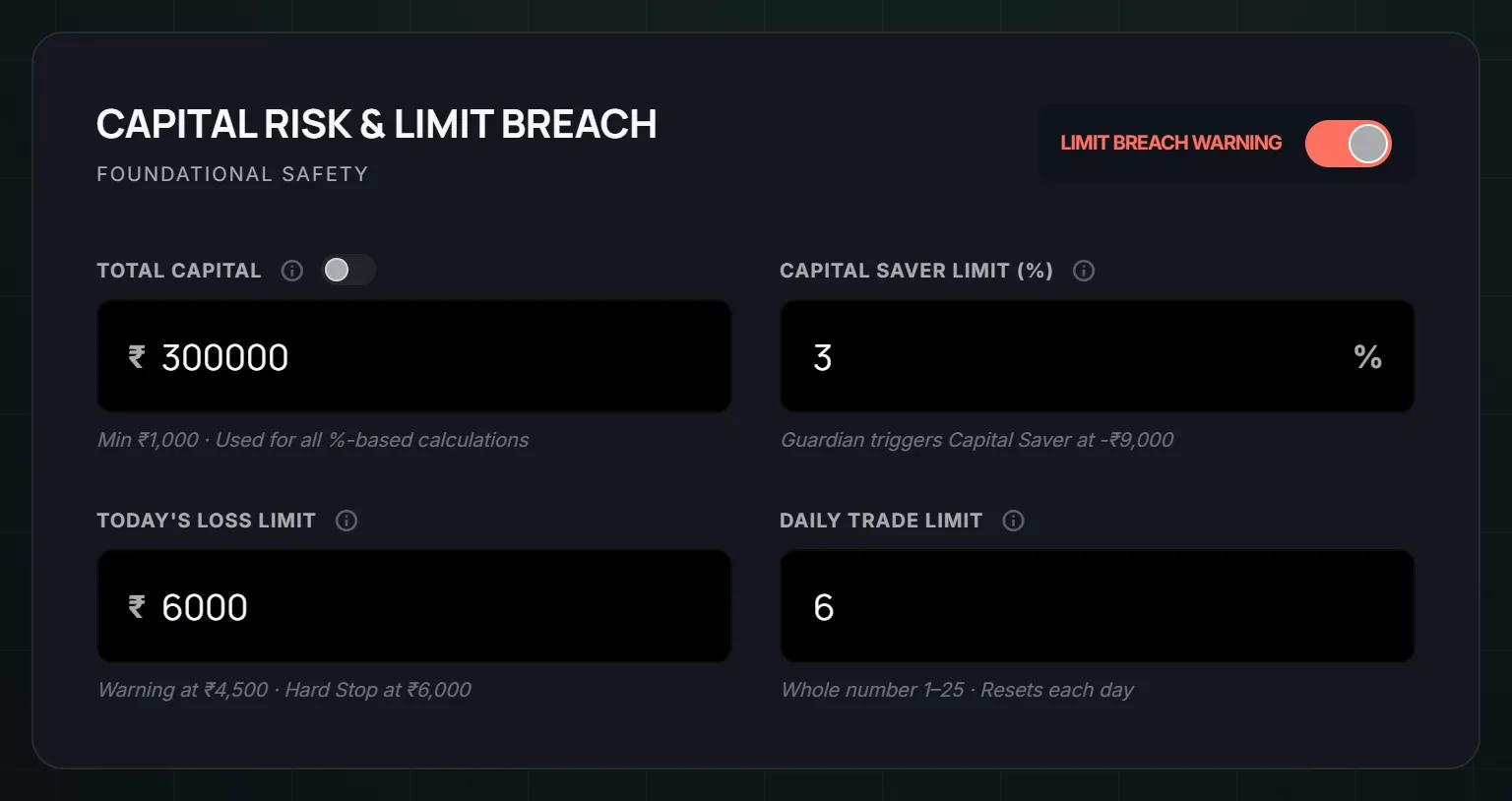
This card shows an example setup. With capital of ₹3,00,000 and Capital Saver at 3%, it sits at ₹9,000. Today's loss limit is ₹6,000, with a warning at ₹4,500, and the trade limit is 6.
Here is what each one does.
- Capital Saver is protection for your capital. It is the most of your capital you can lose in a day, set up to 10%, or up to 20% if your capital is under ₹10,000. When it breaks, the day is over, with no reset. It cannot be changed during market hours, on purpose. See the Capital Saver page.
- Today's loss limit is your daily stop. You get a warning on the way, and a hard stop when you reach it. It must sit under your Capital Saver amount.
- Daily trade limit is the most trades you take today, from 1 to 25.
- Consecutive loss limit warns you after a set number of losses in a row, from 1 to 15.
- Losing trade limit is the most losing trades you allow in a day, from 1 to 20.
When you reach your limit, with your consent LossGuardian can press your broker's own Kill Switch for you. That part is optional. LossGuardian itself never places, changes or cancels an order, and never closes a position. Your exits stay yours.
The guide to the Risk Manager explains every field step by step.
What you gain
You do not need a perfect strategy to stay in the game. You need your losses to stay small enough that the strategy has time to work, and that you can look at your account tomorrow and still want to trade.
The aim is that these rules become your own habit. A trader who has stopped at the same number for months slowly needs a tool less. That is a good outcome.
Nothing here promises results. Risk limits do not make a trade win. They make sure no single day gets to end your trading.
Questions traders ask
Why is risk management important in trading?
Because it decides whether you can keep trading. A strategy can be right often and still lose money if the losses are bigger than the wins. Risk management keeps each loss, and each day, small enough that your account survives the bad stretch every strategy has.
Is risk management more important than strategy?
They do different jobs. Strategy decides how often you are right. Risk management decides how much a wrong trade costs, and whether one bad day can end your trading. Without it, even a good strategy has no time to work.
What is capital protection in trading?
It means setting a limit on how much of your capital you can lose in a day, and sticking to it. In LossGuardian this is Capital Saver. When it breaks, the day is over, with no reset.
How much of my capital should I risk in a day?
That is your choice, and it should be a number you can lose without it hurting tomorrow. Capital Saver in LossGuardian can be set up to 10% of your capital, or up to 20% if your capital is under ₹10,000. Your daily loss limit sits below it.
Can LossGuardian make my trades safer?
LossGuardian is read-only. It never places, changes or cancels an order, and never closes a position. It watches your own limits, warns you as you near them, and ends your day when you reach them.
Which app helps with trading risk management?
LossGuardian holds your daily loss, Capital Saver, trade count and losing streak limits live from your broker, and shows whether losses came from your strategy or from broken rules.
LossGuardian watches your positions across six Indian brokers and warns you the moment you cross your own daily loss limit. It is read-only: it never places, modifies or cancels an order.
Download LossGuardian