 LossGuardian
Risk strategy
How to become a profitable trader: a step by step path
Becoming profitable is not about one magic setup. It is about keeping losses small, cutting mistakes one by one, and staying in the game long enough for your edge to show.
Let us start with the honest number.
SEBI's latest study found that 87.7% of individual F&O traders lost money in FY26. The average loss was about ₹1.17 lakh per person.
That sounds hopeless. It is not. It just means that most people approach trading the wrong way. And if you understand what the losing majority does, you can do something different.
This is not a get-rich guide. There is no secret setup here. It is the slow, boring path that most profitable traders actually walked.
First, understand why most traders lose
SEBI's data holds a very important clue. Among traders who lost, the average loss was ₹1.47 lakh. Among traders who made money, the average profit was ₹1.22 lakh.
In other words, losing traders lost bigger than winning traders won.
This is the whole game in one line: profitable traders keep their losses smaller than their wins. Not every trade. Over time.
Two more findings from the same study are worth knowing:
- Trading more did not help. The share of losing option traders went up as trading activity went up, from about 86% for smaller traders to about 95% for the most active.
- Experience alone did not help either. New traders and regular traders lost at almost the same rate, around 88%. Doing more of the same thing, for longer, did not fix it.
So the path to profit is not "trade more" and not "just keep going". It is trade differently.
Step 1: Survive first
Before you can make money, you have to stay in the game. That means protecting your capital from the one or two days that can wipe out months.
- Set a daily loss limit, based on your capital, not your mood. Many traders keep it around 1% to 2% of capital.
- Set a maximum loss for the whole account that you will never cross in a day.
- Use a fixed position size. Never increase it to recover a loss.
A trader with an average strategy and strict loss limits usually beats a trader with a great strategy and no limits. The loss limit calculator will give you a starting number.
Step 2: Cut the obvious mistakes
Most losing traders are not losing on their planned trades. They are losing on the unplanned ones: revenge trades after a loss, boredom trades, chasing moves, overtrading.
Start by removing these. You do not need a better strategy for this. You need fewer bad trades.
Many traders find that just cutting these trades turns a losing month into a flat or slightly positive one.
Step 3: Know your numbers
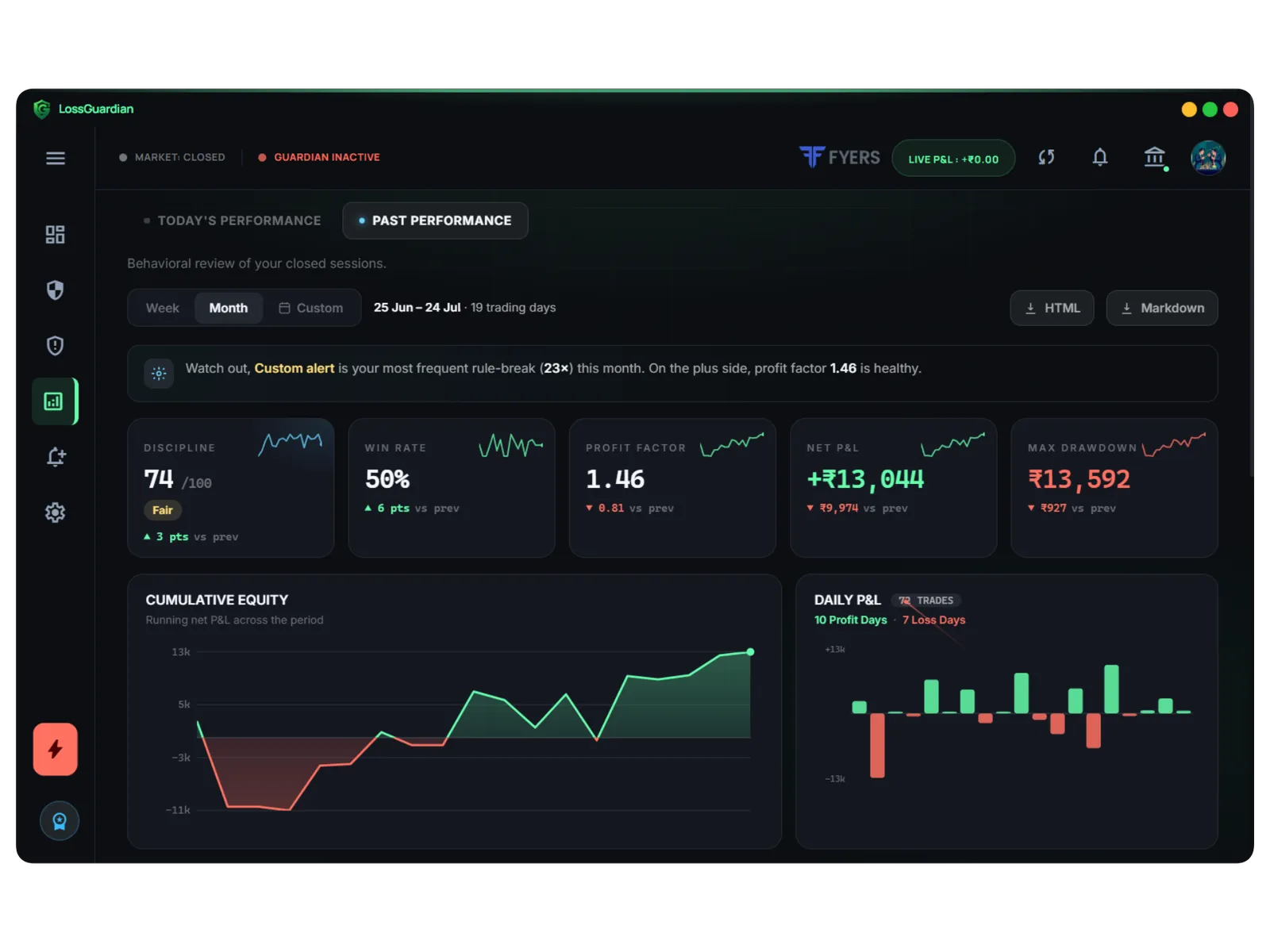
Profitable traders know their numbers. Every week they can tell you their win rate, their profit factor, their biggest losing day and which rule they broke most.
You need the same. At minimum, track:
- Net P&L after charges
- Win rate
- Profit factor (total wins divided by total losses; above 1 means you are making money)
- Your worst day
- How often you broke each rule
We explain each of these in your trading data knows your mistakes.
Step 4: Fix one mistake per week
Look at your data every weekend. Find the mistake that cost you the most. Fix only that one next week.
This is slow on purpose. Trying to fix everything at once fixes nothing. One mistake per week, for a few months, changes your whole trading.
Step 5: Let consistency do the work
Once your losses are under control and your worst mistakes are gone, your real edge, if you have one, finally gets room to show. Small, steady gains start to add up, because nothing big is wiping them out.
This is the part nobody puts on Instagram. It is not exciting. It is small green weeks, small red weeks, and slowly, a rising equity curve.
Tools can help, if they teach you
LossGuardian was built for exactly this path. It watches your trades across six Indian brokers, alerts you when you break the rules you set, and builds your trading journal and discipline score automatically from your broker data.
It is read-only. It never trades for you, because a tool that trades for you teaches you nothing. The goal is that one day you follow your rules without needing any reminder at all. That is when you have really become a disciplined, profitable trader.
How long will this take?
Longer than you want, shorter than you fear, if you do it right. We look at realistic timelines in how long it really takes to become profitable. And if you want to see how professionals think differently, read amateur vs professional trader.
Questions traders ask
Can a retail trader in India become profitable?
Yes, though most do not. SEBI found that 87.7% of individual F&O traders lost money in FY26. The traders who make it usually keep their losses small, trade less, and review their own data regularly.
What is the most important thing to become profitable in trading?
Controlling your losses. A strategy with an average edge makes money if losing days stay small. A great strategy loses money if a few bad days are allowed to become huge.
Do I need a high win rate to be profitable?
No. You can win less than half your trades and still make money, if your average win is bigger than your average loss. Profit factor, which is total wins divided by total losses, tells you more than win rate.
Should I quit my job to trade full time?
Not until you have a long record of steady, profitable trading at a size that could support you. Most professionals would say at least a year or two of consistent results.
LossGuardian watches your positions across six Indian brokers and warns you the moment you cross your own daily loss limit. It is read-only: it never places, modifies or cancels an order.
Join the waitlist