 LossGuardian
Risk strategy
Amateur vs professional trader: the differences that actually matter
Professional traders do not have secret indicators. They think about risk, losses and their own data differently. Here are the real differences, and how to start trading like a pro.
When most people imagine a professional trader, they picture someone with a secret strategy. Special indicators. Inside knowledge.
That is not what separates them. Most professional traders use fairly simple strategies. What separates them from amateurs is almost everything else: how they think about risk, how they handle losses, and how closely they watch their own behaviour.
Here are the differences that actually matter.
1. Amateurs look for wins. Pros look after losses.
Amateur: "How much can I make on this trade?"
Professional: "How much can I lose on this trade, and is that okay?"
A professional decides the maximum loss before entering. Every time. The profit takes care of itself if the losses are controlled.
This matters more than anything else. SEBI's latest study found that losing F&O traders lost an average of ₹1.47 lakh, while winning traders made an average of ₹1.22 lakh. The losers' losses were simply bigger. Professionals make sure theirs are not.
2. Amateurs have a feeling. Pros have a limit.
Amateur: "I will stop if it gets really bad."
Professional: "My daily loss limit is ₹8,000. At ₹8,000, I stop."
"Really bad" moves every time you get close to it. A number does not. Professionals set their daily limit, their trade limit and their cutoff time before the market opens, and they stick to them. At trading firms, a risk manager often enforces these limits. Retail traders have to be their own risk manager. You can get a starting number from the loss limit calculator.
3. Amateurs chase. Pros wait.
Amateur: takes 15 trades a day because sitting still feels like wasting time.
Professional: takes 2 or 3, because that is how many good setups showed up.
Most of trading is waiting. Professionals are comfortable with that. SEBI's data shows the risk of the alternative: among option traders, the more active they were, the more likely they were to lose.
4. Amateurs remember. Pros measure.
This is the big one.
Amateur: "I think I had a decent month. A couple of bad days."
Professional: "Profit factor 1.4. Win rate 48%. Two days over my limit, both after 2 PM. Most of my losses came from trades within 10 minutes of a stop-out."
Professionals know their numbers. Every week they sit down and look at:
- Net P&L after charges
- Win rate and profit factor
- Average win vs average loss
- Maximum drawdown
- Their worst days, and why
- How often they broke each rule
Then they fix the biggest problem. One at a time.
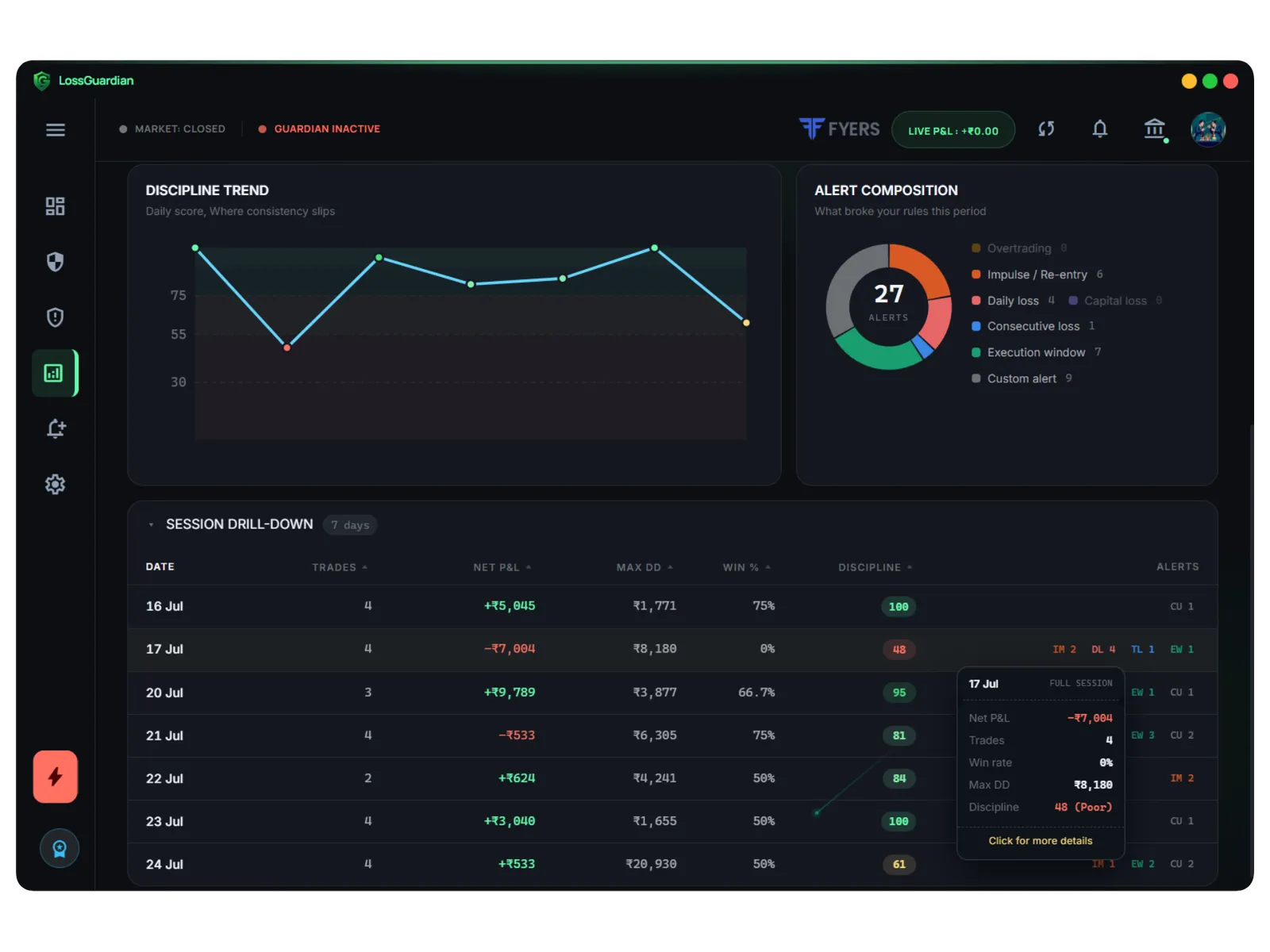
The picture above shows the kind of review a professional does. Look at the table: the worst day by P&L is also the day with the lowest discipline score and the most rule breaks. That link is almost always there. Once you see it in your own data, you know exactly what to fix. We explain how to read each number in your trading data knows your mistakes.
5. Amateurs judge the result. Pros judge the process.
Amateur: a green day was a good day. A red day was a bad day.
Professional: a day where I followed every rule was a good day, even if it was red. A day where I broke my rules was a bad day, even if it was green.
Why? Because results are noisy in the short term. Good process wins over hundreds of trades. Bad process eventually catches up, however lucky you get for a while.
This is why LossGuardian gives every session a discipline score from 0 to 100, separate from P&L. It grades how well you kept your own rules. Read more about the discipline score.
6. Amateurs react. Pros have a plan for bad days.
Amateur: after three losses, looks for a big trade to get it all back.
Professional: after three losses, stops, steps away, and reviews.
Professionals know losing streaks are normal and have a rule ready for them. We cover this in what to do after three losses in a row.
7. Amateurs want a system. Pros want a habit.
Amateurs change strategies every month. Professionals stick with one approach and work on executing it better.
How to start trading like a pro, this week
You do not need a trading desk to do what professionals do. You need a few habits:
- Write your daily loss limit and trade limit before 9:15.
- Use one fixed size. Never increase it after a loss.
- Wait at least 10 minutes after any loss.
- Review your numbers every weekend.
- Fix one mistake per week.
LossGuardian was built to make these habits easier for retail traders. It acts like the risk manager that professionals have: it watches your limits on your broker and warns you when you cross them. Then it builds your weekly review automatically from your broker data. It is read-only and never trades for you, because the goal is for these habits to become yours.
The gap between amateur and professional is not talent. It is process. And process can be learned.
Next, read how to become a profitable trader for the full step by step path.
Questions traders ask
What is the difference between an amateur and a professional trader?
Amateurs focus on finding winning trades. Professionals focus on managing risk, keeping losses small and reviewing their own data. The difference is mostly in process, not in strategy.
Do professional traders lose money?
Yes, all the time. They have losing trades, losing days and losing weeks. What they avoid is the huge losing day that wipes out weeks of work.
What do professional traders track?
Win rate, profit factor, average win and loss, drawdown, worst days, and how often they break their own rules. Many review this every week.
How can a retail trader think like a professional?
Set risk rules before the market opens, keep a fixed size, trade only your setups, and review your trades every week with real numbers.
LossGuardian watches your positions across six Indian brokers and warns you the moment you cross your own daily loss limit. It is read-only: it never places, modifies or cancels an order.
Join the waitlist