 LossGuardian
Risk strategy
How long does it really take to become profitable at trading?
Not weeks, and usually not months. Here is an honest look at how long it takes to become a consistently profitable trader, the stages most people go through, and how to move faster.
Every new trader wants to know this. Most videos answer it with a course link.
Here is the honest answer: it usually takes years, not months. And for many people it never happens, not because they are not smart, but because they spend those years repeating the same mistakes.
The good news is that the time depends much more on how you learn than on how long you trade. Let us look at what that means.
What the data says about "just keep trading"
A lot of traders believe that experience alone will make them profitable. Keep at it long enough and it will click.
SEBI's August 2026 study tested exactly this. It compared new F&O traders with regular traders who had been trading for years. The share who lost money was almost identical: 87.81% of new traders and 87.69% of regular traders. And regular traders actually lost more on average, about ₹1.36 lakh each against ₹59,000 for new traders, because they were trading bigger.
So time alone does not fix it. Time spent repeating the same mistakes just makes the mistakes bigger.
The stages most traders go through
Nobody's path is exactly the same, but most traders who make it go through something like this.
Stage 1: Excitement (first few months)
Everything is new. A few wins make it look easy. Then a few big losses show it is not. Most traders learn the basics here, and many lose a good part of their first account.
Stage 2: The search (often 1 to 2 years)
You try strategy after strategy. Indicators, courses, new setups. Each one works for a bit and then does not. It feels like you just need to find the right system.
This is where most traders stay stuck. Because the problem usually is not the system.
Stage 3: The turn
At some point, if you are lucky and honest, you look at your own data and realise: my planned trades are roughly fine. It is the other trades that are killing me. The revenge trades, the overtrading, the late-day gambles, the days you did not stop.
This is the most important moment in a trader's journey. The focus shifts from finding a better strategy to fixing your own behaviour.
Stage 4: Consistency (the long middle)
Now the work is boring. Follow your rules. Keep losses small. Review every week. Fix one thing at a time. Small green weeks and small red weeks, with the good slowly outweighing the bad.
Stage 5: Profitable, steadily
Not every month is green. But over quarters and years, the account grows, because the big losing days are gone and the edge finally has room to work.
How to move through it faster
You cannot skip the stages, but you can spend much less time stuck in them.
1. Reach stage 3 early. Start reviewing your own trades from day one. Split them into planned and unplanned. The sooner you see where the money really goes, the sooner you stop searching for a magic system.
2. Protect your capital while you learn. Small size, a strict daily loss limit and a trade limit. Learning is much easier when a bad week does not wipe you out. The loss limit calculator is a good start.
3. Trade less, review more. More trades do not mean faster learning. SEBI's data shows more active option traders were more likely to lose. One carefully reviewed trade teaches more than ten you forget.
4. Measure your process, not just your money. Your P&L will be noisy for a long time. Your rule breaks are a much clearer sign of progress. If they are going down, you are improving, even if the money has not caught up yet.
A record of every day helps
One reason the journey takes so long is that we forget. You make the same mistake in March that you made in January, because January is a blur.
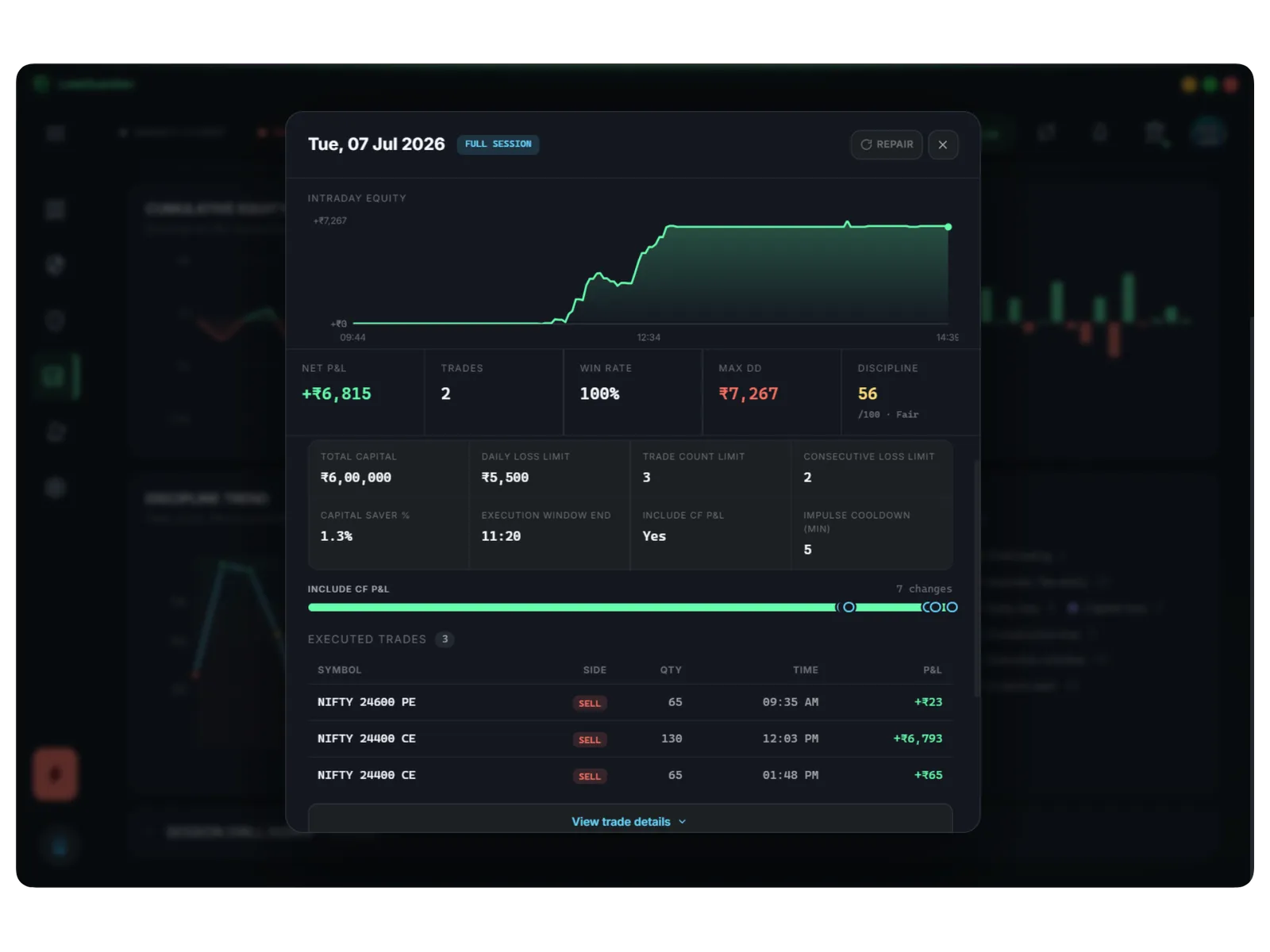
A trading journal fixes that, but only if you keep it. LossGuardian builds one automatically from your broker data. You can open any past day and see its equity curve, every trade, and exactly which rules you had set that day.
Over months, your discipline score trend shows whether the journey is moving forward. Read more about the trading journal and analytics.
Be patient with yourself
If you are a year in and still losing, you are not behind. You are normal. What matters is whether you are learning the right lesson.
The traders who make it are rarely the most talented. They are the ones who stayed in the game, kept their losses small, and kept fixing one thing at a time.
For the full step by step path, read how to become a profitable trader.
Questions traders ask
How long does it take to become a profitable trader?
For most people who make it, it takes years, not months. Many experienced traders say two to five years of focused practice. It depends far more on how you learn than on how long you trade.
Can I become profitable in 6 months?
It is possible but rare. Six months is usually enough to learn the basics and control your worst mistakes. Steady profitability usually takes longer.
Does trading more help me learn faster?
No. SEBI found that more active option traders were more likely to lose. Learning comes from reviewing your trades carefully, not from taking more of them.
How do I know I am getting better if I am still losing?
Look at your process, not only your P&L. Fewer rule breaks, smaller losing days and a rising discipline score are real progress, even before the money follows.
LossGuardian watches your positions across six Indian brokers and warns you the moment you cross your own daily loss limit. It is read-only: it never places, modifies or cancels an order.
Join the waitlist