 LossGuardian
How-to guides
Best software to stop overtrading: what to look for before you choose
Looking for an app to stop overtrading and revenge trading? Here is a simple checklist of what good trading discipline software should do, what to avoid, and the questions to ask.
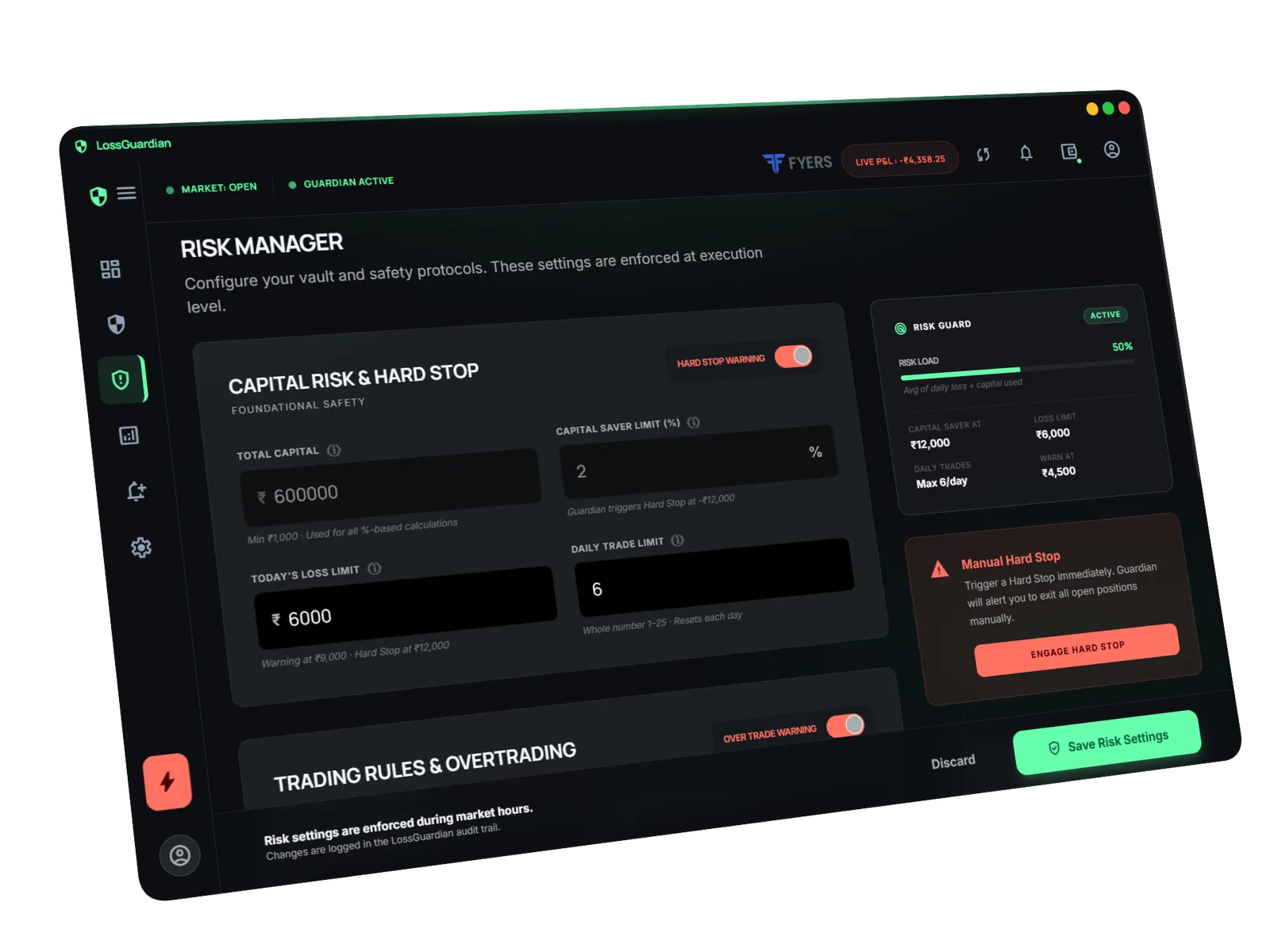
If you have searched for an app to stop overtrading, you have probably found a few options and some very bold claims.
Before you choose, it helps to know what a good tool should actually do. This checklist works for any trading discipline software, including ours. Use it to compare honestly.
First, what should the software actually solve?
Overtrading is rarely about not knowing the rules. You know them. The problem is that in the moment, you do not notice you are breaking them.
So good software should do two jobs:
- Catch you in the moment, when you are about to make it worse.
- Show you the pattern afterwards, so you can fix it for good.
Tools that only do the first one make you dependent. Tools that only do the second one are just a journal. You want both.
The checklist
1. Does it watch your behaviour, not just your P&L?
A loss limit is important. But overtrading and revenge trading often happen before any big loss shows up.
Look for tools that watch:
- Trade count per day
- Losing streaks (losses in a row)
- Quick re-entries after a loss
- A cutoff time for new trades
- A daily loss limit, including open positions
2. Can it place, change or close orders?
This is the most important safety question. Ask it directly.
Some tools need permission to place orders so they can close your positions for you. That means the tool can act on your account. If something goes wrong, or the tool is hacked, that access is dangerous.
A read-only tool can see your positions but cannot place, change or cancel any order. For most traders, that is the safer choice.
3. Do you log in on your broker's own page?
You should never type your broker password into a third-party app. Good tools send you to your broker's own login screen and never see your password.
4. Where does your data go?
Your trades are private financial data. Ask where they are stored. Some tools keep everything on their servers. Others keep it on your own computer.
5. Are the alerts hard to ignore?
A small popup in the corner is easy to dismiss when you are angry. Look for alerts that are big, clear and show your real numbers. Even better if you can write the messages yourself.
6. Does it help you learn, or just stop you?
A tool that only blocks you teaches you nothing. The day you stop paying for it, you are the same trader. Look for tools that show you your data: which rules you break, how often, and what it costs. We explain why this matters so much in why LossGuardian teaches discipline instead of locking you out.
7. Does it support your broker, at a fair price?
Check that your broker is supported, and whether the price changes by broker. There is no reason the same software should cost more because you use a bigger broker.
8. Does it count trades properly?
Broker tradebooks list every partial fill separately. A tool that counts each fill as a trade will give you wrong numbers and false alerts. Ask how trades are counted.
Where LossGuardian stands on this list
We built LossGuardian with this exact checklist in mind. Here is how it answers each point:
- Behaviour, not just P&L: daily loss limit, Capital Saver, trade limit, losing streak cooldown, quick re-entry detection, cutoff time and your own custom alerts. See all features.
- Read-only: it cannot place, change or cancel any order. Ever.
- Login: you log in on your broker's own screen. We never see or store your password.
- Data: stored on your own computer, kept separate per broker account.
- Alerts: full-screen, above your charts, with messages you can rewrite.
- Learning: discipline score, win rate, profit factor, drawdown, a day by day drill-down and which rules you break most.
- Brokers and price: Zerodha, Fyers, Dhan, Upstox, Angel One and Groww, at one price for all.
- Counting: partial fills are grouped by order, so a trade is a trade.
What about the broker's own kill switch?
Most Indian brokers now have a kill switch. It is useful, and you should know how it works. But it only helps if you turn it on yourself, at the right moment, which is exactly when you least want to. We explain it fully in what a trading kill switch actually does.
Discipline software and a kill switch work well together. One watches your behaviour through the day. The other is a hard stop you can reach for when you decide the day is over.
The best tool is the one that makes you need it less
Here is a simple test for any trading discipline app: after six months, do you trade better without it?
If the answer is yes, it did its job. Good software should build habits you keep for life, not a dependency you pay for forever.
Start with the basics in how to stop overtrading.
Questions traders ask
Is there software to stop overtrading?
Yes. Trading discipline apps connect to your broker, watch your trades and warn you when you break limits you set, like a daily loss limit, a trade limit or a cooldown after losses.
Is it safe to connect a trading app to my broker account?
It can be, if the app is read-only, you log in on your broker's own page, and your login details are never shared with the app. Always check whether an app can place or cancel orders.
What is the difference between a broker kill switch and discipline software?
A broker kill switch blocks trading in a segment when you turn it on yourself. Discipline software watches your behaviour through the day and warns you before and when you break your rules, and helps you review your mistakes.
Which brokers does LossGuardian support?
Zerodha, Fyers, Dhan, Upstox, Angel One and Groww, at the same price for every broker.
LossGuardian watches your positions across six Indian brokers and warns you the moment you cross your own daily loss limit. It is read-only: it never places, modifies or cancels an order.
Join the waitlist